

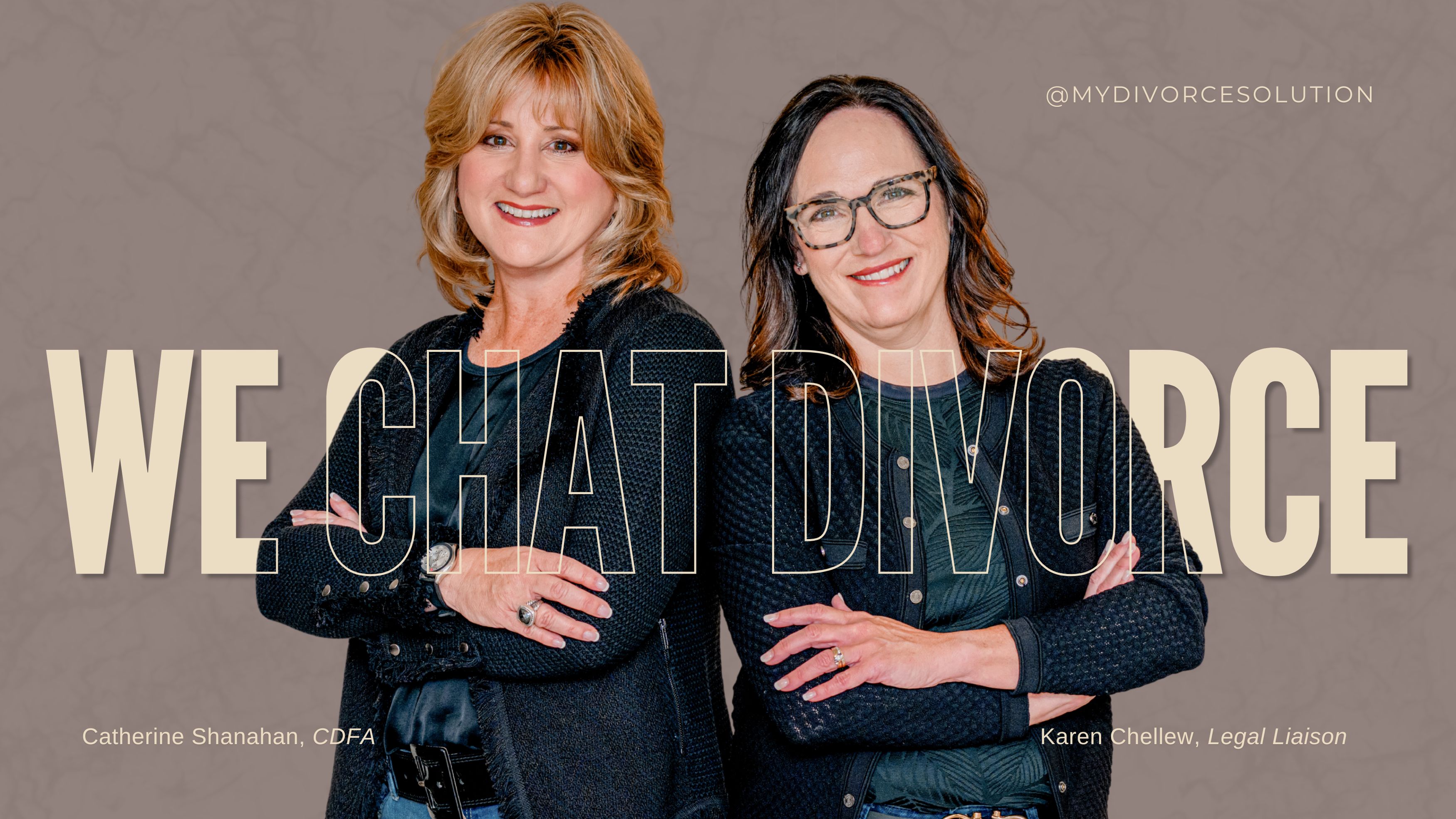

In this episode of Divorce Explored, Karen and Catherine discuss why having “The Money Talk” before separating is essential. They explain how premature financial decisions can harm future negotiations and why understanding your full financial picture is critical. This conversation aims to empower listeners to make informed decisions during divorce by fostering financial transparency and clarity.
Key Topics:
- Defining The Money Talk:
- It’s more than saying, “I want the house” or “I won’t touch your pension.”
- It’s about knowing and sharing verified financial documents, not just spreadsheets.
- Avoid Premature Agreements:
- Why early asset division conversations can be risky.
- The importance of understanding tax consequences before agreeing to asset splits.
- Transparency is Key:
- Both parties need full access to financial information.
- Being amicable means being open and honest about finances.
- Legal vs. Financial Perspectives:
- Courts handle property division differently than a net worth statement.
- Setting informal financial agreements without documentation can create future conflict.
- Managing Expenses:
- Understanding and defending your expenses is critical.
- Avoid making changes to your spending habits without proper documentation.
- The Role of Professionals:
- Attorneys, financial planners, and accountants need to work together.
- My Divorce Solution offers tools to bridge gaps between legal and financial support.
Subscribe & Review:
If you found this episode helpful, subscribe and leave a review to support the show!
Resources Mentioned
About My Divorce Solution
We Chat Divorce is produced by My Divorce Solution (MDS) — a financial divorce preparation company dedicated to helping individuals navigate divorce with clarity, confidence, and a strategic financial plan. Founded by Karen Chellew, Legal Liaison, and Catherine Shanahan, Certified Divorce Financial Analyst (CDFA), MDS was created to solve one of the most common and costly mistakes in divorce: entering the legal process without fully understanding your financial picture.
Divorce is not just a legal event — it is a financial transition that can shape your long-term security. Through the MDS Divorce Financial Portrait™, clients receive expert financial analysis, organized financial disclosures, and scenario planning to understand how different settlement decisions impact their future. This financial preparation often reduces legal fees, shortens the divorce process, and helps individuals negotiate from a position of knowledge rather than fear.
If you are considering divorce or already in the process, you can begin by taking the Free Divorce Financial Assessment to better understand your options. You can also join the MDS Community for expert guidance, educational resources, and live Q&A events designed to help you move from uncertainty to clarity.
Episode Transcript
0:01
Welcome to WeChat Divorce, hosted by Karen Chalou, Legal Liaison and Catherine Shanahan, CDFA.
Each episode we sit down with divorce professionals and industry experts to provide insights and frank discussions about real people, real situations, and real divorce to help you achieve your best life post divorce.
0:39
Welcome to WeChat Divorce, brought to you by My Divorce Solution and hosted by myself, Karen Shalou, Legal Liaison, and Catherine Shanahan, Divorce Financial Specialist and CDFA.
On these special explainer episodes, we answer the top questions about divorce, giving you confidence and clarity.
0:57
Today we’re going to talk about something that I love, the money talk before you split.
You know, Karen, I could take that as a couple of ways.
Is it the money talk before you split up with your spouse?
Is it the money talk before you split your assets?
Because you know how I feel about premature negotiations.
1:14
What doesn’t everybody do?
Premature negotiations.
I feel like every single person I speak with, they start out with, well, we’ve, you know, we want to be collaborative and we’ve had some good discussions and they all feel like that is where you start so.
1:31
Should you have the money talk before you split with your spouse.
Yeah.
But let’s define the money talk.
And it’s not, I would like to keep the house and I promise I won’t touch your pension.
I mean that’s the age-old beginning of a division scenario, right?
1:48
But the money talk is, well, what do we have and can we share the documents with each other And the documents is not a network statement, right, because.
Although it’s not hurtful to have that.
So if your spouse wants to give you their fancy spreadsheet, go ahead and get that.
2:07
But you do need the documents that verify all the numbers that are on that fancy spreadsheet.
And yeah, you can have that talk, but it’s really hard for a lot of people to have that talk.
You know, let’s talk about what we have when you’re not even in the know of what you have.
2:24
A. 100% And even if you get the fancy spreadsheet, the further discussion is especially if both of you agree that you want to do this, we need to talk about the word collaborative a little bit, but you want to be amicable, you want to do it together.
2:39
You don’t want to spend money on attorneys, then that means that both parties should have full access to the documents, whether it’s a sign on, whether it’s the documents themselves.
You know, you can’t be agreeable and preventing the other spouse from actually looking at the documents at the same time if you want to have a successful, if you want to have successful financial discussion.
3:04
So for me, that would be the money talk.
And I think that’s good because you can get the information together.
You can hear what each other saying or thinking.
I doubt that your spouse is going to answer all your questions for you if you were not involved with the finances before.
So you might not even know the questions to ask.
3:21
But if you let them lead the conversation, just don’t agree to anything.
Don’t agree to keeping the house, as you mentioned, Karen, or your spouse keeping their pension.
Just gather the information and be a listener.
Be a really good listener during this talk.
Don’t do so much of the talking, but listen.
3:39
Yeah, I I agree.
And you know, I think another thing that people don’t understand is the way the courts look at dividing property is very, very, very different than splitting a net worth statement.
3:55
And you know, even our clients that are financial advisors or bank presidents, whoever idiot may be, they have a really hard time with that concept.
Well, because we’re money people are logical thinkers typically, you know.
So the logic for them is, of course, this is the account that I would have, this is the account that you would have.
4:14
This is how much is in there or this is a better investment.
So I’m keeping that one or this one has a better tax advantage.
So that should stay on my side because I make more money.
But that is not how it’s looked at in the court system, and you shouldn’t be looking at it like that either.
4:29
Yeah.
And there’s so many nuances, especially when you, you know, apply businesses, real estate, premarital or post separation property if your state acknowledges that.
So there’s so many variables that when you start the discussion and then later have to go back and maybe retract something because you are better informed actually creates adversity where none really should exist if you prepare 1st and have that money talk.
5:02
And definitely before and I, I kind of, you know, doing a play on that with a money talk before the split of the assets, meaning when you’re coming to an agreement, before you finish that conversation, know what the tax impact is on any decisions that you’re making.
5:19
Because I, I hear attorneys make it sound so easy.
Well, you’re just going to take the money from that four O1 K4O1K account.
OK, well wait a minute, what about the taxes that I’m going to pay on that?
Or we’re going to do a lump sum alimony buyout using the retirement account.
5:35
OK, Well, yes, you can roll it over into your IRA with no tax consequence during divorce, but that’s supposed to be alimony.
So you’re going to be taking income out of that.
It’s going to be taxable.
So you’re not getting the benefit of a tax free payment.
You’re you’re getting a taxable payment.
5:50
So you have to understand that before you split the asset.
Right.
That’s so good.
That’s and that’s just getting started, right Catherine?
That’s just getting started with concepts that people don’t even think about.
And then when you lay on the financial disclosures, financial affidavit, the document is staying different in various states.
6:12
You’re if you go and hire an attorney and you think that’s having the money talk, you’re completely misguided.
Again, you’re going to get caught.
You’re going to get going.
The cyclone of the month, of the hour roll, Excuse me, the billable hour.
But Karen, I think 1.
6:29
And I’m digressing maybe a little bit here, but you know, one money talk that could be important would be your expenses.
You know, you know, one party says I want to move out, or you’re nesting, or a party wants to divert their paychecks, or they’re going to keep their paychecks together, but they want you to decrease your spending because now you’re getting divorced so you can’t afford 2 households.
6:53
But that could be detrimental too, if you agree to things prematurely.
Yeah.
And you set precedents that the courts aren’t aren’t going to be interested in one little bit in changing if you’ve short shorted yourself, right or if you are the one who’s paying more money than you, the courts would require.
7:12
You just need to know about it and set in place some type of a written agreement that says for this period of time, we’re doing it this way until we’re better informed or until whatever.
Because if you don’t intentionally have those discussions, well, first of all, your attorney is going to say, well, you know, if your spouse is paying the mortgage or you, you have to pay the mortgage, they, they’ll say all these things because they too can’t give advice until all the documentation is in.
7:42
So they’re just kind of giving you the best they can.
You probably hear, it depends a lot.
However, when you’re queued up for mediation or your first hearing, you’re going to be hearing something very different.
This is what I get back.
7:58
This is feedback I get.
My attorney just let me know today that in anticipation of the hearing or mediation next week, I have to reduce my expenses because they’re way high or we just went to mediation.
We just had a temporary hearing and now I have to reduce the expenses.
8:15
Well, why would you have to reduce expenses that are your expenses?
Maybe you need to qualify them, maybe you need to be able to defend them, but why would why do you have to reduce your expenses?
And it could be that your attorney is taking that position because you can’t defend them.
8:34
They’re looking at your income the way they look at income, and they’re not always financially stood at that.
And then they’re looking at your expenses and they’re wondering how they’re going to present that to the mediator, to opposing counsel, whoever it is.
And so the easiest route to that resolution is just reduce your expenses.
8:56
You can speak to that, Catherine, I know well.
Yeah, it’s frustrating to me because your expense is your expense and I get you can reduce, but I’ll never forget being on a call with our client with the attorney and the attorney saying, wait a minute, you don’t need a 2 bedroom apartment.
You could, you’re going to rent a one bedroom apartment.
9:13
And I was like, wait a minute, where is her child going to go when they’re there?
They’re so I said, well, how can you make them do that?
Well, she can’t afford it.
Well, why aren’t you asking for more support then?
If the other party has the ability to pay, then why are you not asking for more support?
So it is kind of frustrating.
9:30
I get that they see, OK, you take, you know, $5000 a month on vacations and travel.
OK, maybe that’s a little egregious and you don’t need to do that.
But if you weren’t doing it, you were doing it.
So it’s as long as, like you said, you can defend it.
You’re not just making up this number.
9:47
Right and qualified.
I use a housekeeper a lot because that’s typically one of the first things to go when, you know, everybody’s kind of tightening their belt and there’s nothing wrong with that.
It’s just, it doesn’t mean it comes off the sheet.
You can leave it on the sheet and just say, I can no longer afford that.
10:03
This is this was our lifestyle.
These are the things I can no longer support because either there’s not enough family income for it or because I’ve been cut off and there’s plenty of money, but I’ve just been cut off.
So, you know, that’s just a big broad brush over a money talk that people would have no idea about.
10:27
I want to mention, I know you mentioned the spouse who might be paying too much, you know, but there’s also the spouse who’s not paying enough.
But because they’re paying the mortgage and they’re paying for certain expenses, the receiving party of that thinks, oh, this is so great, he’s paying the mortgage or she’s paying the mortgage and you know, all these expenses.
10:47
Well, there’s a, and, and I can remember them asking like, why would he continue to do this for so long?
Well, it’s because he knows he would have to pay you more.
So you should, the conversation should be what is a legit support payment?
And if it’s higher than what they’re paying, pay the own mortgage yourself, get the check and pay your mortgage.
11:06
Excuse me by yourself.
Yeah.
And if you are the main wage earner in the home and you are paying too much, you know, you should you should know that information too, because even in that space, what are you going to do?
11:22
So all of a sudden say, oh, I don’t have the ability to pay that much when you’ve been doing it for so long because, you know, you care.
And it’s for a variety of reasons.
If you want to continue it forever, that’s one thing.
But backing off of temporary agreements, Money talks without supporting information and documentation can cost you a lot of money and legal and mediation fees, right?
11:49
Because you’re going to spend a lot of time discussing why.
And it can also just cost the family more money, especially if we often see a spouse using community or marital property to fund the household expenses.
Meanwhile, paychecks are going into separate accounts.
12:07
It’s another whole situation.
So it’s really the money talk to be informed so that you could have really good decisions.
Yeah.
And I had a call with someone yesterday or the other day and his wife’s, their financial planner said, yes, you can afford to buy wife a house for, I don’t know, a few $100,000.
12:29
And you know, he was like, wait a minute, I don’t mind her getting a house, but should I be doing that?
And I said, well, why would you do that?
Now you, even though it could turn out that you can’t afford to do that, the two of you, you’re losing your negotiation power because somebody moves on.
12:45
And that’s why a lot of times these money talks that happen before you have those agreements you’re talking about, Karen is detrimental because we’re, how are you going to negotiate for what you really need later on?
And this financial planner was not thinking about the overall global agreement.
She was thinking about, yes, you have this money incidentally in a 401K for the down payment and then you could use money somewhere else.
13:06
Well, no.
You need to negotiate your whole agreement before you make a big agreement like that that you’re not going to be able to unwind a. 100% you need to know the financial impact and so many people get confused in that space of who does what what.
13:21
Doesn’t my attorney do this?
Doesn’t my financial planner do this?
Doesn’t my accountant do this?
Typically, no they don’t, because you don’t have the team working together and you don’t have all.
Of the perspectives.
At Perspectives at the Table, helping you make the best decisions for yourself.
13:41
Yeah.
You know, what I love about our process is that we provide that space where you can talk through these different division scenarios, or you could talk through your expenses, or you could talk through the documents that are needed, or you could talk through, you know, the urgent request your attorney are making at the last minute.
13:56
Because money is scary.
And having that conversation, having this money talk before or after or during your split is scary.
But the more information and knowledge that you have, you won’t be as scared.
I can guarantee you that knowledge is going to be everything to you during this process.
14:13
So just don’t do it before you have that knowledge, we’re saying. 100% So thank you for joining us on this episode of Money Talk Before the Split.
Stay tuned for future episodes as we continue to unwrapped the fascinating world of finance and divorce.
14:30
Remember, knowledge is power.
And remember, if you’re listening and you are one of those people who are afraid to talk about money, afraid to ask the questions and don’t even know the questions to ask, leave us a comment or give us a call.
Thanks for joining us on another episode of We Chat Divorce.
14:47
We hope this episode was informative and supportive on your divorce journey.
If you're looking for more support for navigating divorce with confidence and clarity, head over to azure-emu-499854.hostingersite.com/ for more podcast episodes, divorce events, and resources for your divorce.
15:05
We’ll see you back here for our next episode.
Disclaimer:
The information provided in this podcast is for educational and informational purposes only and should not be considered financial or legal advice. Please consult with professionals in the relevant fields for personalized guidance.
The WeChat Divorce podcast (hereinafter referred to as the “WCD”) represents the opinions of Catherine Shanahan, Karen Chellew, and their guests to the show. WCD should not be considered professional or legal advice. The content here is for informational purposes only. Views and opinions expressed on WCD are our own and do not represent that of our places of work.
WCD should not be used in any legal capacity whatsoever. Listeners should contact their attorney to obtain advice with respect to any particular legal matter. No listener should act or refrain from acting on the basis of information on WCD without first seeking legal advice from counsel in the relevant jurisdiction. No guarantee is given regarding the accuracy of any statements or opinions made on WCD.
Unless specifically stated otherwise, Catherine Shanahan and Karen Chellew do not endorse, approve, recommend, or certify any information, product, process, service, or organization presented or mentioned on WCD, and information from this podcast should not be referenced in any way to imply such approval or endorsement. The third-party materials or content of any third-party site referenced on WCD do not necessarily reflect the opinions, standards or policies of Catherine Shanahan or Karen Chellew.
WCD, CATHERINE SHANAHAN, AND KAREN CHELLEW EXPRESSLY DISCLAIM ANY AND ALL LIABILITY OR RESPONSIBILITY FOR ANY DIRECT, INDIRECT, INCIDENTAL, SPECIAL, CONSEQUENTIAL, OR OTHER DAMAGES ARISING OUT OF ANY INDIVIDUAL’S USE OF, REFERENCE TO, RELIANCE ON, OR INABILITY TO USE, THIS PODCAST OR THE INFORMATION PRESENTED IN THIS PODCAST.