

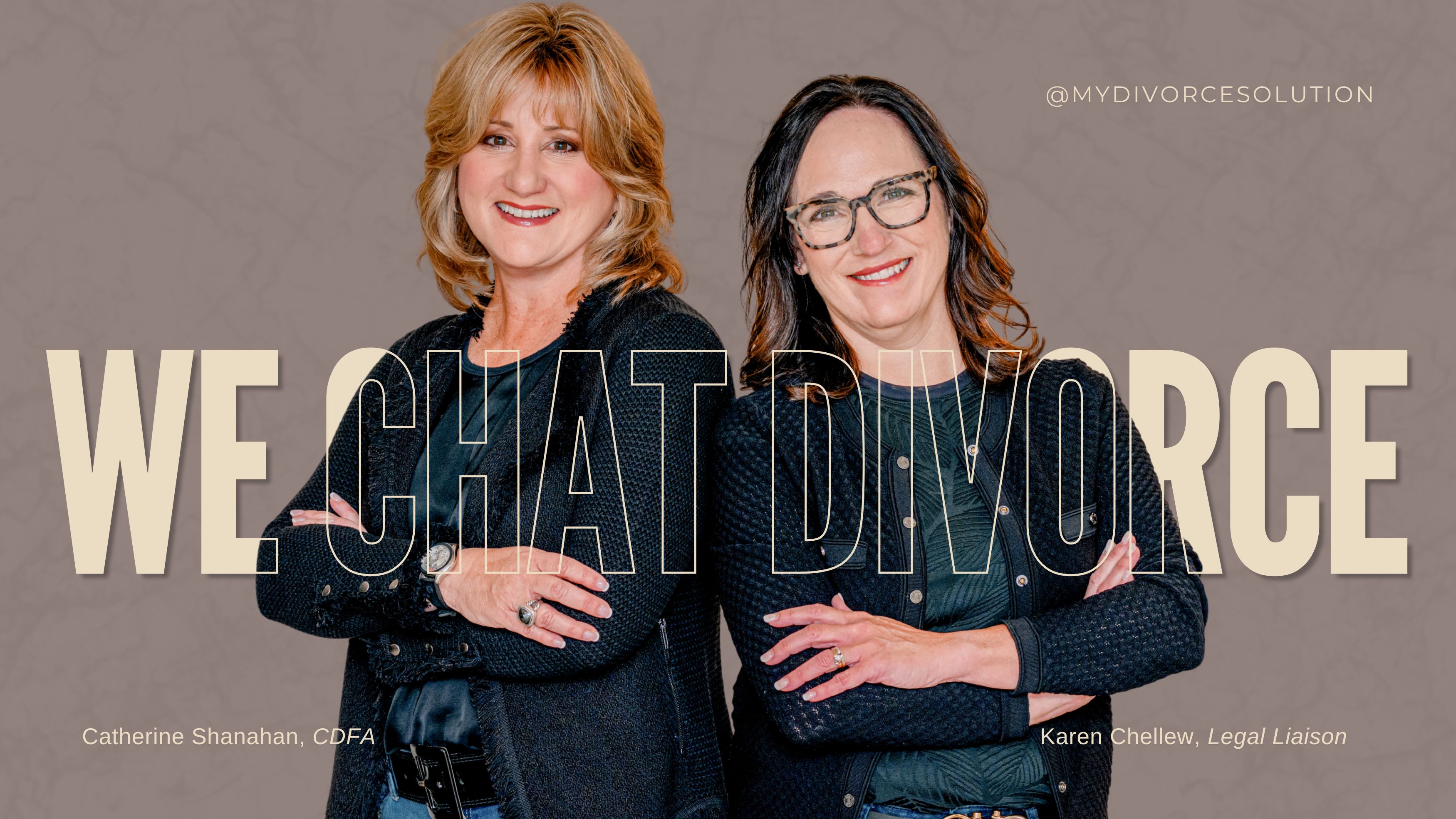

Welcome to another behind-the-scenes episode of Divorce Explored, your unfiltered look at what really happens inside My Divorce Solution. In this episode, Catherine and Karen tackle the five most common — and misunderstood — money questions they hear from individuals considering or starting the divorce process.
If you’ve ever wondered:
- “Can you just take a quick look at our agreement?”
- “Doesn’t my attorney already do this?”
- “Will I still need a forensic accountant?”
- “Isn’t our estate simple?”
- “Will my attorney work with you?”
…this episode is for you.
Our co-founders explain why financial clarity isn’t a luxury — it’s a necessity. Learn how lack of preparation leads to costly mistakes and emotional overwhelm, and why a proactive, data-driven approach saves you thousands while empowering you to make confident legal and financial decisions.
- “The Quick Look Myth”: What sounds fair on paper rarely accounts for taxes, long-term consequences, or unforeseen life events.
- Legal ≠ Financial: Attorneys are not financial analysts. Without financial clarity, you’re navigating blind.
- Forensics Isn’t Always the Fix: Most clients don’t need one — they just need to be prepared.
- Simplicity Is Deceptive: Even “simple” cases often hide six-figure surprises.
- Collaboration with Attorneys: MDS works with — not against — your legal team, setting the foundation for informed negotiation.
- The Divorce Financial Portrait™: Your personalized roadmap to financial clarity during divorce. Begin your Free Assessment,Take the first step toward financial empowerment.
If this episode opened your eyes or gave you clarity, do us (and future listeners) a favor — leave a quick rating or review. Don’t forget to subscribe so you never miss a weekly dose of divorce empowerment.
About My Divorce Solution
We Chat Divorce is produced by My Divorce Solution (MDS) — a financial divorce preparation company dedicated to helping individuals navigate divorce with clarity, confidence, and a strategic financial plan. Founded by Karen Chellew, Legal Liaison, and Catherine Shanahan, Certified Divorce Financial Analyst (CDFA), MDS was created to solve one of the most common and costly mistakes in divorce: entering the legal process without fully understanding your financial picture.
Divorce is not just a legal event — it is a financial transition that can shape your long-term security. Through the MDS Divorce Financial Portrait™, clients receive expert financial analysis, organized financial disclosures, and scenario planning to understand how different settlement decisions impact their future. This financial preparation often reduces legal fees, shortens the divorce process, and helps individuals negotiate from a position of knowledge rather than fear.
If you are considering divorce or already in the process, you can begin by taking the Free Divorce Financial Assessment to better understand your options. You can also join the MDS Community for expert guidance, educational resources, and live Q&A events designed to help you move from uncertainty to clarity.
At My Divorce Solution, the mission is simple: replace fear with knowledge so you can make informed, confident financial decisions during divorce.
Episode Transcript
0:01
Welcome to WeChat Divorce, hosted by Karen Chellew, Legal Liaison and Catherine Shanahan, CDFA.
Each episode we sit down with divorce professionals and industry experts to provide insights and frank discussions about real people, real situations, and real divorce to help you achieve your best life post divorce.
0:40
Welcome back to another divorce explored episode of WeChat Divorce.
You’re all access pass to what really happens behind the scenes of my divorce solution.
Well, as much as we can actually share.
I’m Catherine Shanahan, certified divorce financial specialist and Co founder.
0:56
Think of this as a series of like a backstage tour.
No velvet ropes are up, no marketing costs.
Just the unfiltered.
Strategies that we use.
Every day to help protect families futures.
And I’m Karen Chellew, legal liaison.
Every episode, we let you hover over our shoulders, hear the conversation, see the decisions and understand why financial clarity is the engine that drives a smarter divorce.
1:22
Today our topic is the Burning Money questions.
Why investing in financial clarity beats guesswork in divorce.
You know, today we had a conversation with a divorce coach that we value, Karen McMahon, and she really gave a great analogy about the process in general, and I want to share it because I think it was brilliant.
1:47
She talked about, you know, think of walking into the ocean like, you know, you’re going for your divorce and there you are.
And then what happens is you’re not realizing the Undertow, all the things that are happening when probably when you’re living in your emotional world and you’re thinking everybody’s handling everything for you.
2:04
And then the Undertow takes you and you look up and you’ve probably done this on the beach.
I know I have.
When you’re watching your kids and you see them drifting off to the left or to the right and you’re like waving to them, come back, come back.
You know, you’re, you’re not within my eye view anymore.
And that’s what really does happen in divorce.
2:20
I’m really glad that she shared that analogy because it really did make sense.
And I think it makes sense to the conversation that we’re going to share today.
I.
Totally agree.
So stick around, we’ll show you why investing in financial clarity upfront is the smartest money you’ll ever spend on your divorce.
2:38
Today we’re tackling the five hottest questions we hear on Discovery ’cause we call them assessment calls here at My Divorce Solution.
Questions people ask before they decide to invest in the MD’s method.
So let’s just start out.
The first one we hear a lot is calling in.
2:55
We’re amicable.
We generally, you know, sketched out a division scenario or what we think is fair and reasonable.
Can you just give it a quick look and help us know maybe what we’re missing?
Yeah, Yeah.
It doesn’t really work like that.
3:10
You know, a quick look.
Sure.
What’s a quick look?
I don’t know.
Everyone has a different definition of that because everyone loves those spreadsheets that they create.
And although they can be somewhat accurate, they really don’t cover what you’re giving up or they don’t really get cover the impact to that decision, or they don’t cover talking through another scenario and really talking through what your goals are for your future.
3:36
And that that’s where the conversation becomes difficult because the person making the spreadsheet or the person that says, look, this is what we have, you know this, this is equal.
Look at these two numbers.
You’re getting 500,000, I’m getting 500,000.
But that doesn’t really answer it.
And that’s where you meet people and they say, I wish I knew you five years ago because it sounded fair.
3:58
We were being amicable.
We did trust each other.
But it really didn’t work out that way.
You took an asset you didn’t want to take or you paid taxes where you didn’t think you had to pay, but you did.
So there’s a lot of things to consider, even over a quick look.
Yeah, I I so agree.
You know, let’s look at this scenario where there’s a there’s a home and there’s land and there’s pension and the couple income disparity is about $75,000.
4:25
And so the quick look was, well, he wants to keep his pension, I want to keep the home and I’ll be OK.
I don’t want to ask for spousal support and I’ll pay for my children’s college because it’s important to me and not to him.
4:41
But, you know, do you think that’s OK?
So it’s really not a quick look because all of those underlying issues actually surface, you know, they come to the surface for discussion.
And that’s where it becomes challenging and hard because once you see it in black and white and how those kinds of discussions play forward, it’s skewed.
5:07
And it it’s not as clear cut as what you may agree upon at the kitchen table in a space of just trying to get through this in the least contentious way possible.
Yeah, well, let me just further that scenario that you just laid out.
5:24
So let’s just say that happens.
He keeps his pension, she keeps the house she paid, agrees to pay the kids college.
Well, that sounds wonderful.
And you feel like you’re being the good mom paying for this college.
But let’s just say 2 years goes by and you lose your job or you become ill and you’re you’re house poor, meaning you gave up your other assets to keep this house.
5:44
And now you have a written agreement that you’re going to pay for the education of your children.
But you can’t.
So now you have to either sell your home, uproot your whole life because you didn’t plan for what the impact could that mean on a negative day?
6:01
You know, you do have to think of what could negatively happen along with what positively could happen when you’re making that decision.
So even though it sounds right in the moment and it’s easier in the moment and everybody wants easier, you could regret that decision very quickly if you’re not considering some of the impact that could occur.
6:20
So true.
All right #2 what we hear, doesn’t my attorney already do this?
How do you differentiate yourself from attorneys?
We hear that all the time because historically, when you’re approaching divorce, you’re going to go hire an attorney.
6:36
And So what people don’t understand is a lot of the attorney’s work is in preparing legal paperwork, certainly collecting documents.
But what is the missing piece there is the clarity of those documents and what it means to you.
6:54
Typically, people think, well, I’m going to hire an attorney and they’re going to tell me what’s best for me, and they’re going to advocate for me, and then I’m going to get divorced and everything’s going to be good, right?
That’s what the moment you walk or the moment you retain an attorney, that’s your hope.
7:10
But it doesn’t always go that way.
It rarely goes that way.
As a matter of fact, at MD’s, we’re not attorneys.
We don’t want to be attorneys.
We do not give legal advice and we are happy to get on with your attorneys to cover any legal questions.
But the attorneys are not trained in financial literacy or I don’t even know if that’s the right word.
7:30
They’re just not trained in assessing all of your assets and debts.
That’s not that’s not their role.
It shouldn’t be their role.
Their role is to take what you do have and advocate for you legally.
And yes, it is true.
Do they align with certain Cdfas or certain financial planners or their forensic accountants?
7:49
Do they have them all on board some way in case they need them to go to court and be a certified with test to do a certified testimony for them?
Yes, they do have those people, but that’s not what we’re talking about in our process because we get you prepared so that you ask your attorney really good questions based on your data, what’s there, what’s missing, what’s not.
8:10
Based on all of that, you could decide if you need a forensic to be your expert.
You can decide if you need somebody else to be your expert, but if you don’t get prepared beforehand, your attorney is just running on your emotion.
So yes, if you tell them you want something one day, they’re going to go in that direction.
8:27
And if two days later goes by you change your mind because something else came up in your discussions with your spouse or lack of discussion with your spouse, then the attorney’s going to flip that direct to that direction.
So they have no choice but to advocate for what you’re asking them for.
8:44
So you’re better off getting prepared first and then you’ll know what type of an attorney you need.
You’ll know what where the loopholes are loopholes, but you know where the missing data needs to be collected if we can’t get it.
Or you, you just know better on how to move forward so that you’re not, if we take that ocean analogy, just keep drifting off to the left or to the right without staying focused on where you’re actually trying to get to go.
9:09
Yeah, that’s so true that that undertow of hiccups or texts that you get or events that happen that you don’t necessarily know what to do.
And so that’s where your case starts shifting sideways versus moving forward because you don’t understand the financial impact of those decisions.
9:29
And there may be financial impact, there may not be financial impact, but not having the clear path forward.
You know, to your point, Catherine, the all the attorney or mediator or anyone else can do is say, all right, well today you want the house and you know, tomorrow you want me to address an issue with the children.
9:48
And the next day you think maybe some money was taken out of the IRA and the next day, how do I pay for this specific expense?
And that’s your sideways shift because you don’t.
You’re not in the clear.
You’re not in the know.
Yeah, and then you’re treading water and you feel like you’re paying these bills to go absolutely nowhere.
10:05
So many people come back to us and say, Oh my God, I spent $25,000 to go nowhere.
And it’s because you really weren’t prepared, is what I want to say.
You let somebody else lead you based on all the unknowns instead of focusing on the knowns.
And you can know, you can know.
10:21
So the third question that we get a lot is 1.
I still need a forensic accountant and people ask that question because when they hire an attorney or when they speak with an attorney and they have financial questions, typically the response is I have a good forensic accountant that I work with.
10:39
Why?
Because attorneys don’t do financial analysis, right?
So immediately they pivot to tracing valuation, which is even different than you as a client having financial clarity about your options in a division scenario.
So.
10:54
Interesting because you know, here’s where one place I’ll defend an attorneys reaction, which I know there’s not many times I do that.
But when you go to your attorney and you say, Oh my gosh, my spouse is hiding money.
He’s opened accounts here.
He has a girlfriend, and he’s been spending money from this account.
11:12
And I don’t know anything about that account, quite honestly.
The attorney’s only response is, yeah, we’ll have to get a forensic because they’re not going to do any of that work.
So they have to respond like that.
But in most cases, you forget to ask, wait, how far back can we go to recover any of that money?
11:28
Because if you’re thinking 510 years ago and you go hire a forensic and then at the end of the day, your attorney comes back and says, wait, we can’t really use that because it was 5 or 10 years ago.
Or if you send a forensic on this Chase, sometimes I see just glorified bookkeeping that comes back.
11:44
It’s just kind of the bookkeeping that you probably could do on your own.
You know, we have exercises we give you to kind of start tracing your own information.
So the forensic accountant, if it’s needed, be prepared first because Karen, how many people don’t even know the scope of the work that the forensic is doing?
12:01
So you say they get these reports back and I’m like, OK, let’s look at the report.
OK, what are we doing with this information now?
Well, it’s not what I thought it was going to be.
Well, yeah, because you never identified the scope.
You never really understood what you were looking for because you were too emotionally charged and you weren’t prepared.
12:17
So do you need a forensic?
Possibly, but probably not.
It just depends on, you know, your, your complexity of your estate.
And the issue lies in the attorney wants to reserve a forensic if you go to trial, right?
Forensics are experts at trial.
12:34
That’s the whole term forensic.
And so if you hire a forensic, and many times I’ll say I’ll ask the client, OK, can you get me the scope of work so that we’re preparing the documentation so that they can have a packet delivered to them so you’re not reinventing the will when they actually do their work.
12:52
So many times it comes back, well, they’re going to do whatever the attorney asked them to do.
So in the meantime to to your point, they’re doing bookkeeping because the financial bit, the business information or the cryptocurrency information or whatever is credit card statements where there’s chasing being done, whatever the IT may be.
13:11
They’re going over in segments to the forensic who’s doing bookkeeping.
And so if you already have that done, and if you already have the scope ready and available for when the forensic may be needed, that saves you so much time because so many forensics are just doing the best they can until the issues have been solidified in the case.
13:36
Yeah.
And again, just make sure that whatever it is that you’re going after can actually be legally recouped as in your settlement agreement.
Because a lot of times, Karen, we just see that it can’t.
We always hear, well, that happened so long ago.
Well, do you really want to go to court and you know, pay 100,000 to get 50,000 back?
13:55
So why even go down that road if it’s something that’s not going to benefit you either way, other than you feel like you’re getting some kind of justice, like they’re verifying or validating your mind that you’re thinking that your spouse is running off with money.
And a lot of times to your point then, and I think that is exactly what we’re saying, the attorney has no other response to you then well, we can have that assessed.
14:17
And so the financial impact to the eventual negotiation, settlement negotiation is probably very minimal.
All right.
So the next one we hear a lot is, well, our marital estate is fairly simple.
It’s straightforward.
We have these assets and there doesn’t seem to be complexity to them.
14:34
But how many times, Catherine, have we once we received the information, there’s thousands and 10s of thousands and sometimes $100,000 that’s sitting right there in the open.
That’s never been identified via the legal process for a variety of reasons.
14:52
Well, you know, you say we’re amicable, I believe our spouse.
And here’s the spreadsheet again.
You know, and this is everything that’s on here or OK, so if you’re agreeing to go off of that information, everybody’s going to agree to go off that information.
So just be careful because you’re you could be leaving thousands of dollars on the table by making a bad mistake because you weren’t financially clear.
15:16
So although it seems simple, you’re only going to get to do this once.
Once you sign that dotted line, it’s over, you know?
So why not take the extra time, spend a few $1000 to maybe save a few $1000 more because we see it happening over and over and over again.
15:33
And you know what even happens as little as doing your lifestyle analysis, you know, you’re Oh no, I don’t need support, blah, blah, blah, blah, blah.
And then all of a sudden hidden kids expenses come up.
But wait a minute, I need to have this covered.
You know, I didn’t think of that or I didn’t think of the loan that was on the four O 1K.
15:49
Nobody ever told me.
They just said the value of the four O 1K is this.
But a loan was never verified.
Like there’s so many little hidden complexities that are in every divorce.
Case.
I totally agree and I’m going to have two little case studies here or case situations.
16:07
So the first one is a client who they had two homes, some 4O1K, husband was a wage earner, whatever the IT may be.
So as part of our services we have verified documentation.
So we pull the deeds and mortgages just to verify ownership.
16:24
But we found a mortgage, just a second mortgage that no one had talked about.
And not only had they not talked about, it turns out that that mortgage had not been paid for about 15 years, creating a huge lien against the home that wife was going to retain.
16:44
And so the family law attorneys don’t didn’t understand the real estate or the title company, the mortgage company impact to that.
So, you know, they said, well, if she sells, you know, husband will agree to pay half or all of these things.
16:59
But that’s that wasn’t the point.
The point was it had stopped being paid.
There were penalties and interest which would severely impact her credit, impact her ability to sell, impact her ability to refinance, which was more than I think $150,000.
17:15
So that’s one scenario of just something that would not have been uncovered because people take discovery as it comes in, right?
No one’s checking the mortgages there.
Another one very relative to your lifestyle analysis, you know, the client came in, she had not been the wage earner.
17:34
She made fairly good money.
And when we did the lifestyle analysis, we found out that she did not have access to her tax returns.
We helped her get her tax returns and shock, shock of her husband’s W2 earned income was incomprehensible to her.
17:53
She had no idea that as much as she was struggling to make ends meet, their family cash flow had ability to pay that times 5.
We’ve had a few of those.
Yeah, it’s incredible.
I was on an assessment called the other day actually, somebody incidentally, who thought, you know, they’re, they’re not complex at all.
18:15
You know, she was trying to have our fee reduced, which we don’t do for anybody.
Our fees, our fee, it’s flat fee and we have a minimum anyway.
But she gave me when I was asking the information, they have a HELOC, a second HELOC on their home.
This HELOC was used to pay off a debt that they had.
18:34
That’s now it’s not really an asset because it’s a timeshare, but it wasn’t considered.
She didn’t consider when I asked a few questions, what’s going to happen to that?
But we why would you take that that off the value of the home if you want to keep the home, if the other party is keeping the asset, it’s a commingled asset creating a problem.
18:53
That’s not easy.
It’s not it becomes a complex situation and it’s not something that can’t be handled, but it’s something you have to consider that second HELOC was used for another asset that you might not be able to sell, which might end up being a debt.
So who’s going to get that and who’s responsible for paying back that HELOC?
19:11
So it’s just again, another little thing that we talk through with every asset and every debt to make sure that whenever needs to be considered, needs to be considered or brought up to your attorney.
You know, that’s something that now we lay out the situation and now legally you go to your attorney and say, how do, how would we handle this, right.
19:29
So otherwise your attorney’s not going to know.
They’re just going to see your Helocs, they’re going to take you off the value.
They’re not going to know to go through that unless it’s pointed out to them.
That’s not their concern.
So again, it’s just another one of hundreds of scenarios we can give you.
19:46
Absolutely.
And I’m going to tell just one more because this is a really recent one.
They had two pieces of property and other accounts and assets, retirement accounts and so forth.
But the person calling in believed that when it came to real estate, they split the real estate.
20:03
So she was believing that she had to get a loan to.
Buy out her spouse just in the lens of the real estate, not even, you know, taking into consideration all of their other assets that could have been offsets for that.
20:19
So, you know, you don’t know what you don’t know.
And there’s a lot of creative ways that you can settle to meet your goals and also to have a very equitable settlement.
Yeah.
Oh gosh, there’s another one.
Someone’s spending their inheritance, you know, to live because they haven’t asked for support yet.
20:38
And spouse makes three times the amount she makes, but she’s just thinking, oh, I have my inheritance, I’ll spend that.
No, no, no, no, no.
Let’s get clear on this and then move forward.
OK, We could do this forever.
Go forever.
Let’s let’s just say to one more and they say, well, their turn.
20:56
A lot of people ask, well, you’re will my attorney work with you?
Well, if they don’t, that’s on them.
They are working for you.
And so most attorneys more, you know, 90% of the attorneys of course are working with us.
But there are those attorneys that say, oh, we have our own financial people.
21:12
But I will say in my experience from from my viewpoint, those people generally come back to us because they’re not getting that one-on-one attention that they want to get that clarity that they need.
But I don’t know, Karen, you might have more of a perspective there.
Well, the the perspective I have is that when a client hires us and they have an attorney retain, one of the first things we want to do is get on a call with that attorney.
21:35
We send a template e-mail to our clients introducing our services, giving them authorization just speak with us, meaning giving the attorney authorization to speak with us.
And our whole goal is to help the attorney understand that we’re helping the client.
We use a consultancy agreement that waives confidentiality, but but more than that, it really sets the pace of everybody being on the same page about what are the critical issues, what’s the path forward, where should be.
22:04
We be focusing on our efforts and that we’re not getting in the attorney’s lane, but we’re definitely helping to deliver an informed client who’s ready to make really good decisions for themselves.
Yeah, so that we don’t ramble on forever, let’s just shift this from theory to what you can actually do for for yourself.
22:22
If you’re listening and you’re nodding along, go to our website, book a call with one of our lead advisors.
That can’t hurt.
It can only help.
And remain.
Remember that gaining financial knowledge does not cost you legal billable hours, but it can save you thousands when negotiations start.
22:38
So that wraps up our Backstage tour for today.
If you found value here, do us and future listeners a favor.
Leave a quick rating or review on our podcast app.
It helps more families find the clarity they deserve.
Oh yeah, and don’t forget to hit subscribe so you don’t miss our weekly episodes and leave us a little note if you want us to talk about something that we have not covered.
23:00
Until then, I’m Catherine Shanahan.
And I’m Karen Shalu, stay informed, stay empowered, and keep moving forward.
Thanks for joining us on another episode of We Chat Divorce.
We hope this episode was informative and supportive on your divorce journey.
23:17
If you're looking for more support for navigating divorce with confidence and clarity, head over to azure-emu-499854.hostingersite.com/ for more podcast episodes, divorce events, and resources for your divorce.
We’ll see you back here for our next episode.