


Should you take the lump sum alimony buyout or stick with monthly support payments?
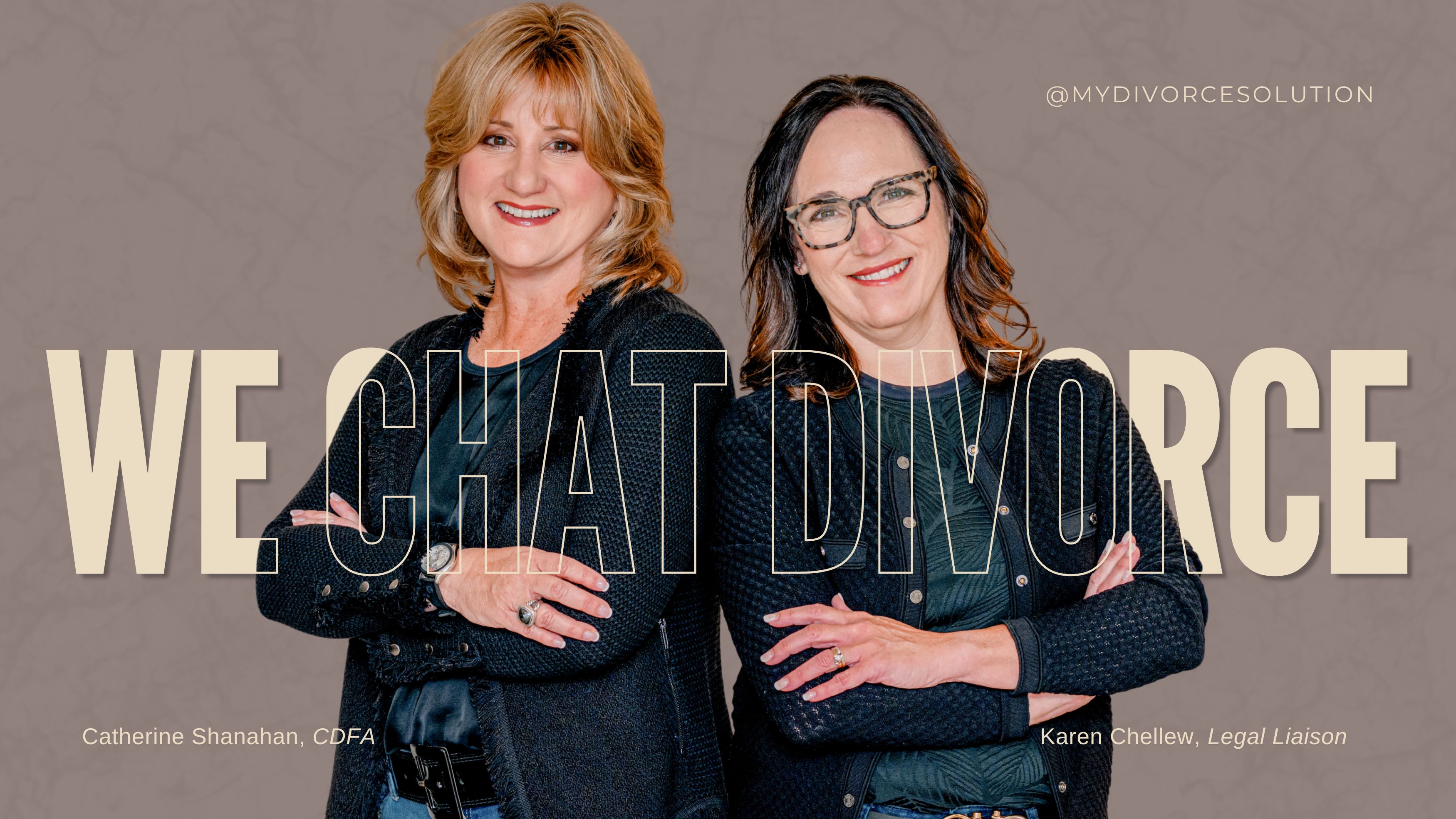
In this episode, Catherine and Karen unpack one of the most misunderstood yet consequential decisions in divorce: alimony buyouts. Together, they demystify how these lump sum payments are calculated, who truly benefits, and what hidden pitfalls can jeopardize your financial future.
From passive income projections to payout timing and mortgage qualification hurdles—this deep dive explores the real-world scenarios and tough questions you must ask before signing your agreement.
- Lump Sum Alimony: Pros & cons for both payer and recipient
- Tax implications & investment risks
- Liquidity vs. long-term cash flow
- Calculating present value & discount rates
- Passive income assumptions—and why timing matters
- What if the payer can’t pay all at once? Tranches, step-down payments, and protective clauses
- Impact on mortgage eligibility
- The role of life insurance and estate protection
- Why enforceability & agreement language matter
- The crucial importance of stress-testing financial plans
About My Divorce Solution
We Chat Divorce is produced by My Divorce Solution (MDS) — a financial divorce preparation company dedicated to helping individuals navigate divorce with clarity, confidence, and a strategic financial plan. Founded by Karen Chellew, Legal Liaison, and Catherine Shanahan, Certified Divorce Financial Analyst (CDFA), MDS was created to solve one of the most common and costly mistakes in divorce: entering the legal process without fully understanding your financial picture.
Divorce is not just a legal event — it is a financial transition that can shape your long-term security. Through the MDS Divorce Financial Portrait™, clients receive expert financial analysis, organized financial disclosures, and scenario planning to understand how different settlement decisions impact their future. This financial preparation often reduces legal fees, shortens the divorce process, and helps individuals negotiate from a position of knowledge rather than fear.
If you are considering divorce or already in the process, you can begin by taking the Free Divorce Financial Assessment to better understand your options. You can also join the MDS Community for expert guidance, educational resources, and live Q&A events designed to help you move from uncertainty to clarity.
At My Divorce Solution, the mission is simple: replace fear with knowledge so you can make informed, confident financial decisions during divorce.
Episode Transcript
0:01
Welcome to WeChat Divorce, hosted by Karen Chellew, Legal Liaison and Catherine Shanahan, CDFA.
Each episode we sit down with divorce professionals and industry experts to provide insights and frank discussions about real people, real situations, and real divorce to help you achieve your best life post divorce.
0:39
Welcome back to WeChat Divorce, the number one podcast for straight talk about finances before, during and after divorce.
I’m Catherine Shanahan’s certified divorce financial analyst and divorce financial specialist.
And I’m Karen Chellew, legal liaison and Co founder of My Divorce Solution.
0:57
Around here we believe clarity is power and we don’t sugarcoat the numbers.
Anyone knows who knows MDS knows that’s true.
Today our explored is going to tackle lump sum alimony buyouts.
It’s probably one of the hottest topics when we’re talking about particularly some complex cases in negotiations.
1:20
And Karen, it always amazes me some of the things that are included in the conversation and some things that are excluded from that conversation.
So should you take that lump sum alimony buyout or stick with the monthly support payment?
Think of it as cash now versus cash flow later.
1:37
Sounds simple in theory.
For sure.
A buyout can feel like ripping off the Band-Aid.
A claim break.
No more calendar reminders.
No more chasing payments.
That was my experience, but it also loads every risk market swings, longevity, taxes right on to day one.
1:55
And I know Catherine, you’re going to talk about other things that’s loaded on.
So it’s going to be a good conversation, I know.
Yeah, one that we’re asked about daily, it seems like over the last few weeks.
So let’s break down really today about how buyouts are actually calculated, who really benefits from them, some of the pitfalls that you may not see and some action steps to a stress test the numbers before you sign it.
2:23
And remember, nothing in this show is personal, legal or tax advice.
We’re here to arm you with questions and data points you’ll need when you sit down with your own professionals.
Who are your advice givers?
Yeah.
So get your questions in mind in case you have to put comments later.
2:41
We’re going to talk about cash now or checks later.
So welcome to divorce explored, alimony buyouts demystified.
So there’s a pro side to the payer and the recipient.
Let’s talk about that, you know, for the payer.
The payer is the person actually paying support to somebody else.
2:59
For the payer, it’s like the finality of it.
You know, no one, I don’t care who you are, even if you say you’re taking care of your ex-spouse, no one loves writing that monthly check to them.
They rather just give them money as it goes, as they need it, I should say, them actually being mandated to give a monthly check, right?
3:17
So they like the finality of it.
There’s no tracking, there’s no enforcement they have to worry about.
There’s no modification risk and it’s over.
You don’t have that nodding feeling, you know, that you’re writing that check the next month.
They also get a potential discount when negotiating because when you negotiate the present value of a future payment, it’s usually a less you, a less lump sum that you actually have to give to the other person.
3:45
And then you have freedom, you know, from life triggering events the the the fear of losing your job or not receiving the bonus that you thought you would receive or actually being able to retire.
So those are all positive for the payer.
Could it also be, you know, if the payers knows that their job is going to be more that I guess their career, their salary, their executive compensation, their commissions are going to be more in the future and they don’t have to worry about being reassessed or RE, you know, all of that looked at again in the future for whatever reason if the modifiable.
4:22
Yeah, the modification risk, yeah, You know, that could go that that modification clause, if it says modifiable, can work against you as well, you know.
So to your point, if their income does go up and they have a modification clause, yeah, they could be at risk for a potential increase in their alimony payment or spousal support, whatever your state calls it.
4:42
But it also then, you know, this is the con that we’ll talk about later.
If your job, if you lose your job, you know, if you don’t make it modifiable, it’s hard to get that modified.
If you have assets, you know, there’s so many things to consider, right?
The pro side for the person receiving the money is they have immediate liquidity, right?
5:01
They have a lump sum given to them.
So they if they need to use some of that to buy a home or they want to invest it or they need to pay off debt, it could help with that.
Again, there’s going to be cons to this that we’ll talk about later, but that is a pro side.
Again, you’re protected if your spouse does lose his job.
5:20
You know, if you get the lump sum, it really doesn’t affect you.
If your spouse dies, you still got your lump sum.
So everything is there for you and the right now it’s done and probably emotionally speaking, you don’t have to remain tied to your ex-spouse by waiting for that monthly check to come in, whether it’s on time or if it’s late.
5:39
You know, you don’t have that angst every month.
So and.
Also move forward to other relationships.
Yeah, that’s exactly where it’s going.
That too.
Some people say, oh, I’m never getting married again or Oh no, no, no, I’m never doing that.
But they do, you know, which is why we have higher statistics for divorce rate the second, third time around.
6:00
But you know, you get to protect yourself and move on with your life.
Yeah.
And some states are very, very rigid, most are, most are not.
But rigid in what cohabitation would encompass that have.
6:17
I mean, we’ve seen in some of our clients put them severely at risk for just, you know, essentially going on a date that, you know, is crazy.
Yeah, it’s so true.
Let’s just talk a little bit about the cons to each person.
For the payer.
6:32
The con is it’s a lump sum payout.
You know, you’re, you’re draining some of your assets to make that payment.
So that could not feel great for somebody as well.
Again, you have the loss of a, a possible downward modification in case you lose your job or anything happens, you’ve already made that payment tax treatment.
6:53
There really is nothing since 2019 that that has changed.
But for the person receiving it, the support payment, you know, not everybody can save on a monthly basis.
So the the idea of getting a lump sum, that money is supposed to be put into an account that you take that monthly payment out each month as if you were receiving it monthly.
7:17
So do you have the discipline to only take that monthly payment out?
Because if, you know, we talked earlier that a pro could have been that you could buy a house.
But remember, if you do that or you pay off debt, you’re dipping into that lump sum that was supposed to generate your monthly income.
7:34
So will you still have cash flow if you dip into that?
It takes a lot of discipline to manage that basically for yourself.
So is that passive growth on the monthly income taxable?
Yeah, yeah.
Whereas alimony monthly would not be taxable.
7:50
Well, I mean, you’re really getting the lump sum tax free.
So that’s, that’s fair.
Your monthly income, if you’re investing it and there’s any passive income on it, it’ll be taxable.
All passive income will be taxable.
So I mean, there’s pros and cons to both.
And a lot of it sometimes boils down to does the payer have the ability to make that payment, that lump sum payment?
8:11
And, you know, their con is if their spouse gets remarried, they wouldn’t have had to pay all that alimony, you know, so that’s a risk.
It’s all a risk, but it’s definitely something that should be considered.
And, you know, when we talk about this, you know how it’s calculated, you’re getting a present value calculation of future growth.
8:32
So if you’re the person paying, for example, if you were paying $1000 a month for 12 months, for 10 years, some people just calculate that and say, OK, I’ll give you $120,000.
That’s 10 years of $1000 a month.
8:47
The person receiving the money is thinking that I’m going to get $120,000 in lump sum.
But that’s not how it works.
There’s discount rates in there, right?
So it’s the value of calculating what that value is today.
So in that scenario, the payer probably only has to pay you around a $100,000 instead of 120.
9:07
So it’s good for them.
They’re saying over time I’m saving $20,000, right?
And this is just me throwing these numbers out as an example.
And the person receiving it has to realize if they received that $100,000, it’s like getting 120 over the 10 year period because you’re supposed to have that money invested.
9:26
So it’s growing as you’re taking only $1000 a month out for your support payment.
And that’s why I mentioned if you take 50,000 of that and pay off debt, there goes your cash flow.
You you’re not going to keep up with the $1000 a month for 10 years.
9:41
You’ve dipped into it and the market won’t keep up for that.
But what if you don’t get it in a lump sum?
You know what if there’s some kind of payment plan that the spousal support is going to be delivered to the recipient.
Yeah, that is the hot topic right now.
So several cases, and these are complex cases who have 5 million, $10 million and they’re they’re going to do a lump sum buyout.
10:07
And it’s interesting to me to see that one party is receiving an equitable distribution, $5,000,000.
Not one party, both parties.
Let’s just say the state’s worth $10 million.
One party is getting 5 thousand $5,000,000 and for support purposes, they’re using the passive income off of that $5,000,000 to calculate what an alimony or spousal support payment would still be on top of that.
10:36
And that’s fair.
If you have $5,000,000 on your side and even if you you’re not employed with any W2 earnings, passive income should be calculated as one of the factors when when computing spousal support.
The problem is to your question, when are they actually getting that $5,000,000?
10:54
So it looks good and everyone seems like it’s fair, but when are you getting that?
Because if the if the estate doesn’t have $5,000,000 that they can transfer at the signing of the agreement or whenever they decide that it would be transferred, then you don’t really have that passive income coming in as the person who would be receiving support.
11:15
So is it fair to calculate that passive income at that moment if you’re not receiving it?
No, it’s not.
Is it fair to let your spouse have a payment plan to pay you the $5,000,000?
Yes.
Because in reality, if they don’t have the money, how are they going to give it to you?
11:32
So if it takes them a year or two to get their finances together, they’re giving it to you in tranches.
Maybe, you know, maybe at the end of the year you’ll get a third of it.
Maybe the next year you’ll get the other third.
You know, maybe it’ll take them three years.
So your passive income is not on the full $5,000,000 until you actually receive it.
11:52
So you might need to have step up or step down from step down, I should say from support payments.
You know, maybe in the first year you’re calculating it with no passive income.
Maybe at the end of that first year when you get the 3rd, that’s the passive income that it kicks in after the first year, the next year, the second third at your.
12:10
So you could do a step a step decrease or increase from your support payment.
So that would presume that the income coming to the recipient is all investments, not retirement accounts, not equity in the home and things like that where you know, they’re, they’re really calculating it on actual accounts that create present day income, not retirement income.
12:37
Gosh, Karen, that’s such great point because a lot of times people are like, I want to keep the house.
OK, All right, you can have the house.
It’s worth net equity $1,000,000.
My $500,000 I’m going to let you keep is 500,000 towards the 5 million that I owe you, right?
12:54
So now it sounds fair.
Everyone thinks it’s fair.
But wait a minute, that’s not passive income eligible for you.
There is no passive income on the House that you’re living in.
So now you’re down to 4.5 million that a calculation should have been a runoff.
13:10
Same thing with retirement.
OK, we have $2,000,000 in retirement.
I’ll give you the full 2 million.
So that’s another million towards my lump sum buyout.
OK, well that’s taxable income and you brought up earlier, is it taxable or tax or non taxable?
Well now that’s taxable income to you.
13:27
So it’s not just what you’re receiving from the retirement it you need to, I lost the term you need to net of taxes, you need to reconcile what that would be.
So you need to get an additional.
So instead of getting a million, you might need 1.2 million, you know, to cover the taxes.
13:47
So all of these things look fair on a spreadsheet when you’re moving these accounts, but is it fair to use those amounts when you’re calculating a support payment on the passive income?
And another consideration, which is really important we run into a lot is if you need to be able to get a mortgage, be eligible for a mortgage, you know, how does that factor in?
14:14
Because I’ve not really come across any no doc mortgages anymore that used to be super popular I’ve.
Not popular for elderly, mostly elderly people.
They are age 60 or something.
I don’t hear them now either.
Too many of them, yeah.
14:30
I haven’t run across them, but I think it’s really hard to be approved for a mortgage if you don’t have that cash flow income.
And if it’s coming in in tranches, like how do you deal with that?
That’s a, that’s a really big consideration, especially if you’re tasked with the refinance of the home or if your spouse is keeping the home and you know you have money to buy a home.
14:53
That’s great, but what about qualifying for a mortgage that’s challenging because you know your spouse probably is not going to agree to be a cosigner.
Nor do you want them to because then you’re still attached to them, right, moving forward.
So I mean, there’s so many considerations, but everything we’re talking about requires more work that you know it, it requires multiple calculations of support at different periods of time, you know it.
15:22
It requires more language to be in your final agreement so that you don’t end up back in court or and if you do, you have a good agreement to stand on.
But it’s really worth it.
We always say whatever looks fair on paper needs to have the backup data to support that.
15:39
So don’t just say oh great, I’m getting $5,000,000 and yes, I’m getting 250,000 off of that and income.
So now I’ll be set with the additional support payment because you might not have that $5,000,000 for five years.
So what do you do for the next 5 years when you’re counting on that?
15:58
Exactly, and sometimes, you know, it could be a good option that your spouse acquire a loan to pay you.
You know, so many times I feel like that’s not even a consideration when I’m speaking with the attorneys or the clients because they don’t want to put the payor under stress, but the recipients going to be under stress until they get stabilized into their new life.
16:24
So, you know, sometimes some type of loan the payer could acquire to pay some of the buyout.
For me, that could be a consideration and I do press in on that sometimes, especially when I see that they’re capable of doing that and it wouldn’t put financial stress on them.
16:43
Yeah.
I mean, here’s where I’m a little bit more generous to the payer, right?
I are more than I am.
When it comes to a lump sum buyout, I certainly AM and I I’ll tell you why.
It’s because they know the wheelings and dealings.
16:59
Whether we think they’re shady or not or you’re we meaning the spouse or anyone think that their dealings are shady or not.
These are generally long term marriages with large estates and complex.
You know how your spouse has been Wheeling and dealing, even if you don’t know the specifics of it, you kind of know, right?
17:18
Which is why you always think they’re hiding money or something.
But you can’t make someone pay $5,000,000 if they don’t have it.
I get it.
Yeah, they can apply for a loan.
But applying for a loan, they’re probably already leveraged out with their businesses.
It’s not really as easy just applying for a loan, right?
Because it that loan’s going to affect another loan that they have a dealing with, with the business for something else.
17:38
Everything is a trickle down effect.
So I rather say, how are you going to pay this?
Like tell me how you’re going to give them the benefit of a doubt.
And that’s why I said just I just had this conversation.
They’re like, well, he he has to pay it.
He’s going to have to pay it the signing of the agreement.
17:53
OK, well, how you don’t have $5,000,000 sitting in the council where if you did, terrific.
OK, great, they can transfer it.
But if they don’t give them the benefit of telling you how they think they can do it, and if it is a three-year plan or a five year plan, it’s probably because that’s the business deals they have set up, you know, and it could affect their business deals.
18:16
And if it does, you’re not going to get that money anyway.
And if you set them up with an UN payment plan, they’re just not going to be unrealistic payment plan, they’re not going to make it.
They don’t care.
They’ll say sure, I’ll give you $5,000,000.
And when it’s due, they’re going to say, well, I don’t have it right now.
18:32
And So what do you do?
You end up back in court and they tell the judge, well, I don’t have it.
I know I’m a content.
I applied for five loans.
I wasn’t approved.
I’m thinking my deal is going to happen in the next 6 months.
I can get it then.
But you just end up in the courtroom forever.
So I just say given them the benefit of the doubt, but to protect yourself, that passive income should not be used as income for you until you receive it.
18:56
Make them pay you more in alimony.
That’s the benefit to them.
You know, they get more time to give you a lump sum, so they get to work out their business deals, but they have to pay you alimony and they have to pay you more than they anticipated because you don’t have the passive income yet.
I adopt your point.
I do #1 if someone’s going to pay anything in tranches, make sure if that first one doesn’t come through, that your agreement has a very strong protection and enforcement provision.
19:24
So if that payment isn’t made, agree ahead of time on what’s going to be done, what assets going to be liquidated, that then, you know, spousal support is going to be paid monthly.
There’s all kinds of remedies.
If that tranche doesn’t get paid, that’s better than going back to court because going back to court, you’re just going to be on the hamster wheel again.
19:44
We all know what that experience is like.
So, you know, it sounds good and it probably is good, but life happens, right?
So then if life happens and that can’t be paid, make sure there’s some provisions that can be counted on that you can rely on to make sure that money makes it to your bank account.
20:05
Margin interest.
You can have an interest payment on the money they owe you too.
I mean it.
Could be a lot of things.
If you get the mindset that this is a business transaction.
So.
Someone owes you $5,000,000, you’re actually lending it to them and if they can’t give it to you right there at settlement, you’re setting up a plan.
20:24
So charge them interest until they pay you It’s.
All kinds of things.
And then the second life event could be that, you know, your spouse’s passes away, your spouse passes away.
So make sure there’s something in place if that happens as well for frankly any financial obligations that remain as part of the marital settlement agreement.
20:44
That’s really, really important.
That’s really important.
I’m glad you brought that up because a lot of people say, well, I’m going to make him get a life insurance policy.
Oh, yeah, OK.
And oh, we have a life insurance policy.
And even if there’s provisions in your in your agreement that says they have to provide proof that you are the beneficiaries, you don’t know if they provide you the proof today and then tomorrow they change it.
21:08
So it goes beyond that.
What Karen’s saying is make sure your agreement reads that his estate pays you back or pays you back, pays you the outstanding balance of we’re using this example of the $5,000,000 before his estate pays anybody else.
21:25
In addition to the life insurance if he didn’t or she didn’t keep you on his beneficiary.
Well, not in, well in, in alignment with.
It’s just that you full 5 million, right?
Yeah.
For sure, yeah.
Good stuff.
Well, you know, it’s it’s definitely an option.
21:41
But what’s frustrating to me, honestly, Karen, is everything right about how the attorneys put this out there, you know, yeah, OK, you’ll get $5,000,000 and you’re going to have passive income of 250, whatever it is that it’s on there.
OK, that all makes sense.
But why are we not taking it the step further?
21:57
What happens between today and the day that I get that $5,000,000?
So now I got to reduce support payment because everyone’s thinking I’m getting 250,000.
And these numbers might seem really unreal to a lot of you listening to this.
It’s all relative to a conversation I just had.
22:12
So that’s why I’m speaking about that number.
But what happens from today to that day that you get it?
You know, nobody goes a step beyond an agreement or proposal to think about the impact of that.
Right, I agree.
And sometimes the focus is so much on crunching the numbers, projecting out all the what ifs kind of gets left by the wayside.
22:36
Yeah, yeah.
So when you’re going through this kind of scenario and if it’s an option for you, and believe me, I love lump sum alimony payments as to a receiver, whoever’s receiving that money, why not get the lump sum?
Work with your financial planner, invest that money and live on your monthly income.
22:56
You never have to deal with getting a monthly check and you can move on with your life.
Like if it’s an option, I love it.
Most people don’t like it for the payer because why pay all that money out if you don’t have to?
You kind of hope your spouse gets remarried or cohabitates, right?
That’s just normal thinking.
23:13
But take some action steps for yourself.
Inventory the liquidity for tax purposes and for negotiation.
What, what money is available to get that lump sum out of money realistically, right model at least three what if scenarios.
I mean, Karen and I talked about a few of them today, but kind of talk through some what if scenarios.
23:31
It’s really important and you know, stress test your longevity.
How long do you think you’ll live?
Because that’s important also for your cash flow.
But secure professional review of your settlement language.
You know, we talk about that all the time.
Agreements just they look fair, but the agreements are not written to really protect you from going to court.
23:50
A lot of times there’s just little loop hopes when it when it comes to the financial piece.
Yeah.
And a lot of times they’re not little, I don’t know, an incident where we reviewed a settlement agreement financially where we were, you know, our jaws didn’t drop for one reason or another.
24:09
And sometimes it’s just a nuance.
It’s just a buzzword.
It’s just something that got overlooked because putting a marital settlement agreement together is not easy.
There’s a lot of details.
Yeah.
And at that point, everyone’s tired, you’re done.
You want to be over with it.
24:25
And you think you have an agreement whether you like it or not, but it is your agreement.
Everybody compromised.
So you kind of overlook that language.
I mean, I don’t look at an agreement as well as you do.
I mean, you, you get in there and you pick out these nuances and these words where me personally, I probably would have overlooked it, right?
24:43
I just looked at the numbers.
So it does take a special eye to kind of look at that.
But you know, take the time you need to review that agreement to make sure it makes sense to you.
We could talk forever about alimony buyouts.
There’s a lot of things to talk about.
It’s certainly something that should be considered if it’s an option to you.
24:58
But just think about all the things we discussed today.
You know it’s only as smart as the math behind it and most importantly, the mindset behind it, making sure that it works for you for sure.
So run the numbers, stress test the risk and be brutally honest about your spending habits because one check today has a has to last a lot of tomorrow’s.
25:20
And if you’re weighing A buyout offer right now, make sure you’ve gone through our process.
We talk about all the considerations for you.
Make sure you have your financial planner for post divorce so they make sure that you do stay on track with that alimony buyout.
And your attorney make sure that they have the language to protect you so that you don’t back end up back in court because clarity definitely beats regret every single time.
25:44
If today’s deep dive gave you an aha moment hit follow right now.
So next week’s episode lands in your queue automatically.
No hunting around required.
Please leave us comments or questions.
We’d like to address it.
This this podcast actually came today because of some questions that we got from clients ourselves and they wanted us to talk about it.
26:04
So please, you let us know what you want to hear about and we’ll talk about it.
Absolutely.
So if you know someone wrestling with alimony math, screenshot this episode and text it to them.
Share the clarity.
Until then, here’s the financial clarity today for confidence tomorrow.
26:20
Thanks for joining us on another episode of WeChat Divorce.
We hope this episode was informative and supportive on your divorce journey.
If you're looking for more support for navigating divorce with confidence and clarity, head over to azure-emu-499854.hostingersite.com/ for more podcast episodes, divorce events, and resources for your divorce.
26:43
We’ll see you back here for our next episode.