






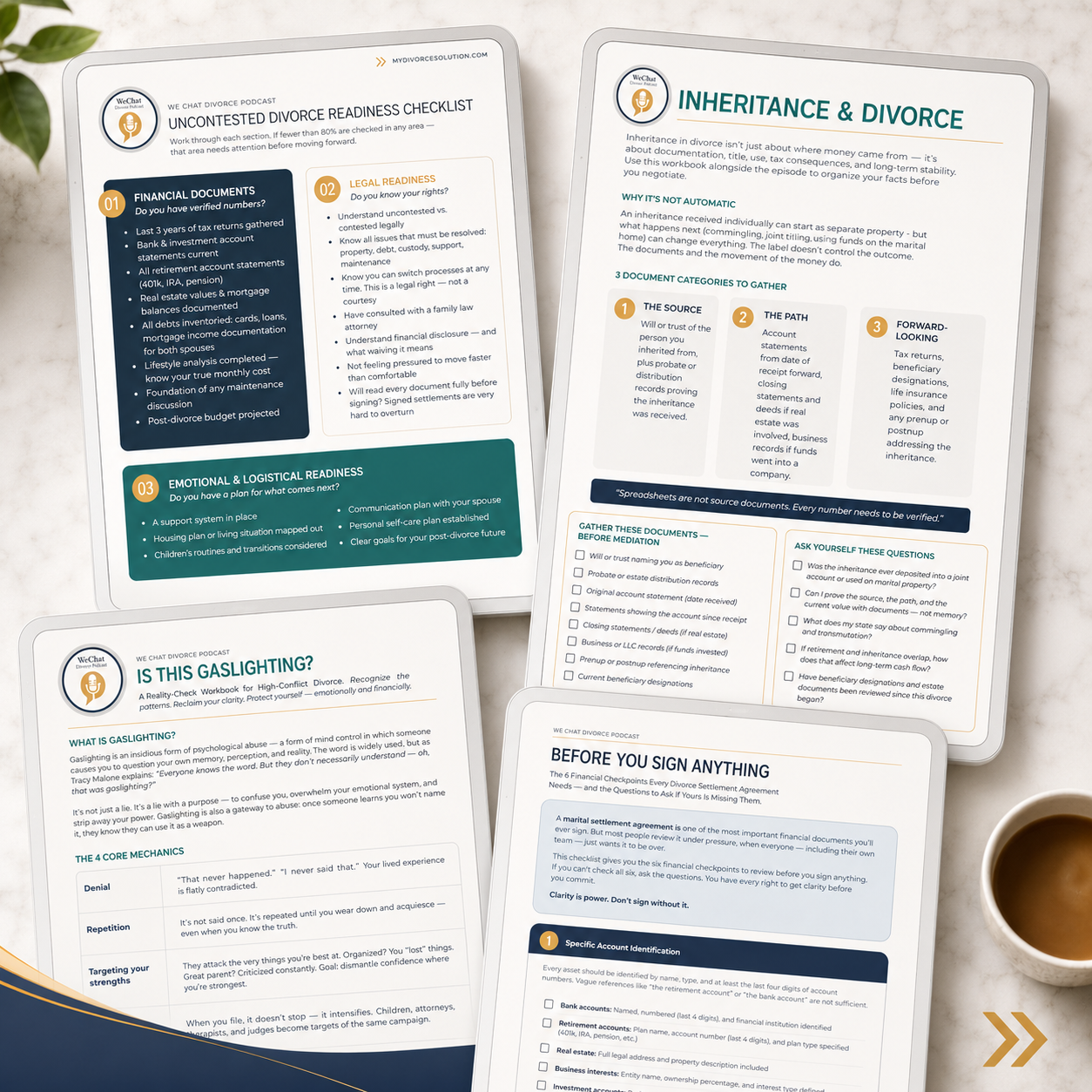
What Ten Years Taught Us About Money & Marriage
Thank you for ten years and 200 episodes. As our gift to you, here is what a decade of this work has taught us — because most people do not discover the financial side of divorce until they are standing in the middle of it. Six lessons, and a few things most people never see coming.
By submitting this form, you agree to receive communications from My Divorce Solution. Your information is confidential and protected.
6 lessons from 10 years of helping people navigate the financial reality of divorce
When Karen Chellew and Catherine Shanahan launched My Divorce Solution ten years ago, they set out to help people understand their finances during one of the hardest transitions of their lives. What they didn’t fully anticipate was the pattern that would emerge after working with more than 5,000 clients across all 50 states: the financial problems that surface in divorce rarely start with divorce.
In the 200th episode of We Chat Divorce, Karen and Catherine step back from their usual topic-by-topic format to reflect on the deeper insight that has shaped every conversation, every client file, and every episode since the beginning: clarity built early changes the story.
Here are six lessons from a decade of this work.
Lesson 1: Preparation Is a Relationship Activity, Not a Divorce Activity
Most people think divorce begins when someone files the paperwork. After ten years of this work, Karen and Catherine have learned it often begins much earlier — when transparency quietly disappears, when assumptions replace conversations, and when two people slowly stop sharing the realities of their financial lives.
By the time legal paperwork enters the picture, the financial distance is already there. The legal process just makes it visible.
The earlier someone understands their own finances, the more confident every decision becomes — in marriage and in divorce. And here is the part that matters most: it is never too late to build that clarity. Even when a marriage has already ended, getting a complete, verified picture of your finances changes what happens next.
Lesson 2: Financial Transparency Is Not the Same as Trust
One of the most common patterns they see: a couple is working cooperatively through their divorce, and one spouse says, “I trust my partner — I don’t need to verify anything.”
Here’s what Karen and Catherine have learned to say: asking for documents to support a spreadsheet is not questioning your spouse’s honesty. It’s trusting yourself enough to make a good decision.
When one person has handled all the finances and the other has stepped back, that isn’t trust — it’s dependence and exposure. No one should enter settlement negotiations, mediation, or even a productive money conversation without their own financial footing.
Even something as simple as signing a joint tax return with confidence — knowing what it says and why — is a form of financial self-trust worth building.
Lesson 3: The Absence of a Conversation Is Itself a Decision
When couples avoid talking about money, they’re not staying neutral. They’re quietly choosing assumptions over facts — and those assumptions compound year after year until no one really knows where things stand.
In this episode, Karen and Catherine talk candidly about the hidden credit card — the one a spouse maintains that the other doesn’t know about. It’s rarely about deception for its own sake. More often, it signals something else: a desire for independence that hasn’t been voiced, a question about the future that hasn’t been asked, or simply a financial conversation that’s been avoided for too long.
If you’re considering divorce and need to establish your own financial footing, that’s a practical reality — but understand that accounts opened independently may still be considered marital assets subject to disclosure. The goal is clarity, not concealment.
Lesson 4: Documents Tell the Truth That Memory Does Not
This is the backbone of everything My Divorce Solution does.
Memory matters — it often surfaces important information, like a former employer with a 401(k) that was never rolled over, or a pension that was never closed. But memory alone cannot verify the numbers. Documents do.
Karen shares a conversation she had just before this recording with someone who believed she had almost no knowledge of her own marital finances. Within thirty minutes, it became clear she actually knew a great deal — she just didn’t know what it meant or how to access it. That shift from “I don’t know anything” to “I know more than I thought” is one of the most powerful things this work produces.
One important note for anyone approaching divorce: be cautious about commingling. If you receive an inheritance or come into separate property, keeping it clearly separate — and not adding your spouse’s name to it — may preserve its classification. Commingling can change that in most states.
Lesson 5: Handing Your Finances to an Attorney Is Not the Same as Understanding Them
For some clients, the pattern of financial dependence that existed in a marriage simply transfers to the divorce process. Instead of deferring to a spouse, they defer to their attorney. The financial fog doesn’t lift — it just changes who’s navigating it on their behalf.
Even for clients who are fully informed, there’s a critical gap: an attorney’s job is the legal outcome of your case. It is not to show you what a settlement means for your financial life years down the road.
You can agree to terms that look fair on paper and still walk away financially impaired — simply because no one modeled what those decisions mean for your future. Fair in the agreement and fair in your future are not the same thing.
Legal representation was never designed to replace your own financial clarity. No one can advocate well from inside a foggy space — and ultimately, you are the only one who can truly advocate for yourself.
Lesson 6: Mediation Without Financial Knowledge Is Amicable Unknowing
Mediation can feel calm and cooperative. But that calm can hide the fact that both people are dividing a financial picture that neither has fully verified.
A common mistake: using mediation as a document collection strategy. Karen and Catherine are blunt about this: they have never seen a spouse arrive at mediation with the documents they were asked to provide. What actually happens is the mediator says, “Can you bring those documents to the next session?” — and everyone has already paid for a session that produced nothing.
The right time for mediation is when you have the documents, not before. Going to mediation prepared means going in with a verified financial picture, not hoping the process will produce one.
The Phrase That Defines a Decade
After ten years, Karen and Catherine kept hearing the same sentence from clients:
- “I wish I had done this years ago.”
- “Nobody ever taught us how to talk about money.”
- “I wish I knew you five years ago.”
These are not regrets. They are early warning signs — and if any of those sentences sound familiar in your own life right now, that is not a reason for shame. It is a reason to build clarity while you still have the time and the choice to do it.
Financial clarity doesn’t just help people through divorce. It can change the conversation entirely. Plenty of people who come to My Divorce Solution to get clarity on their finances walk away not toward a filing, but toward their marriage — with the emotional work they needed to do suddenly feeling possible now that the financial fog has lifted.
Whatever the future holds — staying together, separating, a postnuptial agreement, or a divorce — clarity has to come first.
Ready to get your financial picture clear?
Visit azure-emu-499854.hostingersite.com/ to learn more about the MDS Financial Portrait™ and request access today.
This article is for informational and educational purposes only and does not constitute legal or financial advice. Divorce laws vary by state. Please consult a qualified attorney or financial professional for guidance specific to your situation.