


Show Title: Understanding Property Division: What’s Yours, Mine, and Ours?
Property division is one of the most complex and emotionally charged aspects of divorce. In this episode of We Chat Divorce, Karen and Catherine break down the process of dividing assets to help listeners gain clarity and confidence. They explore the differences between community property and equitable distribution states, explain marital versus separate property, and provide tips for managing high-value assets like businesses, stock options, and retirement accounts.
Whether you’re struggling to define “yours, mine, and ours” or aiming for a fair division of assets, this episode offers practical insights into achieving financial clarity during divorce.
Key Topics:
- Community Property vs. Equitable Distribution States: How laws affect asset division and the role of “just and fair” principles.
- Marital vs. Separate Property: Understanding the distinctions and how commingling can blur the lines.
- Complex Assets: Tips for managing businesses, stock options, and retirement accounts with clarity and proper documentation.
- Financial Preparation: Why being informed is critical before mediation or negotiations.
- Real-Life Stories: How the MDS Divorce Financial Portrait™ empowers clients with organization and clarity.
Key Takeaways:
- Clarity is Key: Understand the knowns, unknowns, and the impact of financial decisions.
- Preparation Saves Time and Money: Being unprepared can lead to rushed and costly decisions.
- Healthy Conversations Matter: Open financial discussions (even prenups) strengthen relationships.
- Take Control: Tools like the Divorce Financial Portrait™ keep you organized and in charge.
Resources Mentioned
About My Divorce Solution
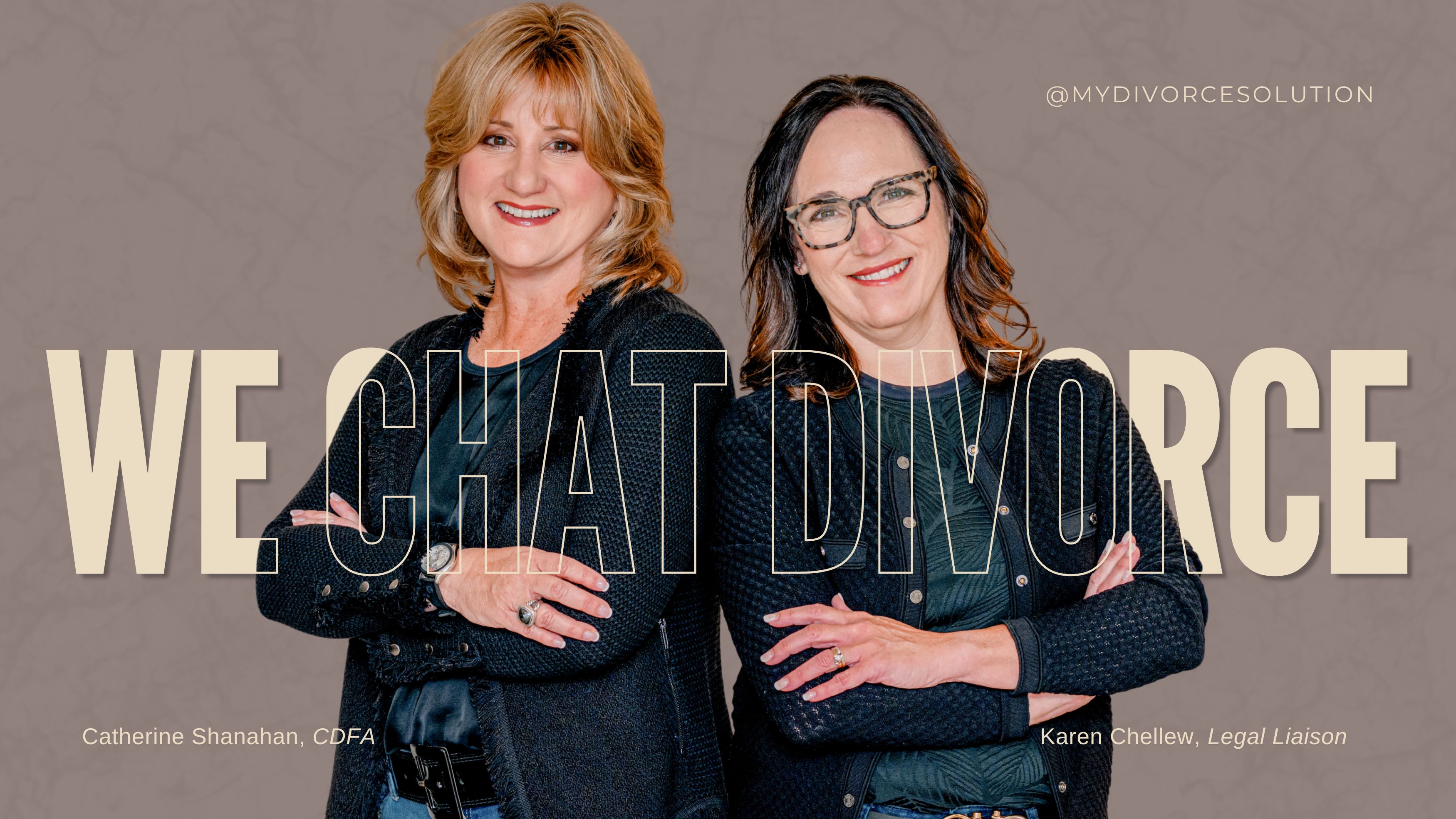
We Chat Divorce is produced by My Divorce Solution (MDS) — a financial divorce preparation company dedicated to helping individuals navigate divorce with clarity, confidence, and a strategic financial plan. Founded by Karen Chellew, Legal Liaison, and Catherine Shanahan, Certified Divorce Financial Analyst (CDFA), MDS was created to solve one of the most common and costly mistakes in divorce: entering the legal process without fully understanding your financial picture.
Divorce is not just a legal event — it is a financial transition that can shape your long-term security. Through the MDS Divorce Financial Portrait™, clients receive expert financial analysis, organized financial disclosures, and scenario planning to understand how different settlement decisions impact their future. This financial preparation often reduces legal fees, shortens the divorce process, and helps individuals negotiate from a position of knowledge rather than fear.
If you are considering divorce or already in the process, you can begin by taking the Free Divorce Financial Assessment to better understand your options. You can also join the MDS Community for expert guidance, educational resources, and live Q&A events designed to help you move from uncertainty to clarity.
At My Divorce Solution, the mission is simple: replace fear with knowledge so you can make informed, confident financial decisions during divorce.
Episode Transcript
0:01
Welcome to WeChat Divorce, hosted by Karen Chellew, Legal Liaison and Catherine Shanahan, CDFA.
Each episode we sit down with divorce professionals and industry experts to provide insights and frank discussions about real people, real situations, and real divorce to help you achieve your best life post divorce.
0:39
Welcome to WeChat Divorce, brought to you by My Divorce Solution and hosted by myself, Karen Chellew, Legal Liaison, and Catherine Shanahan, Divorce Financial Specialist and CDFA.
On these explainer episodes, we answer the top questions about divorce, giving you confidence and clarity.
0:57
You know, Karen, today we’re going to talk about what seems confusing and complicated during a divorce, which is property division.
And then, you know, I can only go back to even my own divorce.
You know, don’t we want it all?
Like when attorneys say to you, what do you want?
I always want to say, OK, well, I want it all right.
1:14
Or some people say I just want out of this so I don’t care.
Oh yes, that’s true too.
You can have her call because I want out.
Absolutely.
And I had a call from a a spouse just recently after the divorce to say I said she could have it all.
1:30
But what does that mean to me now?
Yeah, it’s an emotion.
Like when do you reconcile the emotions with the financial impact?
Yep.
So you might be thinking what happens to your home or your savings or even your retirement in divorce, because a lot of times that’s a big one, people say it was my retirement, it’s in my name, my employer won’t give it to you.
1:53
So do you think that’s true or is it not true?
Does it all get split down the middle?
Well, it’s really not that simple.
The answer depends on where you live and how the law defines what’s yours, mine, and ours.
So in this episode, we’ll untangle the complexities of what it means to live in a Community property state versus an equitable distribution state.
2:13
How to separate what’s considered marital property from separate property, which is a big one because everyone has a different opinion about that and how to handle those tricky high valued assets like businesses, stock options and retirement accounts.
All in 15 minutes.
So if you can get one thing out of this 15 minute episode, I know what I would say.
2:36
But Karen, what would you say?
That you know that there are ways to think through things so you can understand where to spend your money on the knowns and the unknowns.
That’s what I would like people to get from this.
How about you?
Oh.
My gosh, I think I’m going to have to agree with you on that one.
2:55
Awesome.
So, you know, because we often and a lot of our clients believe that financial clarity is knowing down to the penny what you’re going to get.
But actually we all understand that financial clarity is understanding what’s on the table, what is known, what is the unknown, where you want to invest in untangling the unknowns.
3:16
And when you can make a clear decision, knowing that things may be left on the table or not, you can fight to the bitter end as well.
Absolutely.
And also knowing what’s marital and not marital because I don’t know, maybe the two of you want to agree that a non marital asset is going to be divided because of a family arrangement the two of you had.
3:35
And that’s OK.
It can, you can go off the charts and come to your own agreement as well.
But let’s start with Community property and equitable distribution.
What’s the difference between the two and Community property states?
You know, there’s only nine of them.
So most states are equitable distribution states.
3:51
But let’s talk about Karen, the differences.
Yeah.
And I think the differences are becoming less and less, you know, especially in states like California and Texas, while they are Community property states, there a term has come in that we hear often all the time what’s just and fair.
4:08
The courts are always looking to be just and fair.
And so if you can demonstrate on a variety of levels what’s just and fair, it can affect that split of marital assets.
You’re right.
And equitable distribution states it just means that fare is not always equal.
4:25
So the division can be based on various factors and I think the difference between the two of them is or not not the difference.
But the most important thing about the two of them is understand where that cut off comes of what’s marital and not marital.
Yeah.
You know I mean 50. 5050 it doesn’t mean what most people think. 5050 is what in whatever type of state you’re in, right?
4:50
That’s true too, yes.
You know, I, I think what you’re saying is, you know, a lot of times we see somebody take all of their property statement and their financial portrait and they just want to split every account 5050.
Well, maybe that’s not the right way to do it because different assets have different value.
5:09
And when you’re doing your overall global agreement, you also want to divide these assets with with ease, right?
For example, the retirement accounts, yes, you can split 5050, but first you should reconcile the difference in the values because maybe you can keep all in one name and all in the other name except for one account.
5:27
Maybe that account needs to be used to reconcile to get to a 5050 division.
And your spouse and your team and you may be ready to go to mediation way sooner than your financial understanding is ready to go.
So knowing these things is really important because you know you’re going to mediation to settle and if you don’t know this information or if you don’t have this documentation to divide 5050 or 5545, whatever you’re working towards, you’re going to be settling and not understanding financial impact.
6:01
It’s just so.
Yeah, ’cause you get that pressure, right?
I spoke to a client yesterday, a past client of ours, and she took her portrait and went to the attorney who is going to be drafting their marital settlement agreement.
And the attorney was blown away by the portrait because she every question she had was answered in a footnote or in the recommendations and considerations.
6:26
And the client, our client said she felt so impact.
So what did she say?
She said so felt so good about herself for being so organized.
They got their appointment done in 45 minutes.
The attorney couldn’t believe it, but they didn’t have any questions.
6:43
She was able to move forward.
And she feels like that was a luxury.
The client felt like she had such a luxury to go in someplace feeling prepared.
And I said, that’s such the such a compliment to the MD’s method because watching our clients go from feeling so unempowered and so in the dark about some things to go into an attorney’s office and direct that call, that’s the way it’s supposed to be.
7:06
These attorneys are working for the client, but they can only work for you if you are prepared with all of the information.
And this attorney was so thrilled because she could just be an attorney and do her work because she had all the information she needed, even the table of contents.
I think this is the first time for me that I heard an attorney say to a client, it was so nice seeing the table of contents.
7:26
I knew exactly what you had in this portrait.
A lot of times I get things dumped on my desk and I don’t even know where to find anything.
That’s great, that’s awesome, and if we could get more attorneys, mediators, and divorce professionals to adopt the MD’s method, you know, it really can be a game changer in any divorce.
7:47
You know, I think the only way to get them to adopt is to educate the people going through the process, let them know they were in control and you going with this, this information organized and knowing your scenarios, different scenarios and knowing the impact of that, you’re going to be able to direct the course of your process.
8:06
Yeah.
All right.
Let’s define what’s yours and what’s mine.
Marital versus separate assets.
So marital assets are assets acquired during the marriage regardless of whose name is on the title, right?
So some states vary in assets that are owned premarital and what value could be attributable to marital property post, you know, in the divorce process.
8:30
That’s a nuance of course, but these are examples, you know, homes, joint savings, vehicle, vehicles, earned income, if they’re acquired during the marriage, their marital property.
There are some nuances, of course, if they come through an inheritance or gifts in some states as well, defining separate assets, assets owned prior to the marriage.
8:51
Some states, I’m going to say inheritance, but some states include inheritance as divisible property.
Believe it or not, most states do not.
Or gifts specifically designated for one spouse.
That’s what I was saying before, how commingling shared bank accounts can blur the lines between marital and separate property.
9:11
You can talk about that, Catherine, for sure.
Yeah.
And that’s a mess because what happens is you have premarital monies depending on what type of account it is in, if it’s in the stock market, OK, how do we determine what the growth of that portion is?
Because you’re adding earned income, for example, that’s marital during your marriage.
9:31
So how many shares did that buy in that account and what was the growth?
What’s the cost basis of that?
It can become a mess.
So you really have to be clear.
And I wish when you got married, people understood to keep your separate accounts separate and do not commingle any earned income or any other accounts, whether or not you’re getting divorced.
9:50
It’s always good to keep that separate just so you’re clear.
And if I take this money out to spend on a vacation for the two of you, you’re doing that because you want to, but you’re using money that would never be considered marital to do that.
That’s a healthy conversation to have when you’re getting married.
10:06
A lot of people think, oh, that just means we’re preparing for divorce.
Actually, it’s you preparing to stay married, honestly.
You know, can I bring up a, you know, if you know me, you know, I like reality TV.
I know it’s not real.
So you don’t have to call me and tell me that.
10:22
I’m gonna call you right after this episode.
I think Karen, I forced you to watch when you when you were in.
Jail.
OK.
I think I saw you watching more than you would tell anyone else you watched.
But anyway, regardless, and I think there are a lot of husbands are out there like that too.
They say they’re not watching, but they’re watching alongside their wives.
10:41
We’re watching with.
Seriously.
I watched OK can I say it was Wags, Wags to riches.
And it’s about famous athletes and their spouses or soon to be spouses who are also entrepreneurs on their own.
11:01
They don’t don’t just rely on the athlete to supply their income and so forth.
And there is one woman who’s very successful and her fiance, he’s a retired athlete who I know, I don’t know him personally, but I know him from watching him.
They were on there and they seem to have been, you know, you see them with their kids, you know, Co Co blended family.
11:22
They’re not married yet.
They’re engaged.
But they everything looked nice.
The way they communicate with each other.
They actually meet with their pastor to just do counseling to have healthy communication.
And I, I said, wow, that’s pretty good.
Well, Fast forward to another episode.
They are having lunch, dinner with their attorneys because they want to discuss a prenup.
11:42
They want their prenup in place before they go ahead and get married.
And you, I was mortified by the attorneys.
The attorneys acted as if they were the spouses getting married.
Her attorney at one point even said, well then we’re not getting married.
11:59
She actually said that, well then we’re not getting married.
This is not going to happen because they were talking about percentage.
If they were to get divorced, what percentage would each get of each other’s business?
Who started the business before they even got involved in relationship?
It became so ugly that I was sitting there.
12:15
If I would have had a dial in number, I would have been calling out those attorneys.
They became arrogant, they became aggressive and the other two parties are just sitting there and I don’t even think they’re getting married now.
I don’t really know.
I don’t follow them, but they, these two attorneys actually I think broke up this relationship.
12:32
If if that couple would have came to our process like some other, you know, we have other very wealthy people in the whatever industry that come to talk about a prenup and then go get their portrait because they get to have a healthy conversation.
12:49
Or what do you what are your expectations here are mine?
OK, let’s talk it out.
These two didn’t even talk.
And then when they come to an agreement, take that healthy financial conversation and what you 2 are attending and then get your attorneys involved.
I know.
Because you understand the financial impact versus someone feeling like they’re being hired to protect you from yourself, right?
13:15
Instead of creating an arrangement that both spouses are hoping to get.
So, you know, we want to do it this way.
What’s the financial impact?
I believe from what I’m listening to you, the attorneys are taking the position, no, you hired me.
I’m not going to let you do that because my job is to protect you from yourself.
13:33
But but I do agree they need to protect them.
Right?
But why not?
The two parties need to understand what they want in their relationship.
And I think This is why prenups, This is why prenups get such a bad rap because the attorneys were approaching this as if they’re already divorcing.
13:53
It sounded like a divorce instead of let’s see what you 2 are intending.
They barely even let the two parties talk.
I was very uncomfortable.
I really wish I could talk to that couple.
That is not how you should get a prenup.
And and you know, we see it all the time.
Even if you’re thinking divorce, I’m sure there’s large percentage of marriages that everyone at some point thinks divorce, right?
14:15
Long term marriages.
But a lot of times if you come and have a healthy financial conversation, it resets everything in your marriage and resets I, I believe, because the finances trickle into every part of your relationship.
So, but but I think having that space where people can come this, you know, that’s why I love the portrait.
14:33
You can use it for a post, not prenup or if you just want to have a healthy conversation with your spouse.
I know I went.
Off on a but that was important honestly, because you know some people do reconcile during our process as well and they say, well wait, do I need the portrait?
14:50
You absolutely need the portrait, right?
Because this finds your pathway moving forward.
You’ve got to us because you weren’t clear.
Let’s get clear and move forward.
I think you’re meeting with someone today that reconciled.
Oh, good.
But again, you know, it brings me back to this defining what separate assets are, right?
15:09
So we’ve had couples come through our process that, you know, they may have invested in real estate with a family member or with a friend and they don’t those those properties are not really deeded to them.
So they’re not considered marital money, right?
So, but if the parties know that, know that they did that and their intent is that whatever happens, whether it’s marital or not, we’re splitting it.
15:33
If you have two attorneys are talking about that, they’re going to talk them right out of that.
You know, they’re going to say, no, that’s not marital.
You don’t have to agree to that.
And this is another example is when the two attorneys come to the table and start doing all the talking for you.
And if you don’t have the clarity to tell your attorney what your intentions are, then they’re going to, this is going to be a runaway train.
15:52
You know, it’s going to be what the attorneys are saying and they’re going to interpret what you’re saying differently or deliver what you’re thinking differently unless you have your own voice.
And you can’t do that until you’re financially clear.
Yeah.
And it takes time.
You can’t get financially clear in two days just just saying or even.
16:12
All right, let’s get on to handling complex assets.
So in property division, even when some people think that their asset division is fairly straightforward or if they think it’s very complex, it’s still important that you know, the components of, you know, how do how do you divide a business and divorce, what’s marital?
16:33
Are there separate components to it?
Stock options, retirement accounts, you know, a lot of discussion and money gets spent in these spaces a lot of times because forensics are brought in too soon or you don’t have the documentation to support the stock options or a whole host of things.
16:54
Again, getting clarity on these assets and support it with documentation, then you can decide how those are valued.
Totally.
And the the importance of knowing what we spoke about earlier that date of separation, that date that the assets are being divided is really important when it even comes to the stock options, if I could just pick out one of the three that you mentioned.
17:16
But the stock options, you know, it’s not uncommon that the party who receives those equity awards will ask for a divorce prior to a granted to the day that it’s granted because in some states it goes by the date it’s granted and others go by the date it’s vested.
17:31
So it’s really important to know that before you agree to a data separation.
I love that and it’s important that you have the proper documentation.
So many times we see attorneys just accepting what the person who’s receiving these stock options, what they say the value is, and they just go with it.
17:52
How many times have we had to help attorneys write subpoenas for the specific information needed to value these assets and you have to wait for the subpoena response?
Exactly.
So thank you for joining us on this episode of Understanding Property Division.
18:07
What’s yours, mine and ours.
And if you take away anything, I hope you’re taking away that.
It’s really important to know your data separation, to understand what’s marital and not marital.
And don’t be afraid to ask those questions and don’t be afraid to have conversations with your spouse.
Just don’t agree to anything until you’re really clear.
18:24
So if you have any comments or you have anything that you want us to talk about, please send those over to us.
We’d be happy to entertain whatever you’re thinking.
Stay tuned for more future episodes as we continue to unravel the fascinating world of finance and divorce.
And remember, knowledge is power.
18:40
Disclaimer The information provided in this podcast is for educational and informational purposes only and should not be considered as financial or legal advice.
Please consult with professionals in the relevant fields for personalized guidance.
Thanks for joining us on another episode of WeChat Divorce.
18:59
We hope this episode was informative and supportive on your divorce journey.
If you're looking for more support for navigating divorce with confidence and clarity, head over to azure-emu-499854.hostingersite.com/ for more podcast episodes, divorce events, and resources for your divorce.
19:17
We’ll see you back here for our next episode.