






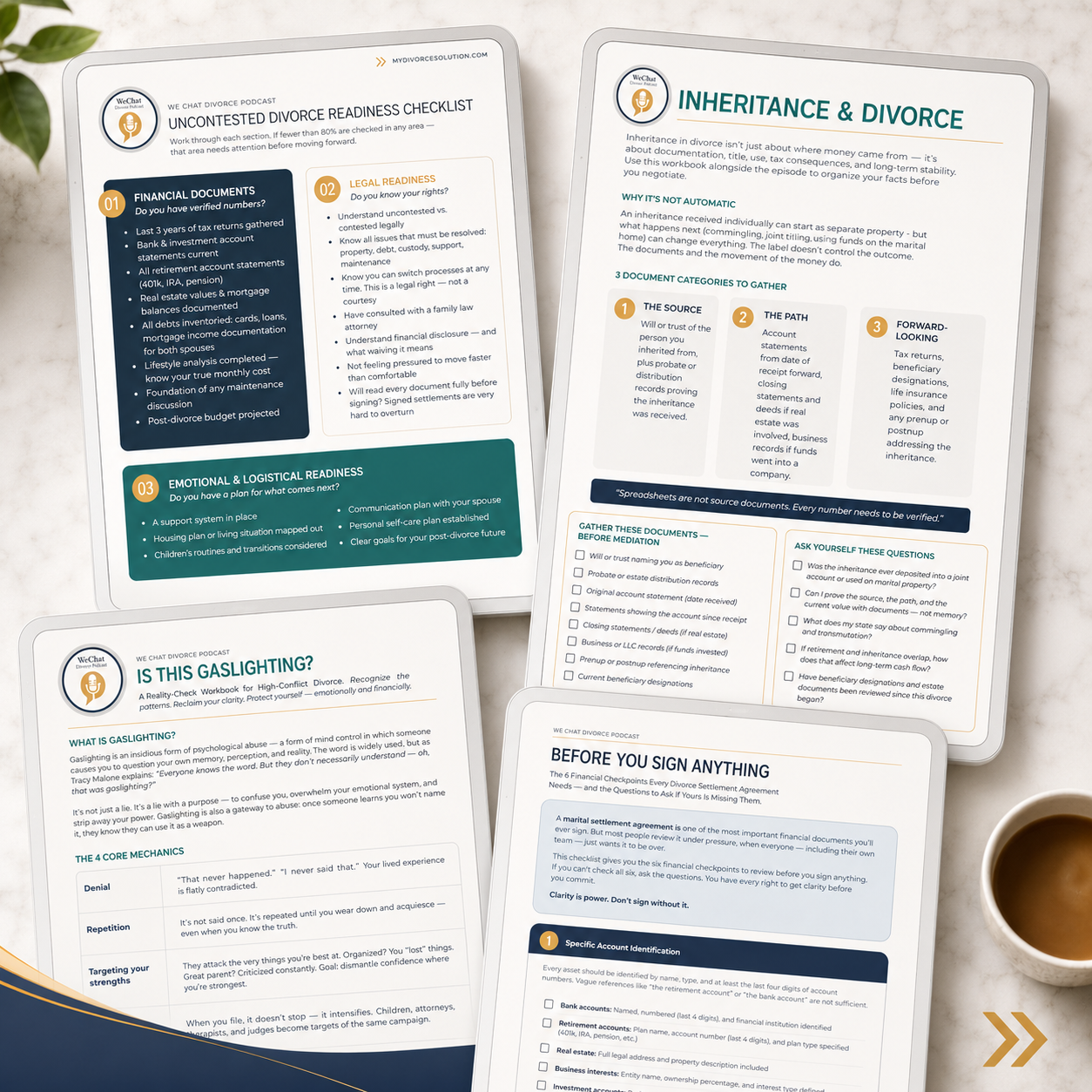
Download The Uncontested Divorce Readiness Checklist
A step-by-step guide to knowing whether you’re financially and legally ready to pursue an uncontested process.
By submitting this form, you agree to receive communications from My Divorce Solution. Your information is confidential and protected.
Uncontested vs. Contested Divorce: What Every Divorcing Person Needs to Know Before They Choose
When you imagine your divorce, chances are you’re hoping for something manageable — civil, even. The idea of an uncontested divorce sounds like the answer. No courtroom drama, no drawn-out litigation, no judge deciding your future for you.
But here’s what most people don’t know: uncontested divorce isn’t just a mindset. It’s a legal framework that requires specific conditions to work — chief among them, genuine financial clarity.
In this episode of We Chat Divorce, hosts Karen Chellew and Catherine Shanahan sat down with Renee Turner, family and matrimonial attorney and founder of Thoughtful Lawyering in New York, to break down the real differences between contested and uncontested divorce — what each involves legally, what it means for your children, and how financial preparation determines which option is actually available to you.
What Is an Uncontested Divorce? (And What It Actually Requires)
In legal terms, an uncontested divorce means both spouses have reached agreement on all major issues without a judge being asked to resolve disputes. In New York, where Renee practices, those issues include:
- Property division (marital assets and debts)
- Child custody — both physical custody and legal custody
- Child support
- Maintenance (New York’s term for spousal support or alimony)
- Parenting time arrangements
When all of those issues are settled by agreement, the divorce proceeds through the court system with minimal judicial involvement. The judge reviews and approves, but doesn’t decide. That’s a meaningful difference.
Renee typically negotiates the marital settlement agreement — the legal document memorializing all those terms — before officially filing the divorce action. This keeps the process out of the adversarial court system for as long as possible, reducing both cost and conflict.
Contested Divorce: When Agreement Isn’t Reached
A contested divorce means one or more of those major issues cannot be resolved by agreement — and a judge must step in to decide. This triggers a formal legal process that includes:
- Formal discovery (requiring the other side to produce documents and answer questions)
- Motion practice (filing legal requests with the court)
- Hearings before a judge — often scheduled months apart
- The possibility of a trial if no agreement is ever reached
Renee described cases in New York’s crowded court system that took years to resolve simply because of scheduling — judges with full dockets, months between hearings, and one side consistently failing to produce required documents.
That’s not a system designed for your timeline, your children, or your wallet.
The Financial Disclosure Question — And Why It Matters More Than You Think
One of the most important parts of this conversation was the discussion of financial disclosure — and the risks of waiving it.
In New York’s uncontested process, there is no automatic requirement for a formal Statement of Net Worth (the document that lays out each party’s assets, income, debts, and expenses). Parties can, in theory, waive full financial disclosure — as long as both people confirm they understand what they’re giving up.
Renee is clear about her position: she still requests full disclosure. “I believe in transparency,” she said. “At minimum, I want to see tax returns. There has to be some financial documentation so I can advise my client on what is actually beneficial.”
Catherine echoed this from the financial planning side: “We have so many people come through who say, ‘I know what we have.’ And then when we start the work — probably 90% of the time — there are nuances or facts they hadn’t even considered.”
The point is simple but critical: you only know what you know until someone starts unpacking it with you. Entering an uncontested divorce without a verified financial picture isn’t just risky — it may mean you’re agreeing to terms based on incomplete information.
New York’s Maintenance Cap — And Why It’s Not the End of the Story
Maintenance in New York — what most people know as alimony or spousal support — is calculated using a formula that includes a statutory cap on income. That cap can feel deeply unfair if you were married to a high earner or spent years out of the workforce raising children.
But Renee explained something important: the cap is not a ceiling that applies in all cases.
“Judges have discretion,” she said. “And if you’re in an uncontested process — negotiating with attorneys or through mediation — you can discuss the fact that the income exceeds the cap, and that the standard of living during the marriage was based on that higher income. So the maintenance amount can be negotiated above the cap.”
That negotiation is informed — and strengthened — by lifestyle analysis. Both Renee and Catherine described the value of completing a detailed lifestyle analysis: reviewing how much it actually costs to live the life you’ve been living, then building a forward-looking budget for the life you’re transitioning into.
“It’s always an eye-opening experience,” Catherine said. “It’s the first step we take with our clients.”
Can You Switch From Uncontested to Contested (or Back)?
Yes. And this is one of the most empowering things you can understand about your divorce.
“There’s always the option to convert to a contested process,” Renee confirmed. “You’re not stuck in it.”
Both Karen and Renee highlighted a common fear: clients who feel pressured to continue in an uncontested process — even when they’re uncomfortable — because they worry about upsetting their attorney. Months of work have been done. An agreement seems close. Who wants to start over?
But Renee was direct: “You need to ask yourself if you’re making a knowing, voluntary, and informed decision about waiving your rights. If you’re not comfortable that you have all the information you need to make that decision — that’s when you have to question whether this is the right process for you.”
And if an attorney pushes back on switching — ask them why. Is it based on a genuine legal assessment of your chances? Or is it convenience? You deserve an honest answer.
The Document You Should Never Sign Under Pressure
The marital settlement agreement is, in many ways, the most important document in your divorce. It defines the terms of the rest of your financial life. And yet Renee has seen clients sign it without fully reading or understanding it.
“Before you sign anything — even if your attorney says, ‘just sign it’ — don’t just sign it,” she said. “You have to read it and understand it. Because once you’re out of the process, it is really hard to go back to a judge and say you didn’t understand what you were signing — when you had an attorney who was supposed to explain it to you.”
Karen underscored the pattern she sees from the financial side: clients handed documents late, asked to sign the same day, exhausted and ready to be done. Fatigue is a real danger in divorce negotiations. The pressure to be finished is real. But so are the long-term financial consequences of an agreement you didn’t fully understand.
How the Uncontested Process Protects Your Children
One of the most significant — and underappreciated — benefits of an uncontested divorce is what it means for your children.
In New York, when a divorce becomes contested and children are involved, the court often assigns an attorney specifically for the children. That attorney is required to meet with the children, regardless of their age.
“It forces your children to now be a part of your divorce,” Renee said. “When it’s uncontested, there is not that extra layer of having an attorney for your child.”
There’s also the matter of who decides custody. A judge who doesn’t know your family — their dynamics, their routines, their needs — is being asked to make decisions that will shape your children’s lives for years.
“Divorce is not what messes your kids up,” Catherine said. “It’s how both parties behave before, during, and after divorce that can mess your kids up.” The uncontested process creates an environment where parents can negotiate parenting arrangements together, with the children’s best interests at the center.
You Are the Employer — Of Every Professional You Hire
Perhaps the most important thread running through this entire conversation: you are in charge. Your attorney works for you. Your financial analyst works for you. Your mediator works for you.
“When you’ve employed an attorney, you are the employer,” Renee said. “You’re paying them. If you have questions and doubts, you need to ask the questions. And if you’re not comfortable with the answers, you need to consider whether or not you need to change attorneys.”
Asking questions isn’t questioning someone’s competence. It means you don’t yet have the clarity to make a permanent decision — and that’s not just okay, it’s essential.
How Financial Clarity Changes the Conversation
The entire episode circles back to one theme: preparation transforms your position in any divorce process. When you understand your finances — verified, documented, clearly laid out — you can negotiate from knowledge instead of fear.
Catherine described what happens when clients come through the MDS Financial Portrait process before sitting down with their attorneys: “Your attorney can look at that and say, ‘Now legally, this is the strategy I recommend.’ It’s a whole different conversation.”
Renee agreed: “I’m not a financial expert — but I can bring in a financial expert to help explain the finances to my client, so that they’re clear about what they have and what they’re giving up.”
The Bottom Line
Uncontested divorce is a powerful option — but only when you’re prepared for it. That preparation is financial, legal, and emotional. It means knowing what you have, understanding what you’d be giving up, and entering negotiations with verified information rather than assumptions.
It means knowing you can switch paths if something doesn’t feel right. It means never signing something you don’t understand. And it means approaching every professional in your divorce the way you’d approach any employer-employee relationship: with questions, expectations, and the confidence that comes from being informed.
Knowledge isn’t just power in divorce. It’s everything.