

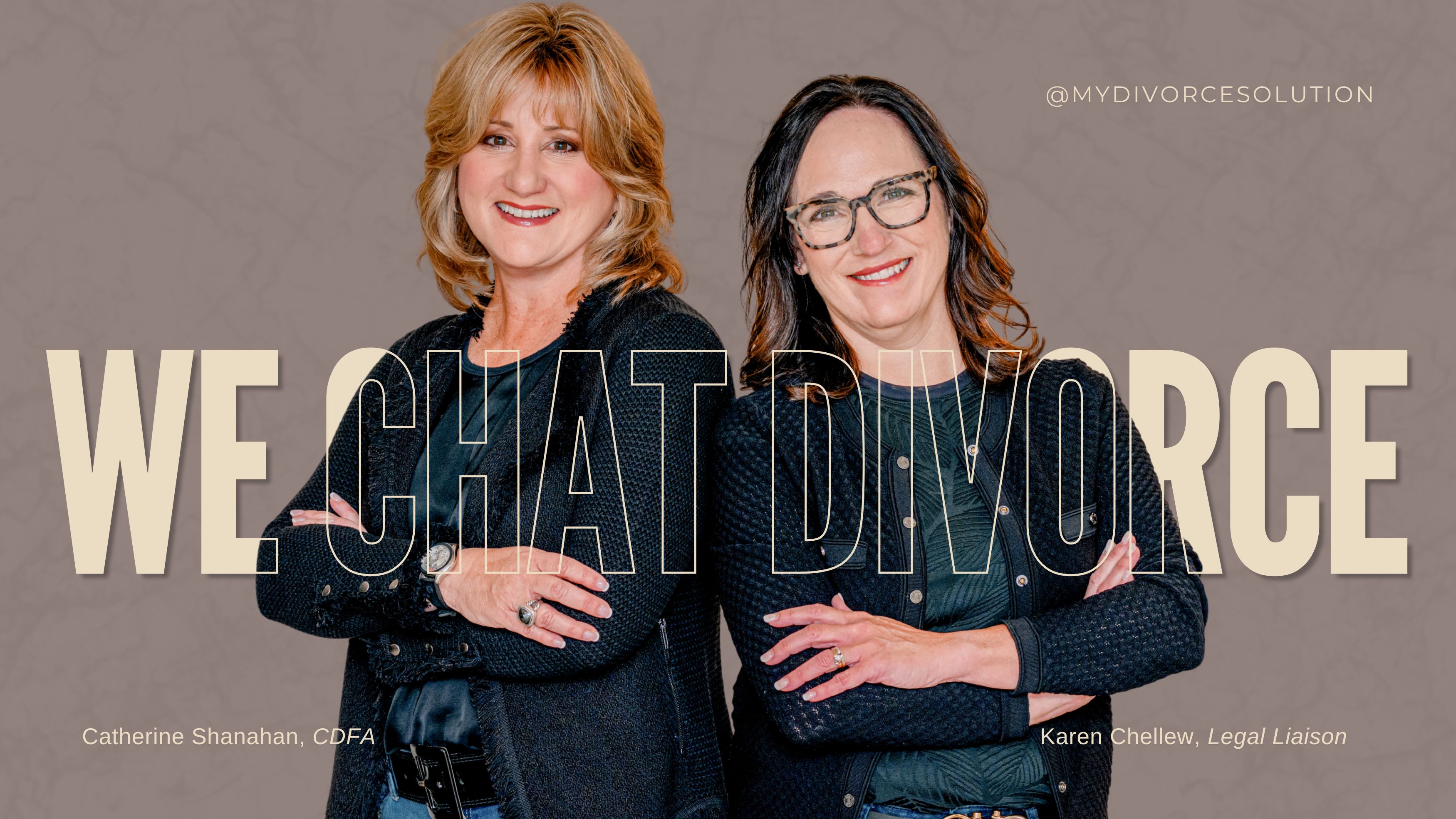

In this episode of We Chat Divorce, hosts Karen Chellew and Catherine Shanahan welcome back attorney Elise Buie, founder and CEO of one of the top virtual-first law firms in the U.S. Together, they pull back the curtain on the realities of mediation—the good, the bad, and the ugly.
Mediation is often seen as the ideal path to an amicable divorce, but as Elise explains, there’s more to it than meets the eye. This candid conversation dives into:
- The misconceptions about mediation and why it’s not about someone else making decisions for you.
- How preparation—emotionally, financially, and legally—is key to a successful mediation process.
- Why some attorneys fail their clients during mediation by neglecting critical details like financial disclosures and tax implications.
- The dangers of being bullied into agreements and how to avoid mediation regret.
- The importance of managing expectations and knowing your “lines in the sand.”
Elise’s no-nonsense approach sheds light on how attorneys can better advocate for their clients, the necessity of financial clarity, and the role of compromise in mediation. Catherine and Karen add their own insights, highlighting how the Divorce Financial Portrait™ provides invaluable preparation for mediation by offering a clear view of assets, debts, and long-term financial impacts.
Whether you’re contemplating mediation or already in the thick of it, this episode will equip you with the knowledge and confidence to navigate the process effectively.
About My Divorce Solution
We Chat Divorce is produced by My Divorce Solution (MDS) — a financial divorce preparation company dedicated to helping individuals navigate divorce with clarity, confidence, and a strategic financial plan. Founded by Karen Chellew, Legal Liaison, and Catherine Shanahan, Certified Divorce Financial Analyst (CDFA), MDS was created to solve one of the most common and costly mistakes in divorce: entering the legal process without fully understanding your financial picture.
Divorce is not just a legal event — it is a financial transition that can shape your long-term security. Through the MDS Divorce Financial Portrait™, clients receive expert financial analysis, organized financial disclosures, and scenario planning to understand how different settlement decisions impact their future. This financial preparation often reduces legal fees, shortens the divorce process, and helps individuals negotiate from a position of knowledge rather than fear.
If you are considering divorce or already in the process, you can begin by taking the Free Divorce Financial Assessment to better understand your options. You can also join the MDS Community for expert guidance, educational resources, and live Q&A events designed to help you move from uncertainty to clarity.
At My Divorce Solution, the mission is simple: replace fear with knowledge so you can make informed, confident financial decisions during divorce.
Episode Transcript
0:01
Welcome to WeChat Divorce, hosted by Karen Chalou, Legal Liaison and Catherine Shanahan, CDFA.
Each episode we sit down with divorce professionals and industry experts to provide insights and frank discussions about real people, real situations, and real divorce to help you achieve your best life post divorce.
0:39
Welcome to WeChat divorce.
Catherine and I are so happy to welcome back attorney Elise Bui to our podcast.
I’m really looking forward to our conversation.
It’s.
Just.
Palpable in the divorce world.
In this episode, we’re going to talk about the good, bad and ugly of mediation.
0:59
Mediation is in a trending of the end all be all when divorcing.
And we’re going to unpack that and break that down.
But first, let me just take a couple minutes to introduce Attorney Bowie.
Elise is the founder and CEO of one of the top virtual first law firms in America.
1:19
Congratulations Elise on that.
That’s really truly amazing.
She began her legal career as a federal judicial law clerk to the Honorable Stanwood R Duvall Junior of the Eastern District of Louisiana.
After undergoing divorce and becoming a single mom, Elise Bui made it her mission to advocate for other women through practicing family law and building one of the most successful virtual first law firms in America.
1:47
Welcome, Elise.
Thanks so much for having me.
I appreciate it.
I love talking about mediation too.
That’ll be fun.
Yeah.
I love having a lawyer on who will call out the system on how it works, so this will be a fun juicy conversation.
Yeah, you are a force for sure, Elise.
2:04
So, Elise, I love this quote of yours.
I think I bring it up in every one of our conversations, but it really resonates with me and especially when I think about you and all that you do for so many people.
You say I’ve been in your shoes and I know that divorce can be scary shit.
2:22
It’s OK not to be OK Divorce is an ending and a beginning, the beginning of a new chapter filled with second chances to live your best life.
And this is just you all the way around.
And so I just like to say that quote when we have you on as a guest.
2:40
Yeah, well, it’s so true.
I mean, I think about as an attorney, people come to us and they’re so upset and it, it’s always the traumatic part of the divorce.
And I’m like, let’s think about the transformation part of the divorce.
We’re really on the other side.
2:56
You do get to live your best life.
And I think to your topic about mediation, mediation is that bridge between the two.
And sometimes people end up on the other side with that, you know, not being thrilled with what happened in mediation.
So that’s something we have to navigate too, but it’s also transformational.
3:15
That’s so true.
You know, like I said, mediation is trending and I think a lot of people approach mediation or when they think mediation, it just means they’re going to streamline to a fair and equitable settlement, right?
There’s still people are going to figure it out for them and everything’s going to be transparent and there’s going to be, you know, everything being perfect except they’re not going to be fighting.
3:39
And I believe most people think that is the definition of mediation.
Well, I would not think of mediation as other people figuring it out for them.
Mediation is your chance to come in with your own agency and make decisions for your family that makes sense for your family and take it out of a judge’s hands so that somebody else is not making decisions for you.
4:04
So to me, mediation is such an empowering experience because you can walk away.
Like mediation is not a, you know, hostage process.
I mean, you sit there, you make decisions, and then you can leave and say.
4:19
No.
Well, you know, that’s that’s the true definition of it, right.
But I think what Karen’s bringing up is what we experienced, people don’t know that that’s the definition.
And often they feel bullied into making that decision there.
Or the, and I’ve witnessed attorneys bullying their own clients to settle because they say if you don’t sign today and this is after 10 hours, we’re going to trial for this and it’s going to cost much more money to do that, blah, blah, blah.
4:45
Or on the flip side, they actually do go to mediation and they come back and they say, oh, I thought the mediator was going to tell us what to do.
They don’t understand that’s not the definition of mediation.
So it’s a really good thing to talk about now.
So if you’re listening and you’re contemplating, it is not going there for someone to tell you what to do.
5:04
Not at all.
I mean you should be partnering with your attorney prior to mediation.
At least in my version I want to know what my clients very few and I mean one or two lines in the sand.
5:19
Like, I don’t let a client come in with a whole list of lines in the sand because it won’t work.
I mean, but they can have, I mean solidly one line in the sand for sure, maybe 2, you know, one on the parenting side, one on the financial side.
And then they must be open minded.
5:37
They must come in curious.
They must come in empowered with all the information though.
That is the key.
So that they know what are they walking away from, what are they walking towards if they choose a trial.
5:52
Because when you have somebody who’s like it, we live in Washington and so Washington is a Community property state.
And you might have somebody who’s like, well, I think I deserve 70% of the property because, you know, I work the whole time in the marriage.
And I’m like, dude, I can assure you if you go to court, unless you’ve got some brilliant reason that I don’t know yet as to why you should get 70% of the property.
6:16
Like you’re dying of cancer and your $1,000,000 job is about to be gone tomorrow maybe.
But you know, it’s going to have to be pretty dramatic.
And we probably should have had an expert before that to figure that out.
And so people need to know the reality of what court is.
6:32
So when a lawyer is bullying, bullying their client into settling, I see that as a lawyer not doing their job on the front end, developing those expectations of what is likely in trial.
Because I think of the mediator as a partner in helping the client understand objectively what’s going to likely happen in trial.
6:56
So they don’t have to just look to me and they don’t have to look to whatever their spouse has thrown out.
Like, well, my lawyer says this, it’s like here is this neutral party that we agreed on, you know, we all respect.
And they’re telling you as well, this is a likely trial outcome and they’re confirming that trial is ridiculously expensive.
7:18
So so to go to trial, it had better be worth your money, you know.
What I mean, right, that’s why I love our portrait is because we go through different division scenarios so that they can go and sit there and know, you know, there’s there’s no here’s your options.
7:35
You know, you’re going to have to compromise somewhere.
Everybody compromises in mediation.
That’s what that’s what gets you to the end, end game, right.
So know where your comfort lies and what that impact will be for you.
And then I, you know, I just wish that everyone and would understand that that’s what mediation is, you know, and hopefully this podcast at Lisa outlines that at the very least.
7:56
Well, I was just going to say, the thought that anyone is telling somebody what they must do in mediation is such a misnomer because I don’t even feel like when my client says to me, Elise, what would you do?
I don’t feel comfortable ethically answering that.
8:14
Like I can tell them all the things I would consider all the questions I have.
Like, you know, how will this impact my family life?
How will this impact my finances short term, medium term, long term, You know, what is the impact on my ability to be able to get work moving forward?
8:31
All kinds of things.
I can analyze the questions, but I can’t tell them what I would do because what I would do is not necessarily what they would do, you know?
This is their decision.
Which is why, which, oh, sorry, Karen, I just just had one thing there is, which is why when people say, well, my sister said I should do this or my best friend told me to do this or they got that.
8:54
There’s no, it’s not one divorce for all.
I mean, everyone’s situation is different.
Completely.
So we have no small percentage of clients.
And tell me if you’ve experienced this to Elise where we’re just getting financial disclosures exchanged, many documents missing, and all of a sudden mediation is scheduled.
9:19
So everybody’s in full gear and we’re saying we’ll wait.
What about all this missing documentation?
Oh, that’s the purpose of mediation.
Instead of going back and forth and asking for documents, we’re going to go to mediation and we’re going to ask for documents.
I kid you not.
9:35
I kid you.
Not.
And then the next day we’ll say, OK, client, please don’t sign anything.
Whatever you do, don’t sign anything because we don’t have nobody has authority to Nix it, right?
They say you have to go.
So they come back and you know there’s an agreement on the table.
9:54
They want you to look at this agreement and and then move towards discovery.
I’m telling you Elise, it’s no small percentage.
We experience our clients experience it.
In every state.
In every state.
10:09
I mean, I hate to be so bold as to say this, and I mean my own malpractice insurer probably wants to plug their ears, but I mean, that is flat out malpractice.
Like you cannot go to mediation as an attorney in a case where there’s financial information missing and actually believe you can represent your client properly to make a decision.
10:35
I mean, because you don’t even know what you’re walking away from at all.
Exactly.
You don’t understand the tax implication of what you’re doing if you don’t have the I mean, that is a total no go in my world.
10:51
Like if we do now, I’m going to say we have clients who will say to us we do not want to do formal discovery.
You know, we have decided we do not want to do formal discovery.
We’ve done informal discovery like in our main county here in Washington.
11:06
I mean, we have a set slew of documents, financial documents that are required to be discovered.
And it’s kind of like, you know, everybody is going to share those no matter what, informally or formally.
So if we have all those and our client says they do not want to do formal discovery, I’m likely going to go along with that, assuming we don’t have some key things like a business, any type of potential of separate versus community tracing that we might have to do, you know, but I mean, if it’s literally just two W two people, each person has a four O 1K, they’ve been paid under W twos forever.
11:47
I’m fine to go to mediation with informal discovery and a signed letter from the client saying that they definitively instead they don’t want formal discovery, despite our explaining the risks of that.
Because I’m not worried that I’m sitting on, you know, some, you know, this person has been a startup of some, you know, Microsoft adjacent company that’s about to, you know, take off and be sold and be worth, you know, $50 million.
12:13
Like obviously I need to know that.
Yeah.
And you know the those same clients come back.
First of all, I’ve been on a call with you, Elise and one of our clients who had come to a negotiated settlement and they wanted to avoid formal discovery.
12:28
So I really appreciate that you brought to the table all of the not, not disclaimers, but all of the this.
You need to understand what you’re giving up when you when you do this.
And that is really important and we certainly adopt that.
But these clients are coming back from mediations and the attorneys are hostile because they’ll say, we spent six hours, we spent 10 hours on this mediation and now you want to think about it, It’s.
12:56
It’s.
It’s, I’m telling you, it’s prevalent in the divorce world.
It’s.
Actually sad, it’s actually sad and only because we’ve witnessed it so many times.
I just don’t understand how the attorneys get away with it, to be honest with you, kind of like what you’re saying, you know, you’re not, you’re not able to do your job if you’re going there looking for documents, how you even go into mediation?
13:18
And I love how you even say, I’m all for a limited scope discovery.
If if you have a case that warrants that, right.
But but how do you go there saying literally, let’s just use this time to collect because we’ll do our portrait and our portrait will outlay, you know, six major, major key items that are missing.
13:37
And to hear the attorneys say, well, let’s just, we still have mediation scheduled.
Let’s just use that time to get those documents or they come out of with agreements that say, OK, we agree.
Oh, this was a terrible one.
They they had.
So there should have been some reconciling of some retirement accounts to reduce some Quadros needed and some penalties needed for some a buyout information.
14:01
And the attorney actually wrote, because we, we gave her the considerations to take to mediation and the attorney says, oh, it’s too late.
We already agreed to that.
You could deal with your financial planners after this to move that money.
They can’t.
They’ll have to.
They would have to go back to court to change the order because a Quadro, you know, is going to be administrated like the order states.
14:22
I couldn’t believe it.
She tried to stop her attorney in mediation to say, wait, can I think about this?
I think we need to, you know, one of my options was condense them.
It’s too late.
You’ll deal with that later.
We’ll see in that.
I mean, it’s so interesting we’re discussing this.
14:37
I mean, when is this podcast coming out?
Hopefully it’s past my court hearing, but.
Well, we can arrange that.
But I mean, it is fascinating how many people, how many attorneys go to mediation One, they don’t understand taxes at all.
14:58
And they’ll be like, oh, well, I’ll agree that, you know, these four years of taxes that have not been paid, we’re going to split that.
I’m like, oh, really?
We’re going to split that based on what?
I’m like, you know, like, what are the taxes based on?
Are they, you know, just income tax?
15:14
Are they payroll taxes that haven’t gotten paid by said business owner who’s not my client?
You know what I mean?
Like we had that.
That’s insanity.
You can’t agree to that.
Like you don’t even know.
You could be agreeing to criminal liability without realizing it.
15:32
And so no, like no, no, no.
And then you have people who go in and they don’t understand the Quadro process or the actual, you know, like, what is the Quadro based on?
15:47
Like, is it a teacher retirement?
You know, like what is that plan’s availability?
And in Washington we have these things called the wax.
And so there’s rules about, you know, how things are divided or what it’s going to look like.
And there’s case law about it.
I mean, lawyers are like, woohoo, you know, they’re not even mentioning it in the settlement agreement.
16:08
How do?
They get away with that.
This is why I love having you on because you, you call this stuff out that I still want to say so many times, but I’m not a lawyer, but I just don’t under I, I say to Karen all the time.
How, how are they getting away with this Karen?
16:24
She, she had that same exact conversation with an attorney.
They wanted the wife to pay a set dollar amount of taxes that they were anticipating to be due.
But the tax return showed the husband doesn’t even pay that.
He’s not even in that tax bracket.
And when you brought Cameron, what happened with that?
16:41
So it was a situation where they split AK1 distribution from a a buyout of an equity ownership.
And so the stipulation, which if you saw it, it was handwritten, crossed out and then the judge signed it at the bottom.
16:57
You can’t, you couldn’t, you can’t even make heads in her tail of it.
But in any event, so it said that wife had to set aside X amount of dollars for her tax contribution.
And the attorneys insisted that she had to give that money to the spouse for payment irrespective of what the net tax obligation was going to be.
17:21
What?
Yes.
Yes.
That’s.
Her own attorney that was our client’s joint, our joint client’s attorney and we’re sitting there because we’re not the attorneys like.
Yeah.
I mean, what are we going to do That’s.
Just insanity like and one she would, I mean, you would want her to go to her own tax attorney and figure out, you know, because who knows who’s doing this?
17:43
Who knows?
Which we did, Elise, we presented that to the attorney.
This is the accounting.
And so I think some attorneys, to your point, are so disconnected from the financial impacts, they just defer and punt because they don’t know what to say.
18:04
They don’t understand it.
They don’t understand this part of the law.
And this is a common thing I have to tell you.
I mean, where you will have people, attorneys who will tell you I don’t know how to read a tax return.
And I’m like, oh, well, that is intriguing.
18:22
Obviously, we need to know how to read a tax return, all of the different kinds, you know?
And they’ll be like, oh, there’s an S Corp.
I don’t even know what that means.
And I’m like, huh, OK.
But I mean, that’s on, you know, us older attorneys when we’re hiring young attorneys and baby attorneys to train them up and make sure they’re going to trainings and understanding the financial part.
18:48
But also I have to be really honest understanding when you don’t know what you don’t know.
And that means you need help, you need an expert.
Like when somebody tells me, Oh, well, this person’s business is valued at this, I’m like, based on what?
Who came up with that?
19:03
They’re like, oh, the husband did.
I’m like, oh, that’s cute, real cute.
But no.
That doesn’t care.
That was that was nice of him.
Lovely for him to give us.
His thoughts and then we on our side, if the husband has the business and his counsel and we have the spouse or vice versa, it doesn’t matter, you know, immediately go hire a forensic, spend money on what?
19:29
What’s the scope?
Well, I don’t know.
Whatever they tell me to do.
And then it becomes comes a bookkeeping experience that, you know, clients 50,000 in and they’re just bookkeeping for a while until the documents come in and then by then you’re out of money.
But yeah, it’s, it’s crazy.
19:46
Oh, I think the financial part of divorce is like the wild, Wild West.
I just said that yesterday to my client.
I said you really need to recognize that family law is just an experience out of the Wild West.
20:05
There’s no.
To.
Me, that’s so sad because these are we’re talking about every 50% of the people in this world.
Like you don’t have a higher statistic than that because that just multiplies, right?
20:21
Because every 50% of every 50% of a person and their family.
And the fact that this is going on so long and, and I always get so frustrated when I hear an attorney say we want to change this.
And I’m thinking of the one in paternity in particular.
Well, if you want to change it, then, then change it.
20:37
Like you can act differently.
You know, you don’t have to bully your client.
You can.
You can learn how to read a tax return if that’s what you need to do, or you can get the appropriate help and respect the help that you’re getting and stop.
Bill, we, we.
Had one attorney who 100 grand in it for the client and there was a number of mistakes.
20:55
Something was wrong to the tune of $200,000 and until the client paid another X amount of dollars, she wouldn’t even get on professionally to talk about the mistake.
And it was her mistake.
She just wanted more money, more money to have the conversation.
And I said that to me is not an attorney changing it.
21:10
She already made 100 grand she can’t get on the call and that.
Well, and if it’s her mistake, like exactly that things have been billed by her that were in error, she likely owes a refund to the client for those errors.
And thus, I mean, that’s ridiculous.
21:28
Like you need to not only get on the call, but you need to make it right.
You need to figure out how that error happened.
What can you do to prevent it in the future?
Report it to your malpractice insurer because that on you like you know.
And this was something, this was a mediated agreement that we were just trying to align the numbers and we really just need the conversation and it really was just a wrong sentence put in the mediation agreement for this particular issue.
21:53
So it was their mistake.
We just need to take it out, right?
But she and she was telling her client she needed to sign or they’re going for trial.
Like she didn’t even want to explain it.
And then she withdrew from the case.
What she wants to withdraw.
I mean, this is, and this is just one attorney and there’s probably about 10 that I could talk to talk about right now.
22:12
And it’s, it’s upsetting to me because, you know, we like these attorneys.
They, they’re, they’re acting like they’re really going to do this, you know, and I mean, they just don’t have to follow through.
It falls off somewhere or it just goes into these mediated agreements and they’re over it, I feel like, and they want to come to an agreement.
22:31
That is a real thing.
That is a real thing when you get to mediation and you get a signed agreement in Washington, it’s called ACR 2A.
And then you have this whole thing of when you have to do your final orders and it is literally like the bane of everyone’s existence, getting the final orders.
22:51
But oftentimes that’s when you discover big holes where you’re like, whoopsie, we didn’t do this or we didn’t talk about this.
And in Washington that CR2A is a contract.
I mean, it is a signed contract.
Like, you know, to get out of it is a tough deal.
23:08
And it is.
That’s where I think a lot of the remorse comes from when if an attorney is honest and they go to their client and say, oh, we should have dealt with this or we should have dealt with this differently.
You know, then they’re looking at ACR 2A that has a problem.
23:27
And you know, you have to analyze the law.
And here in Washington, it’s, you know, very high standard on fraud, you know, duress, like it’s hard standard to flip that into, you know, get it, get it taken out or get it chained, edited in any way.
23:47
And so I think to your point of people being bullied at the end of a day, like that to me is its own level of thing.
When you are mediating way late, you know, and it’s been a really long day, it is risky, of course, to leave that mediation without a signed agreement.
24:03
I mean, because all kinds of things can happen in the interim, but you also have to really question whether your client is up to making that decision.
And if you are encouraging your client to make a decision that you know good and well mentally and emotionally, they are not in a place to make, to me, you’re not being a counselor at law.
24:24
I mean, you’re actually being a bully.
Yeah.
Well, and that would presume Elise, that you walked into that mediation with all the documentation and information necessary to for your client to make a decision in the 1st place completely right.
24:41
So.
Not only having all the documents, having had conversations with the attorney prior to mediation because prior to even, I mean, we write mediation statements, you know, days in advance of a mediation.
So I mean, we have sat down and had conversation after conversation to get those bottom line in the sand.
25:01
You know, what are our non negotiables that and like I said, I mean they are so few.
Like I just don’t let people go in with huge amounts of non negotiables because if you come in with a list of non negotiables, you’re not ready to mediate.
Like you are not in a place where you understand mediation.
25:20
So we’re literally wasting everybody’s time and money.
And so until you can come in understanding that that you should have one or two things, the other side’s going to have one or two things and the rest is up for grabs.
And we’re going to be, you know, negotiating and giving in and making adjustments, but you must know the the dynamic of what everything is involved.
25:47
It’d almost be like creating a parenting plan with children that are you don’t know.
So you don’t even know.
Like, I don’t know whether that kid would do great with, you know, week on week off.
Like maybe they got a ton of special needs.
This would be a disaster.
Like how do?
You.
26:02
That’s it, yeah.
And that’s how those $200,000 mistakes get made because it gets lost in the whole day of a figuring out what the, what the IT is.
I always call it, we got to know what the IT is.
And then negotiating off of something that’s kind of smoke and mirrors at that point.
26:23
Oh my God.
Well, it’s, I mean, yeah, I mean we have a situation where we are in a, we have filed a motion on having ACR 2A thrown out.
And it is, it is a fascinating analysis to go back in after a mediation and look at it with an objective I as to what happened.
26:45
And you know, what was, what were the documents you had?
Were they real documents?
Like I love when somebody gives me like a handwritten P&L and I’m like.
Cute I’m.
Like I wonder where those numbers came.
27:01
From you know, but.
Literally, they’ll be like, yeah, we gave you that and yeah, no.
Yeah, we get the same thing when we have a spouse give APNL.
We’re like OK, we believe your numbers, but can you just show us the document to support that number?
It just.
27:18
Well, and even some basic things like somebody’s like, Oh yeah, well I have this LLC and I’m like, well, you know, it’s noteworthy that we looked in the Washington State records and your LLC was dissolved like.
You know, or how I have this, I have a company and it’s A2 member LLC, but we don’t file separate tax returns.
27:41
Now, how do you do that?
We just file it on our own personal.
How do you do that?
That’s just how we do it.
And that’s not even accurate.
There were separate tax returns.
They just wanted us and everyone else to believe something different.
27:57
And the attorney was adopting that.
Oh, they said they don’t file separate tax returns.
OK, the world would.
I’m going to start using your.
Oh, that’s.
Cute.
Yeah, yeah, that’s cute.
Well, I mean it just I look at it as and I think, I mean I guess I think all attorneys do.
28:17
But when I’m listening to you all, maybe not, but I think of mediation as a mini trial prep.
So I look at mediation.
I mean, I have a divorce checklist literally from day one.
These are all the issues in this divorce.
28:33
And so then I figure out what is the evidence I need to prove every one of those issues if I were to go to trial.
And the key for me is to go to mediation and have all that evidence so that there’s no question that the other side knows that I’m not bluffing when I’m saying I’m happy to go to trial on this.
28:56
Like here is all the evidence.
I mean, here is the proof of everything I am alleging, I am asking for, I am claiming.
And if, if you don’t have that, then it becomes, I think the attorney becomes like jammed because they’re like, Oh my gosh, now I’m going to have to go get all this.
29:18
But if you already have it all, there is no reason to bully anybody, no reason to get all worked up because you’re like, everything’s all buttoned up.
You have all your documents.
You know exactly what the, it is, what, what pie you’re sharing.
And then you can go in and do it and you can be so much calmer for your client.
29:38
So when your client is getting elevated and whatever you can be like, you know, we can think about this like this is not, it’s not a hostage situation.
Well, most importantly, you don’t have to feel like that hostage.
If you’re the ones going in, the going through the process.
29:53
And it’s much easier, easier if you know you already prepared to go to trial, you’re prepared to go to mediation, and the other side is not, then you could just sit there silently.
Yeah.
So let’s talk about that.
30:09
Let’s talk about being prepared for mediation.
You know you have the documents, you know you’re plan AB and C.
You know you’re non negotiables.
You go in, you mediate, you sign, and the next day you’re not feeling so good.
30:25
I have to tell you, I don’t see that often when we do our jobs right.
I really don’t.
Now I do see it if we don’t do our job right.
I mean, and like I said, I mean we have a case now where I had somebody who absolutely did not do her job.
I mean absolute.
30:41
And that client had remorse and she should have had remorse.
I’ve given her more remorse.
You know, as I’ve looked through the things and you know, and I’m like, yes, you should have remorse.
And I think that is really on the attorney because if the attorney has truly done their job right, which in addition to what you said, you have to prepare the client emotionally for the concessions they are going to have to give to settle.
31:12
You cannot go in with false expectations that there is a winner and a loser in mediation.
Everyone should come out thinking it sucked because everyone should feel like they gave away stuff they didn’t want to give away.
31:29
But if you have one person who’s like, oh, I made out great in mediation, the other side did not do their job.
Yeah.
And that means that, you know, you’re compromising somewhere.
Yes.
So even though you, even though you got your worst option, at least if you’re prepared to know what that worst option is, you’re not going to feel so blindsided when you’re sitting in there and you’re signing off and then you wake up the next day like, Oh my gosh, I was blindsided.
31:56
That’s the worst feeling to have.
Or the, I mean, the worst feeling is when somebody wakes up the next day, they don’t even realize they were blindsided or that blindsided and come like 2-3 weeks later when they’re signing their final orders and they’re like, oh, I didn’t know that that meant that, you know, and it’s like when I hear somebody say, Oh yeah, we didn’t mention taxes and mediation.
32:23
I’m like, there’s a whole paragraph in here on taxes.
I’m like, you signed this document and you’re telling me no attorney discussed taxes with you at all?
Ever.
We hear that too.
Sign saying you’re paying 50% of four years of liability.
32:40
I’m like, well, do you know what that 50% is?
No, got no idea.
I’m like, well, that is adorable.
Like how?
I mean, this is supposed to be ugly, not adorable.
Like that’s craziness.
It is insane.
32:57
It is.
And I was when I was saying you’re, you know, you’re ready to go.
Typically the clients that we experience that have that remorse are those that cannot understand that this is what it is.
There’s no, there’s no account on.
33:13
Everything’s been subpoenaed.
This is the knowledge that we have.
This is the result.
This is it.
But they can’t let go that somehow they, there must be something else out there.
And I, I believe those clients are the ones that have the remorse the day after because they really wanted more to be out there or more to be divisible than what was actually divided at mediation or trial or wherever they’re at.
33:45
Yeah.
And I think that, I mean, again, you know, I think it goes back to the attorney.
I mean, either, you know, if they’ve done all their discovery and they have all the documents they should have, you know, either your kind of work product where they have a portrait and they can look at it, or they have some type of asset and debt spreadsheet and they can see like all the community assets, all the community debts, all the separate assets, all the separate debts.
34:11
And there should be no mystery.
You know, the numbers should be at the bottom.
Like they should know exactly what their apple pie is worth, you know, and how are they going to divide it up?
And so if at the end of mediation they are feeling like somehow there should be more, they did not understand the exhaustive nature of the discovery.
34:33
And again, that goes to the attorney.
I mean, we are attorneys and counselors at law.
And I think that so many attorneys do not think of themselves in that emotional part of this.
And the, the counselor at Law Park, I have some clients that I need to explain things to like 12 times.
34:54
And, and I, I, and I’m truly not kidding.
I will be telling them the same thing.
I will say it in different words.
I might put it in writing.
I might do a video, I might do a zoom call.
I might sit down and talk to them.
I’m going to do every kind of learning.
You know, that might be applicable because people learn differently.
35:13
And, but when people are asking you the same questions, you have to realize they do not get it yet.
And that is on you to make sure they get it.
And I also see a lot of attorneys appeasing their clients, especially when it comes to alimony.
35:28
You know, they’ll say, you know, we do extensive budget work with our clients.
And, you know, alimony, there’s no set calculator in anywhere.
There’s all these guidelines that everyone follows, right?
But the budget work is the budget work.
And I, you know, we sit in there and we, you know, oh, that’s what you want.
That’s what we’ll ask for.
35:44
You know, if that’s what you want, that’s what we’ll get, you know, and we’ll go for that.
And, you know, I can remember a couple of times just saying I’ve never seen anyone to get that high of the support.
Now you should really know know that if this is a range and they sometimes get a little angry when they hear that, but then when it comes out truth in negotiations and they get much less.
36:03
They were happy that we pointed that out.
But we’re not attorney.
So we say whatever your attorney strategy is, we’re not going to go against their attorney, but we’re going to say there might, you might want to ask about this range.
And the low number is here.
Make sure you cover that with your attorney in case you have to realize that you’re going to get the low number and they don’t want to really hear it.
36:22
And it’s when they get a lower support number where their attorney always says, well, you know, that’s the way it came out.
You know, that’s what happened.
But they never set them up for that.
They set them up for this higher expectation because they don’t want to get into that conversation.
Like you’re saying, I’m glad you talked to your client 12 or 13 times and you’re listening.
36:39
This person isn’t really grasping it.
I don’t.
I don’t think I have enough intuition to know that, but I don’t see that a lot, quite honestly.
And then that’s when they wake up the next day and they’re crying because they realize their support number was a lot less than they ever anticipated.
Well, and that is such an issue with attorneys, though, I mean, a huge issue about managing expectations and attorneys not wanting to have those tough conversations with their clients.
37:06
And you know, if it’s probably says more about my messed up mental health in some ways, like I feel like it’s important to have those very difficult conversations.
It is manage my clients expectations.
37:21
I mean, I just talked to a client the other day who’s dealing with college costs and I’m like, you’re not going to get your ex-wife to turn over her four O 1K to pay for college.
Like the court is just not going to do that.
I’m like, if you want to pay for it out of your own income, absolutely more power to you.
37:39
But this isn’t going to be a 5050 game because she doesn’t have the same income like in the facts or the facts.
And he’s like, well, how fair is that?
I’m like well maybe next time when you get married married, marry an equal earner dude.
You know what I love about that, Elise, and that, you know, I haven’t talked to you in a while and I, you know, you’re getting me all excited again.
38:01
But then there’s not many attorneys like you, but that expectation is so important.
We have been on doing a portrait with clients and we’re on for some of them a long time.
You know when we get on the attorney calls and through let’s just say through three month period, we hear the attorney saying, yeah, yeah, we’ll we’ll go for the college cost as one example since you brought call.
38:21
Oh yeah.
And they’re feeding, they’re fueling the client.
So the client keeps wanting to meet about these same issues.
And I’ll say to Karen, how many cases have we seen there where they’re supposed to that they have to pay for college?
None, right?
So why is this attorney like fueling this fire as her the billing is like keeps going going and then Fast forward to settlement time.
38:42
Oh no, they’re not going to make you pay college.
It’s not never going to get in the agreement.
But meanwhile, the client was expecting all this time.
Same thing with attorney fees.
Oh, we’re going to get your spouse to pay your attorney fees.
So they keep using the attorney’s time thinking they’re never going to pay it.
I it’s rare I see full attorney fees paid by one spouse, right?
38:59
If ever.
If ever, but they’re promised this.
So they keep doing all this stuff and the bill gets mounting at the end.
They’re so mad because now they have this attorney bill that’s not being reimbursed by the other side.
And I say to Karen, Karen, I have this all the time, right?
Because I get all doped up.
I’m like, why do they promise this?
39:16
They should just set it out there that this is probably not going to happen, right?
That is so weird, I am the exact opposite.
Like I want to manage their expectations.
I want them to understand the worst case scenario here and let us plan for that worst case and make it workable and then anything we get above that, that’s land.
39:37
Yap.
We did great then, do you know what I mean?
100%.
Can understand, Oh my gosh, spousal maintenance is the biggest crapshoot.
Like in our world, you know, we have our short term marriages, mid term marriages, long term marriages, and we determine, you know, whether it’s three to five years of maintenance for every one year of marriage.
39:59
You know, that’s a big old range and depending on need and ability to pay, you know what I mean?
All the things.
And so I’m always like, let’s pretend this little number over here.
As your thing.
And then I mean we can build a case for whatever, you know, we can build for bigger, but we need to plan for the worst.
40:22
I mean, because I want my clients to know like, I mean, and this is definitely from my own world of, you know, like Hurricane Katrina, COVID, like how did I function during all these things?
Was I always plan for the worst and then I I strive for the best.
40:39
Do you know what I mean?
Yeah, but I’m they’re ready for whatever that worst case scenario is.
It’s not going to knock me off my my equilibrium because I’ve already prepared for it and.
It’s a reality.
It’s reality.
Yeah.
Let’s live in reality, you know, and the amount of money that you’re spending by living in non reality is you get to keep, you know, you can keep in your own pocket.
41:04
Exactly.
And it’s happening in every state.
I mean, if we could just go on the three of us and talk.
And I’ll tell you, we’re going to get on ABC News and call this out because it needs to be called out.
Obviously you want to call out some real stuff too.
And it’s, you know, a little bit out of y’all’s world, but is the the parenting?
41:22
I mean, when we look at, you know, what happens in parenting situations where a woman will get more custody and she’s all, yay, me, look at me, I’m getting all this, you know, residential time.
And that means she’s also doing all the work, all the labor, all the invisible labor, all the mental load of everything.
41:41
And Buster Brown over there is like, OK, will you send me a detailed sheet on, you know, when?
Yes, You go somewhere.
I’m like, yeah, dude, pay her secretarial fee.
But I mean, it’s insane.
Yeah.
And lawyers, I mean lawyers who do not think about that when they’re setting their people up for this, because I’ll tell women in particular, I’m like, you want right now to have, you know, all this residential time.
42:10
I’m like, I can assure you, you do not really want this.
And you really want more built in shared responsibility because this is going to become your life burden.
That and it is huge.
And and then they wonder why they can’t work full time or can’t do I’m like, because you’re parenting 99% of the time and doing 150% of all the mental load.
42:35
Plus they still impute an income on you, so your sport calculation is still not right because they imputed a number that you’re never going to achieve because you’re doing all that invisible work.
Exactly.
Yeah, it’s.
Terrible.
Oh my gosh.
Terrible.
I mean, it is terrible.
42:52
I’m always telling people I feel like the I’m the Debbie Downer of things like explaining, you know what it is to raise the children.
And I’m like, you know, it’s not just signing up for soccer.
It’s, you know, getting the medical thing, it’s getting the uniforms.
It’s finding out the coaches are getting the carpool set up, buying the coaches gift, getting the immunizations, getting the uniforms sent to you from Amazon and then you have to return half of them because it’s the wrong size.
43:18
You know, and you’ve got to figure out the whole schedule and coordinate it with all your other kids.
I’m like.
Oh my God I’m so glad my kids are grown adults now on their own.
You’re I’m getting re stressed out from my child when my kids were.
Children, I mean.
For real.
Yeah, I know it’s a lot.
It’s a thing.
43:35
I remember my first divorce dinner.
Everyone’s like, Oh my God, you’re going to be so sad.
You know?
It was Christmas Eve.
They were going to their dads for dinner.
And I was like, OK, So I made myself dinner.
I sat there with a glass of wine.
I put some little music on.
I was going to eat and I cry a little bit.
Then I was like, oh, this is nice.
43:50
I’m all by myself.
They were back like in an hour.
And I was like, Oh my God, you’re back already.
I I started getting used to having my little alone time.
And they were like, yeah, we, we just went to dinner and wanted to come right back home.
I’m like, Oh my gosh.
Oh my God.
44:07
So it’s so true.
You don’t know it when you’re in it, but you are going to want a reality check there.
I’m glad you’re honest like that with them, whether they listen or not in the moment, a few years down the road, they’re going to say it.
Shit, I should have listened.
I mean, I feel like I have to tell people so often.
44:23
I’m like, remember how blunt I am?
I’m like, so I’m just going to keep it in in because they do pay by the hour.
I’m like, you don’t need me to give you a bunch of sugar coating.
I’m like, I got to just tell you the real deal quick, you know, so that we can move on.
And but I’m like, you pay me to help you through this, not actually make up stuff.
44:45
And so and I I think being blunt is much better.
It just.
I love blunt.
Than necessary.
I love being blunt.
I think it’s just better that’s they didn’t hire us to be their best friends.
Yeah, they hired us to be their advisors.
And at the end of the day, we all go home to our own problems, our own situation.
45:04
So while you’re with them, they should get that information.
So they, I like what you said before, plan for the plan for the worst and strive for the best because that that’s how you should set it up and, and have a reality check, whether it’s good, bad or ugly, have a reality check because it will be really helpful for you if we’re moving forward.
45:24
Absolutely.
Yeah.
All right.
The good, bad and ugly of mediation reality.
Thank you, Elise, so much for being here today.
How can our listeners find you and learn more about you when they need representation in Washington?
45:42
Well I mean we have you know, a website and my e-mail.
I mean sure, y’all can put all that in your show notes.
Absolutely.
But yeah, and, you know, you can go on social media and all those kind of regular things and listen to more of my bluntness, but.
It’s excellent.
45:59
I think we’ll have you back on for another reality check in a few months.
Yeah, we could do a quarterly blunt podcast.
Oh, why don’t we do that?
We might do that.
So if you’re listening and you have some situations that you want some blunt talk about, just send it in and we will get Elise back on and we’ll have that fun conversation.
46:16
I.
Love that.
Yeah, that’d be awesome.
I hope you all have a great day.
Thanks for.
Having me too you, too you.
Too.
Thank you, Elise.
Thanks for joining us on another episode of WeChat Divorce.
We hope this episode was informative and supportive on your divorce journey.
46:33
If you're looking for more support for navigating divorce with confidence and clarity, head over to azure-emu-499854.hostingersite.com/ for more podcast episodes, divorce events, and resources for your divorce.
We’ll see you back here for our next episode.
Disclaimer:
The information provided in this podcast is for educational and informational purposes only and should not be considered financial or legal advice. Please consult with professionals in the relevant fields for personalized guidance.
The WeChat Divorce podcast (hereinafter referred to as the “WCD”) represents the opinions of Catherine Shanahan, Karen Chellew, and their guests to the show. WCD should not be considered professional or legal advice. The content here is for informational purposes only. Views and opinions expressed on WCD are our own and do not represent that of our places of work.
WCD should not be used in any legal capacity whatsoever. Listeners should contact their attorney to obtain advice with respect to any particular legal matter. No listener should act or refrain from acting on the basis of information on WCD without first seeking legal advice from counsel in the relevant jurisdiction. No guarantee is given regarding the accuracy of any statements or opinions made on WCD.
Unless specifically stated otherwise, Catherine Shanahan and Karen Chellew do not endorse, approve, recommend, or certify any information, product, process, service, or organization presented or mentioned on WCD, and information from this podcast should not be referenced in any way to imply such approval or endorsement. The third-party materials or content of any third-party site referenced on WCD do not necessarily reflect the opinions, standards or policies of Catherine Shanahan or Karen Chellew.
WCD, CATHERINE SHANAHAN, AND KAREN CHELLEW EXPRESSLY DISCLAIM ANY AND ALL LIABILITY OR RESPONSIBILITY FOR ANY DIRECT, INDIRECT, INCIDENTAL, SPECIAL, CONSEQUENTIAL, OR OTHER DAMAGES ARISING OUT OF ANY INDIVIDUAL’S USE OF, REFERENCE TO, RELIANCE ON, OR INABILITY TO USE, THIS PODCAST OR THE INFORMATION PRESENTED IN THIS PODCAST.