

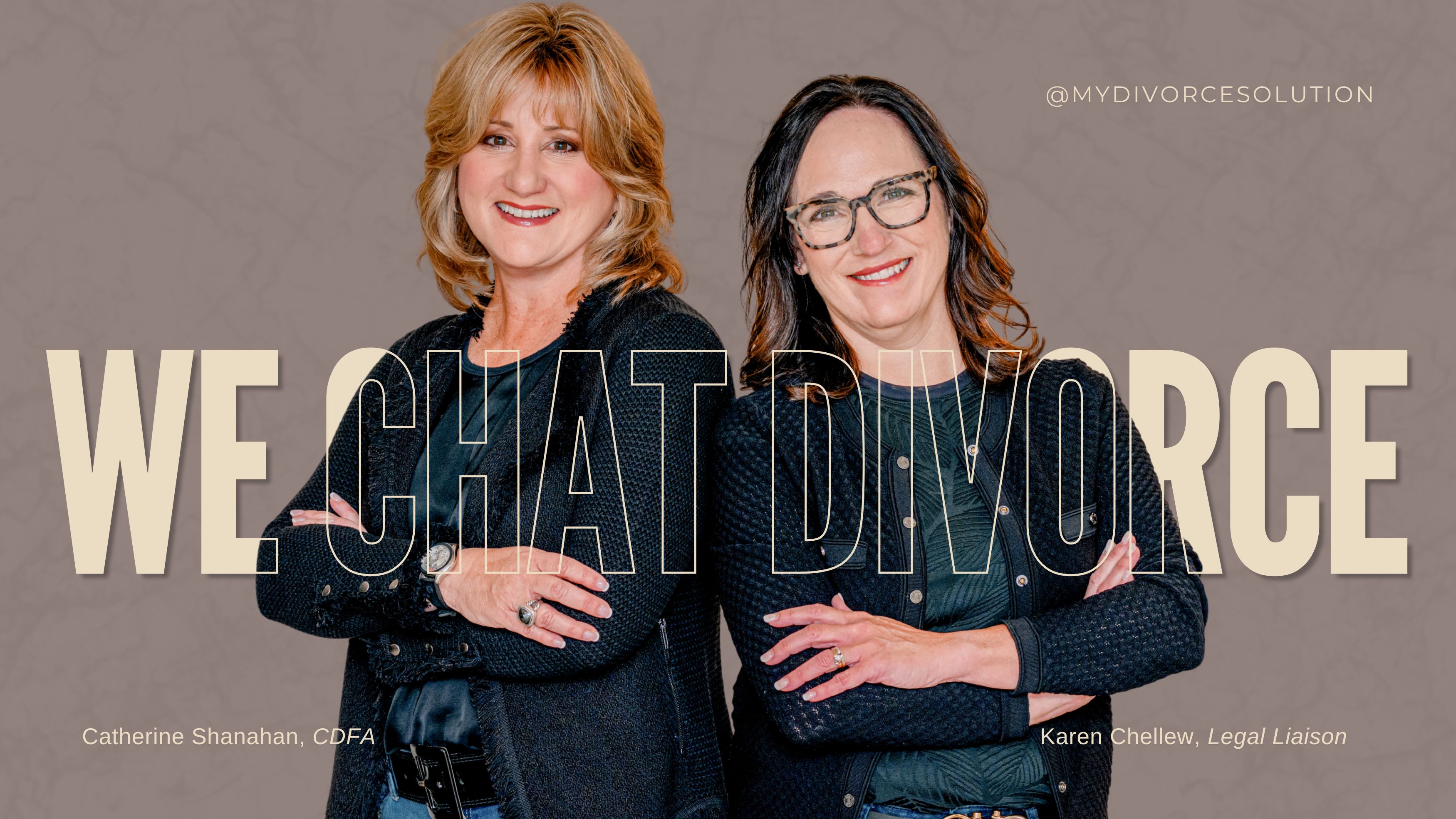
128. Healing Financial Betrayal in Divorce: Expert Strategies for Healing and Empowerment

In this insightful episode of We Chat Divorce, Karen and Catherine welcome Lora Cheadle, an attorney, TedX speaker, and betrayal recovery coach, to discuss the profound impact of financial betrayal in divorce. Lora, the author of Flaunt: Drop Your Cover and Reveal Your Smart, Sexy, and Spiritual Self and host of the podcast Flaunt: Create a Life You Love After Infidelity and Betrayal, shares her journey from personal betrayal to empowering others to heal and reclaim their identities.
Together, they explore:
- The various types of betrayal — financial, emotional, and even self-betrayal — and how they affect self-trust and decision-making
- How cultural conditioning can lead to overlooking financial independence and self-advocacy, especially for women
- Actionable steps for self-recovery, such as journaling and movement, to process emotions and rebuild confidence
- Lora’s “Flaunt” methodology: a five-step process to embrace authenticity and reclaim personal power, defined as:
- Find Your Fetish
- Laugh Out Loud
- Accept Unconditionally
- Navigate the Negative
- Trust in Your Truth
Lora candidly shares her experience of betrayal and the personal work that led her and her husband to reconciliation, highlighting that the path forward — whether together or apart — must honor one’s own needs and growth. Her “Flaunt” framework serves as a guide to shed societal expectations and live fully as your authentic self.
Gain inspiration to start your journey of healing and self-trust. Find Lora’s free Betrayal Recovery Toolkit at loracheadle.com.
Tune in for a conversation that emphasizes resilience, empowerment, and finding joy on the other side of betrayal.
About My Divorce Solution
We Chat Divorce is produced by My Divorce Solution (MDS) — a financial divorce preparation company dedicated to helping individuals navigate divorce with clarity, confidence, and a strategic financial plan. Founded by Karen Chellew, Legal Liaison, and Catherine Shanahan, Certified Divorce Financial Analyst (CDFA), MDS was created to solve one of the most common and costly mistakes in divorce: entering the legal process without fully understanding your financial picture.
Divorce is not just a legal event — it is a financial transition that can shape your long-term security. Through the MDS Divorce Financial Portrait™, clients receive expert financial analysis, organized financial disclosures, and scenario planning to understand how different settlement decisions impact their future. This financial preparation often reduces legal fees, shortens the divorce process, and helps individuals negotiate from a position of knowledge rather than fear.
If you are considering divorce or already in the process, you can begin by taking the Free Divorce Financial Assessment to better understand your options. You can also join the MDS Community for expert guidance, educational resources, and live Q&A events designed to help you move from uncertainty to clarity.
At My Divorce Solution, the mission is simple: replace fear with knowledge so you can make informed, confident financial decisions during divorce.
Episode Transcript
0:01
Welcome to WeChat Divorce, hosted by Karen Chalou, Legal Liaison and Catherine Shanahan, CDFA.
Each episode we sit down with divorce professionals and industry experts to provide insights and frank discussions about real people, real situations, and real divorce to help you achieve your best life post divorce.
0:39
Welcome to WeChat Divorce, Catherine and I welcome Laura Cheadle, attorney, speaker and coach today.
Hi, Laura, How are you doing?
Hi, I’m wonderful.
Thank you so much for having me today.
Yeah, it’s nice to see you.
Love your little fire in the background too.
0:56
Thank you.
It’s a little chilly today, so I got to take the hedge off.
Love that.
So our episode today is all about navigating financial betrayal and divorce.
And in this episode, we’re going to discuss how financial abuse and betrayal can really affect your journey.
1:14
But first, I want to introduce you to Laura.
Laura Cheadle is an attorney, TEDx speaker, and betrayal recovery coach who helps women heal from betrayal.
Laura is the author of the International Book Awards finalist and tattered covered bestseller Flaunt.
1:31
Drop your cover and reveal your smart, sexy and spiritual self.
And Laura is also the host of the podcast Flaunt.
That’s awesome.
Create a life you’d love after infidelity and betrayal.
Laura lives in Colorado, loves travel, adventure and a good book.
1:48
Thank you.
I’m, I’m really looking forward to diving into this because betrayal, whether it’s financial betrayal or any other kind can have such an impact on us.
And I think it’s really important to start having conversations around what betrayal is, how it impacts us, and how we can best move forward.
2:08
So thank you for having me.
Yeah, I’m sure a lot of people define betrayal differently.
Yes, yes, absolutely.
It’s like when you think about the word betrayal, you tend to think about infidelity.
And that is one kind of betrayal, but emotional betrayal.
Sometimes just getting divorced and this loss of a dream.
2:27
Like we all grow up thinking, oh, I’m going to get married and it’s going to last forever.
So sometimes just the fact that you’re getting divorced can make you feel like I’ve been cheated out of something.
And then there’s this whole financial end of things.
2:42
And so often we internalize like, I should have known better, how could this have happened to me?
I should have been smarter.
When the truth of the matter is, no people can betray you in any number of ways.
And when you have been betrayed, you are indeed victimized.
3:01
You don’t have to stay a victim.
That’s a big part of it.
But you have been victimized.
And it’s important to realize it’s not your fault when somebody else does something wrong to you well.
I’d imagine you can also betray yourself if you don’t, you know, if you don’t stand up for yourself.
3:20
You know, even when we talk to people about their tax returns, while my spouse always signed it for me.
Well, did you let him sign it for you or did you just, were you just too busy or you had no interest in it or did you really just not have any control over it and you were portrayed?
You know.
So sometimes you do have to stand up for yourself.
3:36
So I’m anxious to hear about your book and how that plays forward.
Yeah, yeah, absolutely.
And you hit the nail right on the head right there, because often, and this is a whole thing, I could go on for hours, we have been kind of trained as women in our society to betray ourselves, to put our needs last, to take care of other people first, to let somebody else handle it.
3:58
And it’s an entire awareness shift to start realizing, oh wait, I am in charge of me.
I do need to start advocating for myself, standing up for myself and owning things.
Because, yeah, we betray ourselves all the time, every day, in ways both big and small.
4:19
Yeah, that’s true.
Laura, let’s start with your story.
Can you share with us just you know a background of how you have arrived, the good work you do today?
Yeah, absolutely.
After 23 years of what I thought was a really, really solid marriage and partnership, I was completely blindsided to learn that my husband had been cheating for 15 years with five different women.
4:51
Wow.
Oh, yeah, I mean it.
You know, even in hindsight, when you look back on it, I did not see this coming.
I completely blindsided me.
Believe it or not, I’m just going to cut to the chase here.
5:06
We actually ended up coming back together again because the betrayal uncovered so much that he needed to work on, that he needed to address.
But most importantly for me, things that I needed to heal, things that I needed to address, ways that I needed to stand back in my power.
5:27
Going back to that self betrayal piece, all of the things that I needed to do to make myself a more sovereign, being a stronger person, and after many years of work and therapy, we ended up coming back together.
5:46
But that’s why I do what I do.
I am a former corporate attorney.
I left the practice of law to do legal Wellness and workplace Wellness.
And after this entire journey, I pivoted to specialize in the area of betrayal, because betrayal crops up in so many different areas and it seeps in and there are not a lot of great resources out there for truly addressing it and healing it.
6:13
So are you saying you got divorced and then got remarried to the same individual?
We separated, we never went through with a divorce and then got back together.
So that is a lot of work that you went through to do that.
I’m sure a lot of people listening are saying there is no effing way I would do that, right?
6:28
But to be able to do that, good for you, I mean, you really had to own up to your own stuff.
I would say not take, not take blame.
No.
Because it wasn’t your fault that he did what he did.
But.
No.
And I do want to a few caveats on that.
6:45
It was it’s not good or bad if you stay together.
It’s not good or bad if you separate.
When both parties are willing to look at their stuff and you both become a fuller version of who you are, you might realize, you know what, we should have never been together.
7:01
And you might realize, hey, I want to try something new.
And either way is fine.
And it just happened to work out that way for both of us, which was great and which was good.
But whatever the outcome, as long as it’s right for you, then it’s right for you.
7:18
I like that.
It’s right for you.
It’s right for you.
I like that.
I like that too.
And you know what, we say that at my Divorce solution too.
You know, we take couples or individuals through a process of preparation, but it doesn’t always mean you’re preparing for divorce or you’re preparing for post nub or you’re preparing to stay together.
7:37
You get to choose after you have reset your mindset, after you have the knowledge to make really good decisions for yourself.
And that’s very in line with what you’re saying regarding the emotions of betrayal.
7:53
Yeah, I’m so glad that you said that.
And I love that that’s what you do because that’s a huge piece of it.
Becoming empowered, knowing your rights, knowing what it’s going to look like either way gives you the information that you need to make a quality decision instead of just being like, Oh, well, we’re already married, so we might stay married, you know, or oh, we’re already on this path, so we might get a divorce.
8:16
Look at it.
Do a 360° view of yourself.
What are you willing to do?
Your partner, What are they willing to do?
Your situation, your goals, your dreams, Look at it all and figure it out.
And then if you want to change your mind in six months or six years, how about it?
8:33
Change your mind.
Always advocate for yourself and your needs.
And we always say, you know, we don’t hold a red flag here at my divorce solution, say, yay, go get divorced.
I mean, that’s not our mission at all.
But it is so true.
There are so many times that families come through and usually finances is the biggest thing why people get divorced, right?
8:52
So when they go through and they say, OK, yes, one is the saver, one’s the spender, but 30 years later, the spender when they get the financial clarity can turn around and say, oh, well, thank you for being so all these years because now we have money and we can retire where the saver can say, you know what, but you afforded the ability for us to have fun all these years or we got to do all those things.
9:15
I would never have encountered any of that because I would have never spent the money to do those things.
So it’s really a heartwarming when they come through our process, couples that come through our process together or actually even some that one just participates to to hear them say that to each other because their only other option was to go to attorneys and you’re not going to have that conversation with your spouse and you’re not going to get that realization.
9:39
So we do have quite a few people that end up getting post nuptial agreements to just have a different financial understanding with each other.
Yeah, and that’s so powerful and I love that you mention that because it is the conversation and you know we’re talking about financial betrayal.
OK.
Did somebody completely lie to you and blind side you?
9:57
It’s different if somebody is lying.
It’s different if they are hiding money, if they have different accounts.
If they’re telling you I’m saving this, I’m do you know I’m paying the mortgage every month.
Yes, yes, yes.
When really they’re taking it to Vegas and gamble.
It’s different if they’re totally lying to you, in which case absolute betrayal versus we’re not really having conversations about money and I’m just assuming that you’re paying the mortgage and I’m assuming that you’re saving and you’re kind of assuming that I’m spending.
10:30
But we don’t really know.
And it’s imperative to start having those conversations and to start sitting down together, whether it’s with spreadsheets or bank accounts or credit card statements.
And at least we can agree to disagree.
We can agree to have different values and different priorities because we’re different people.
10:51
But being in a situation you’re aware of and you don’t really like is completely different than being in a situation where you think it’s one way and it’s not.
It’s something else.
Completely so true.
So Laura, let’s dig in a little deeper and talk about the difference between feelings of betrayal and other types of grief or sadness.
11:16
How do you unpack that and break that down a little bit?
Yeah, great question, Karen.
Feelings of grief, feelings of sadness, feelings of disappointment, all of those feelings can kind of just come up and take place for any number of reasons.
And when we feel them, it can feel icky and it can feel bad, but it’s easier to move through them.
11:38
Whereas with betrayal, betrayal disrupts and completely ruptures your view of yourself or the world.
So if there’s a financial betrayal, you’re not just like, oh, I’m really bummed it has disrupted your view of yourself that I was an equal partner in this relationship, that I’m smart, that I’m capable, that I am an adult who’s taking care of myself.
12:05
And then your view of the world.
A partner shouldn’t do this.
My husband shouldn’t do this.
People don’t do this to each other who love each other.
It’s a disruption of your worldview, and that breaks you on the inside in an entirely different way.
12:24
It leads to shame, it leads to panic.
It leads to feelings of like, who am I and what can I trust?
And I’m not safe.
I’m not safe and I’m not smart enough to figure it out because it’s disrupted your worldview.
And having your entire view of yourself and your world disrupted means your identity has shattered.
12:45
And you have to rebuild your identity and you have to rebuild your worldview, which is so different than, oh wow, they’re out of chocolate ice cream and I have to go with vanilla.
I’m so disappointed.
That doesn’t shatter you.
That doesn’t change your identity.
So betrayal is different because it goes back to identity.
13:04
Well, you know, that really will play into why people have so much time, have so much trouble negotiating to a settlement.
Because if you’re feeling, if in fact portrayal is your feeling that everyone is against you or your world has just come upside down, how do you trust anyone to give you an opinion?
13:22
Which again, I never even thought about it.
It’s another great part of our process because we take them through 10 steps and we only stay in the financial world, right?
So taking that 10 steps of getting yourself organized, understanding you know what you have or what you don’t have, and understanding what you need to consider is probably a way to start rebuilding your own self value and actually trusting in yourself.
13:47
Because if you’re not going to trust in anybody else who who you’re going to trust, you have to trust someone.
So you have to trust yourself.
The only way to do that is with knowledge.
And that’s really what we’re all about is providing that financial knowledge.
Yeah, I love that.
And even deeper than that, because you’re totally right.
14:02
You become hyper vigilant when you’ve been betrayed because you don’t trust anybody else.
But the kicker is you don’t trust yourself because I trusted this person before I trusted them.
And if I can’t even judge other people’s characters, how can I ever trust myself in the future?
14:20
So it really breaks you down to that point.
And that’s why people are always saying I feel so broken, because suddenly you think I’m to blame.
I’m the stupid one.
How could I have been so dumb?
And you’re right, knowledge helps.
14:35
But there’s also that emotional and energetic component of healing.
Because we are smart.
You were smart in the past.
Because you were betrayed, because you were fooled, because you were taken advantage of, doesn’t mean your intuition is broken.
14:52
It doesn’t mean your intellect is broken.
It just means you need to rebuild yourself and come to terms with what happened.
So then the knowledge that you are acquiring, you can again start trusting yourself to be like, yeah, I can figure it out and I can manage it.
15:09
And the truth of the matter is, I’ll probably be betrayed at some point in the future in some other way, and I can still come back to me, and I can know that I am capable of figuring it out.
It’s really good because we do find with a lot of our clients that have experienced betrayal either by their spouse or by themselves or just as a function of society, that when they’re approaching divorce or just sometimes it seems like they’re grasping at straws.
15:40
Well, there was this account 10 years ago or I think this happened.
They’re always in a response or almost trauma mode and getting them to come to the table with what we do know and unpack it that way is really difficult because it’s really hard for them to get into that space because to your point, they don’t trust themselves in that space, right?
16:05
They think it’s something bigger or different than that.
So that’s a really good.
Perspective Karen, that’s a really good point because you know, when you saying that, I’m thinking of so many people who grasp at that, you know, 2011 statement that they just believe that’s still there because that, I guess as you’re putting it, that portrayal come in.
16:27
So now they’re they’re dead set on we got to go find that and it cost them hundreds of thousands of dollars to go nowhere, right.
And so probably doing that healing work first or as part of the process is really a good idea.
Yeah, absolutely.
16:44
And I like how you said as part of the process because I wish we could just say I’m going to go get healed.
I have an appointment to be healed and at 3:00 I’m going to sign up.
I only need 15 minutes now.
It is a process and it starts with the awareness and then it’s the understanding and it’s moving in and out of those different layers of understanding.
17:09
The mental, the physical, the energetic, the emotional, the way we show up.
And it is a process.
And being with people, you know, like you, who can give support, who can give emotional understanding, who can give financial understanding, who can give people.
17:25
Here are your 10 steps.
It’s all a part of the process.
It’s just that there’s so many facets and we just have to be kind to ourselves and continue to step forward.
OK, I’m healing energetically.
But sometimes when you’re healing energetically, you need to back off from some of the, you know, hardcore intellectual stuff.
17:46
Perfect.
Sometimes when you’re really learning, OK, I need to understand taxes.
I need to understand interest, bank accounts.
Sometimes then you need to back off from some of the emotional or energetic things.
It’s, it’s all a balance.
But as long as you’re continuing to move forward and be kind to yourself, you will heal.
18:07
Yeah, I agree with that.
And I, I was just thinking too of, I like to use the word pause because someone that’s all full of all of that emotion and not knowing where right or wrong is, you know, they tend to throw out their fears and data and information.
18:27
And like Catherine said, the 2011 statement or whatever it is, and it may be valid, but understanding that sometimes just hold that in a, you know, in a box here, there will be a time to disseminate that information because it it does become a distraction to healing and knowledge itself because it’s something to do, right?
18:49
It’s something to go after.
It’s some kind of, you know, you’re feeling like you’re accomplishing something when at the end of the day, pausing and taking a couple steps back and really having an intention of how can I move forward in the best way is what I think you bring to the table, Laura, just a change of that mindset.
19:10
Yeah, yeah, absolutely.
And I love that you gave that example because that is exactly what it is.
When we are that hurt, when you find out you’ve been betrayed, ask me.
I know.
The horror is so thorough.
I mean, it hurts like I physically threw up when I heard this.
19:31
Because you can’t stomach it, you can’t take it.
It’s pure horror.
So nobody wants to feel those levels of horror and grief and pain and shame.
So you shift to another area.
OK, I can’t feel all of that.
19:47
I’m going to go to my head.
I’m going to go into action.
I’m going to blame.
I’m going to shame.
I’m going to read every single e-mail he ever sent.
I’m going to dig every single account.
I’m going to call everybody because we’re in action.
And the action keeps us out of those horrific feelings.
And yeah.
20:03
And the truth of the matter is.
We need it all.
Yes, we need to get information, but we also need to give ourselves the opportunity to feel those horrific feelings, as not fun as it is.
But there’s ways that we can process them and get them through so they don’t make us sick, make us feel bad.
20:26
Because the truth of the matter is, we got one life.
How are you going to live the rest of your life?
And that was a turning point for me and my own recovery.
We all know those bitter old man hating ladies who are like.
Let me tell.
You what he did to me.
20:43
I don’t want to be that person, you know what I mean?
I want to be happy.
I want to be joyful.
I want to do whatever work I need to do right now so I can live and love and laugh and enjoy my life because this is my opportunity of life.
21:02
And if I let my partner’s bad behavior control and ruin the rest of my life, the next year of my life, that’s on me.
That’s not on them, that’s on me.
So, Laura, how would one target and address feelings of betrayal so they don’t become bitter, jaded or angry?
21:22
What what would be some of the first steps they could take to identify those feelings?
Yeah, I’m a big fan of journaling.
I’ve got journal prompts that I give, you know, people who work with me.
I’ve got some free ones online.
You can just Google journal prompts if you need them, or you can just write things out on your own.
21:41
What am I feeling?
What am I thinking?
The reason that’s important is it just lets some of those feelings flow so they’re not bottled up in you.
So that is the first thing I recommend journaling, some kind of journaling, any kind of journaling.
Just write things down.
21:59
The second thing I really recommend is movement.
I am a somatic attachment therapist and that means I consciously help people use movement to flow feelings and emotions.
But as humans, we already know how to do that.
We know how to move our bodies.
22:17
Turn on music, Turn on rage music, stomp and dance and cry and roll around on the floor.
Turn on happy music and leap around.
If you look back through history, all cultures, all indigenous cultures dance.
22:36
They dance, they stomp, they celebrate, they move their body.
In our Western culture, we don’t.
We sit at desks and we sit on couches across from therapists.
We got to move.
We got to move, run, walk, climb, use music and move your body.
22:57
It will help enormously.
So journaling and movement, I think they’re the two most important places for anybody to begin.
All right, I got to go listen to some music now.
See you guys.
Dance it out, Catherine.
23:14
Dance it out.
Oh my gosh.
I’m ready.
I just.
Read an article recently about when you’re exercising and you’re even, you know, using your muscles or or even just bending your arms, it’s releasing something into your body for healing.
23:33
Have you heard that too?
I mean, it’s just like news to me.
I just that small of a movement.
Yes, absolutely.
Absolutely.
And the other thing I’m a big proponent of is physicalizing what you need.
And what I mean by that is if you can look at your life and you’re like, I’m feeling really rigid and defensive.
23:56
OK, If I’m rigid and defensive, I need flow and softening.
What type of movement can bring flow and softening to my body?
Maybe it’s stretching, maybe it’s some kind of yoga.
Physicalize what you need.
24:12
If you’re sitting there thinking, I feel weak, I feel beat down, I feel just powerless, Do some movement to bring power back to your body.
Lift some weights, run hard.
24:29
Do something that brings you power because when you physicalize it, it will start becoming you on an emotional level.
So identify how you’re feeling.
What is the opposite of that?
How do you want to feel?
And what kind of movement can you bring in to support you to start feeling the way you want to feel?
24:52
I never heard it explained like that.
It’s very good.
Yeah, really, really good.
Tools, yeah.
I have a lot to do, Karen.
So do I.
Have to go play some pickleball.
That’s what I know I have to do.
This is really good information.
25:13
Can our listeners find you and learn more about you?
And can you tell us a little bit more about your book as well?
Yeah, absolutely.
People can find me at my website lauracheadle.com and Laura is LORACHEADLE.
25:30
The other thing is if they have been through a betrayal, I’ve got a free six part betrayal recovery toolkit and they can download that for free at Betrayal Recovery Guide dot com.
So betrayal recovery guide.com or lauracheadle.com, either of those works.
25:50
And yes, I would love to talk about my book because it’s so empowering and it’s just in line with kind of what we were talking about in regards of to physical physicalizing things.
In my book, I use the five steps of flaunt.
26:05
FLAUNT is an acronym, and what I love about that acronym, it’s for whatever we feel like we’re shrinking.
Whenever we feel like we’re shut down, we’ve been beat down again.
The opposite of that, opposite of that, is FLAUNT.
So the five steps of FLAUNT teach us how to step back into that energetic space of fully being who we are.
26:26
If I’m going to make a mistake, let me make it fully.
If I’m going to have a success, let me make it fully.
But no matter what’s going on, I want to step into my full power and to be authentically me because at the end of the day, you are going to succeed more when you are who you are.
26:46
The book uses the concept of burlesque, and I don’t know if you’ve ever watched a burlesque show or heard about it, but it is the removing of layers to reveal what is authentically underneath and the difference between because sometimes people say, Oh my gosh, isn’t that stripping?
27:08
Not really, no.
It’s a performance art and it reveals what is authentically there.
In the burlesque world, performers can be in their 70s and 80s.
You can be any weight, any size, any shape, any any, anything.
27:25
There’s a couple of very powerful burlesque performers who have had double mastectomies.
It’s about revealing the truth of what’s there, not the stereotypical image of what a woman should and shouldn’t look like.
So in the book, I use that concept of what are the masks, what are the labels, what are the rules we are clothing ourselves with?
27:49
And how can I get comfortable taking off that identity, take off that role.
I was a wife, I was a mom, I was a lawyer.
How can I show up without those identities covering and protecting me?
28:06
And how can I be enough?
Just being Bora, fallible, imperfect, afraid?
How can I introduce myself as me?
How can I sit with me?
And how can I reveal all facets of who I am, both the good and the bad?
28:25
Because so often women cover the good as well as cover the bag because oh, I don’t want to brag.
I don’t want to have people think I blah blah blah blah, blah.
So the book uses those five steps and it empowers and helps women learn how to be who they are, to accept themselves as they are, and then to slowly start shedding those layers of conditioning and belief to just show up in their authentic power.
28:54
Wow, that’s amazing.
Thank you.
I’m sure we’ll include in the show notes how and where people can find your book as well.
So thank you, Laura.
This concludes our discussion on navigating financial betrayal and divorce.
29:10
Thank you so much for a fantastic conversation.
Thank you so much for having me.
Thanks for joining us on another episode of WeChat Divorce.
We hope this episode was informative and supportive on your divorce journey.
If you're looking for more support for navigating divorce with confidence and clarity, head over to azure-emu-499854.hostingersite.com/ for more podcast episodes, divorce events, and resources for your divorce.
29:39
We’ll see you back here for our next episode.
Disclaimer:
The information provided in this podcast is for educational and informational purposes only and should not be considered financial or legal advice. Please consult with professionals in the relevant fields for personalized guidance.
The WeChat Divorce podcast (hereinafter referred to as the “WCD”) represents the opinions of Catherine Shanahan, Karen Chellew, and their guests to the show. WCD should not be considered professional or legal advice. The content here is for informational purposes only. Views and opinions expressed on WCD are our own and do not represent that of our places of work.
WCD should not be used in any legal capacity whatsoever. Listeners should contact their attorney to obtain advice with respect to any particular legal matter. No listener should act or refrain from acting on the basis of information on WCD without first seeking legal advice from counsel in the relevant jurisdiction. No guarantee is given regarding the accuracy of any statements or opinions made on WCD.
Unless specifically stated otherwise, Catherine Shanahan and Karen Chellew do not endorse, approve, recommend, or certify any information, product, process, service, or organization presented or mentioned on WCD, and information from this podcast should not be referenced in any way to imply such approval or endorsement. The third-party materials or content of any third-party site referenced on WCD do not necessarily reflect the opinions, standards or policies of Catherine Shanahan or Karen Chellew.
WCD, CATHERINE SHANAHAN, AND KAREN CHELLEW EXPRESSLY DISCLAIM ANY AND ALL LIABILITY OR RESPONSIBILITY FOR ANY DIRECT, INDIRECT, INCIDENTAL, SPECIAL, CONSEQUENTIAL, OR OTHER DAMAGES ARISING OUT OF ANY INDIVIDUAL’S USE OF, REFERENCE TO, RELIANCE ON, OR INABILITY TO USE, THIS PODCAST OR THE INFORMATION PRESENTED IN THIS PODCAST.