

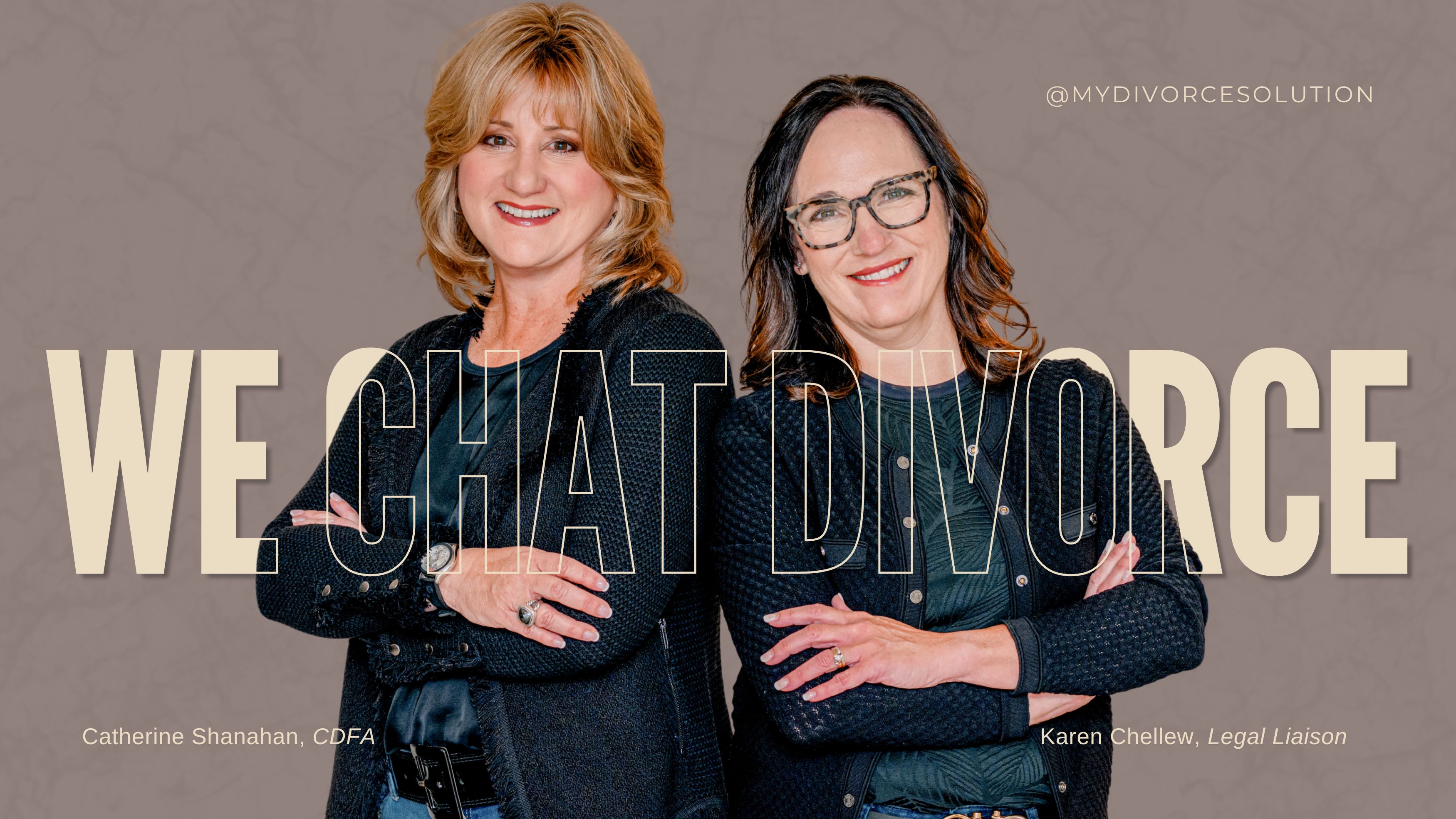

Divorce isn’t just a legal or financial process—it’s an emotional one. In this powerful episode, Karen and Catherine are joined by Virginia Gilbert, a Licensed Marriage and Family Therapist and author of Transcending High Conflict Divorce, to talk about a topic most people don’t expect to encounter during divorce: grief.
Together, they explore:
- The emotional toll of divorce grief—even if you’re the one initiating it
- Why grief can leave you feeling financially stuck or frozen
- The real reason some spouses feel guilt or shame about asking for financial clarity
- How emotional reactivity can sabotage financial decisions
- The pressure many women feel to hold on to the family home
- The myths and realities of “nesting” after divorce
- How to move from emotional reactivity to radical acceptance—and why it matters
Virginia also shares her own story of navigating a high-conflict divorce, how that experience reshaped her career, and why she believes divorce can be a transformative experience—if you’re willing to do the inner work.
Key Takeaways:
- Divorce grief is real—and it’s not linear.
- Expect to cycle through denial, anger, bargaining, depression, and finally, acceptance (aka “DABDA”).
- High-conflict dynamics often carry over from the marriage into the divorce.
- Learning to disengage emotionally is essential.
- Financial empowerment starts with overcoming emotional roadblocks and becoming an active participant in your own decision-making.
- Letting go of control, identity, or even the family home can be one of the hardest—but most liberating—parts of healing.
- Radical acceptance doesn’t mean indifference. It means understanding what you can’t change and choosing how you’ll respond next.
About Our Guest:
Virginia is a licensed marriage and family therapist practicing in California, North Carolina, and Florida via telehealth. She specializes in helping people disengage from high-conflict exes and take their power back. She’s the author of Transcending High Conflict Divorce and leads therapeutic divorce groups for men and women navigating emotional entanglement and reactivity.
Learn more: virginiagilbertmft.com
About My Divorce Solution
We Chat Divorce is produced by My Divorce Solution (MDS) — a financial divorce preparation company dedicated to helping individuals navigate divorce with clarity, confidence, and a strategic financial plan. Founded by Karen Chellew, Legal Liaison, and Catherine Shanahan, Certified Divorce Financial Analyst (CDFA), MDS was created to solve one of the most common and costly mistakes in divorce: entering the legal process without fully understanding your financial picture.
Divorce is not just a legal event — it is a financial transition that can shape your long-term security. Through the MDS Divorce Financial Portrait™, clients receive expert financial analysis, organized financial disclosures, and scenario planning to understand how different settlement decisions impact their future. This financial preparation often reduces legal fees, shortens the divorce process, and helps individuals negotiate from a position of knowledge rather than fear.
If you are considering divorce or already in the process, you can begin by taking the Free Divorce Financial Assessment to better understand your options. You can also join the MDS Community for expert guidance, educational resources, and live Q&A events designed to help you move from uncertainty to clarity.
At My Divorce Solution, the mission is simple: replace fear with knowledge so you can make informed, confident financial decisions during divorce.
Episode Transcript
0:01
Welcome to WeChat Divorce, hosted by Karen Chellew, Legal Liaison and Catherine Shanahan, CDFA.
Each episode we sit down with divorce professionals and industry experts to provide insights and frank discussions about real people, real situations, and real divorce to help you achieve your best life post divorce.
0:44
I’m Karen Chellew, your legal liaison, helping you move through the divorce process with clarity and calmness.
And I’m Catherine Shanahan, divorce financial specialist and certified divorce financial analyst.
Around here at MD’s, we don’t just talk dollars and cents.
0:59
We talk about the emotional roadblocks that keep you from feeling financially in control, which I know there are a lot of them.
For sure.
And today we’re talking about divorce grief.
I’m not sure people really realize that that the that that is the experience that they’re having at any given time.
1:22
Well, that, you know, divorce is second in grief other only to the loss of a spouse or a child.
So it is a grief.
I mean, and it’s hard.
Divorce is hard.
You know, even with our streamlined process, it’s still hard to go through this process.
And I think it’s hard even whether or not you’re the lever or the levy.
1:41
You know, I think some people think if you’re leaving a marriage, there’s no grief going on.
You know, you’re not even looking back.
But there was a relationship, there was a connection.
There is some level of grief, I believe in every situation.
1:57
Well, even you know, people are saying, you know, your spouse is an A hole or whatever, they’re idiots.
You’re going to be better off.
OK, that could be all well and true, but you still don’t like people saying it still has an emotional Ting to you.
You know, it still doesn’t feel good.
You’re like, OK, I know that that’s why I’m getting divorced.
2:15
But I don’t need to keep hearing it emotionally.
It doesn’t help me at the end of the day, right?
But there are, I mean, there’s so many emotions and we see it all the time because I, I can never understand why, you know, why do you not feel worthy of getting the financial documents?
2:30
You know, why do you need an excuse to get that?
Why can’t you tell your attorney that you need this financial clarity?
But they’re so grief driven that they can’t think to have those responses, you know, until they go through and get the financial clarity at that need It’s.
2:47
So true, and that’s why I’m really excited for today’s episode, because divorce grief is real and it shows up in ways that so many people just do not expect.
And there’s an emotional attachment to an asset and a debt that you should understand before you make decisions.
3:05
So I’m interested in the conversation as well.
So if you’ve been feeling emotionally stuck or financially frozen during divorce, this next conversation is for you.
Let’s welcome Virginia Gilbert to help us unpack why and what to do about it.
3:22
Welcome to WeChat Divorce Virginia.
Thank you for having me.
I’m happy to be here of.
Course, we are so happy to have you with us today and truly grateful you’re here to help us explore such an important and often overlooked part of the divorce journey for sure.
3:39
But before we get into today’s discussion, let me just take a minute to introduce you to our listeners.
So Virginia is a licensed marriage and family therapist practicing in California, North Carolina and as a telehealth provider in Florida.
3:54
She specializes in helping individuals and couples at all stages of divorce, including those dealing with high conflict exes and court mandated Co parenting.
She’s the author of Transcending High Conflict Divorce, How to Disengage from Your Ex and Find Your Power.
4:11
She’s deeply passionate about helping people get emotionally unhooked and take their power back.
Welcome again.
Thank you.
I, I, I’m chuckling a little bit at your intro there.
I’m thinking, this is great.
You work with the couples and you and then you tell them how to disengage.
4:28
I can imagine you sit through many sessions saying I wish they would disengage and disengage.
Yeah, You know, it’s interesting ’cause my how I came up in the therapy world is I worked in treatment settings.
So I worked at rehabs, I worked in an adolescent residential treatment facility, I worked in a sex addiction clinic.
4:49
So I got very used to working with people who had a lot of big feelings and had a lot of chaos in their life.
So I don’t know if it’s just something weird about me that I I actually get very focused when people have conflict.
5:04
It doesn’t tend to freak me out.
So maybe it’s just my quirk.
I don’t think it’s weird, I think it’s a gift.
I do too.
And you know, we’re going to talk more about this in our discussion, but that’s definitely something we do here at My Divorce Solution, helping people disengage from their emotions so that they can make clear financial decisions.
5:27
It’s a really important exercise for sure.
Yeah.
Before we get started, and I know you touched on this just a little bit, would you share with our listeners a little bit of a bit of your story so that they can connect how you arrived at what you do today?
5:44
Yeah, yeah, happy to.
So, and I’m, I talk about this in my book.
About 21 years ago I went through a really gnarly divorce and I didn’t understand why it was so bad.
At the time, high conflict divorce was not like a thing in the zeitgeist.
6:01
So we just sort of had the good divorce model, which was kind of like the conscious uncoupling model.
So when I went to therapy, I didn’t really get the help I needed.
The therapy I think was very geared towards more or what I call garden variety divorces.
6:17
So this was not a divorce that got better over time.
It didn’t get, you know, Co parenting didn’t get better if I used my eye statements like nothing really worked.
And I felt really kind of ashamed and alone.
And so I just started researching on the Internet and I found somebody named Bill Eddy who I would really recommend if there’s any listeners out there who who have a difficult divorce.
6:44
Bill Eddy is a high conflict divorce expert.
He’s got something called the high conflict institute.
He’s a social worker, a lawyer and a mediator and he has a lot of just great tools and programs and CE us, if there’s any therapist listening, you know, for how to work with high conflict divorce, but also just high conflict in general conflict in the workplace.
7:05
So I, I just got knowledgeable about it and I started, I just identified that I have a different kind of divorce.
And so standard divorce protocol isn’t applicable for my situation.
7:21
And, and at the time, this was many years ago, HuffPost had something called the HuffPost Divorce section, which was great if you were also a freelance writer like I am.
So you could just kind of have your own column.
So I wrote an article called What Therapists Don’t Tell You about Divorcing a High Conflict Personality?
7:39
And it was just sort of kind of what I learned about how therapy with high conflict divorce needs to be different.
All these people who read the article wrote me like from all over the country, I think even other countries saying, Oh my God, are you in my divorce?
Have you been in that therapy session?
7:55
Like you really understand this?
And I haven’t met other, other people who understand it.
I think now there’s a lot of therapists who are high conflict divorce experts.
But at that time I realized, oh, I, there’s a niche here.
And so I really worked on developing the niche.
8:14
And so I work with, I think as you mentioned, like this is a whole spectrum of people.
Sometimes it’s people sort of contemplating divorce, Sometimes it’s people who are basically amicable and they just want sort of somebody to help facilitate kind of what their financial agreement is going to be or they’re Co parenting.
8:34
Sometimes it’s one person who’s going through a divorce who has a really challenging situation.
Sometimes it’s the Co parents who got conflict and sometimes it’s yeah, court mandated people where they have so much conflict that a judge has said you guys have to go see a professional for X amount of time.
8:53
So I really work with a big and I also run divorce groups.
I run a divorce group for women and a divorce group for men.
Both of those groups are geared for people who have a hard time getting psychologically unhooked from their ex.
9:09
And when I say detach, I don’t mean that you should like ice the other person out and not care and just pretend that they don’t exist.
It just means you don’t get emotionally hooked and do things yourself.
They’re unskillful and sort of contribute to the conflict.
9:29
Wow, that’s really interesting and I’m sure so needed when people are going through divorce for sure.
So let’s carry that forward a little bit and identify what is divorce grief, you know, what is the identifier there?
Yeah, so I typically use Elizabeth Kubler Ross’s grief model because divorce, even though it’s not the death of a person you’re mourning, you are mourning the death of your relationship with the person who used to be your primary attachment figure.
10:02
You are mourning maybe your lifestyle, well, probably your lifestyle is changing.
Maybe you’re leaving the family home.
You’re not spending as much time with your kids.
I think often I will say, I think more for women, there’s a loss of an identity, especially if you were a stay at home mom and like maybe you didn’t have to deal with finances.
10:23
So there’s so many losses that it’s helpful to kind of understand the stages of grief that people move through.
So Elizabeth Kubler Ross identified these five stages.
And it’s not they’re not stages that we move through in a linear fashion.
Sometimes you circle back, but the first four stages really have to be completed before you get set to the final stage.
10:45
So that the acronym is DABDA and that stands for denial, anger, bargaining, depression, acceptance.
So I sort of, I just provide some psychoeducation and I teach people that they’re going to, they’re going to experience these different stages and feelings and that is totally normal.
11:05
That’s what they’re supposed to do.
I will say that, you know, if we’re going to talk about the divorce process and maybe what you see, if there are glitches with with the financial part of the divorce is that a lot of people will just hang out and denial like this can’t be happening.
11:24
Like this wasn’t how my life was supposed to go.
I wasn’t the money person.
My spouse was the money person.
And the agreement we had in the marriage was I was going to stay home with the kids and now I’m expected to go back to work.
11:41
And the it’s just the whole idea of that is like that can’t happen.
So people get kind of frozen in denial or both both genders get angry.
But I will say, I see men tend to get angry about I got, they think they got played, they got taken advantage of like this financial settlement that my, my spouse once is taking advantage of me.
12:12
And they get really angry about it ’cause they’re not accepting like this just sort of realities to divorce and you know, to households and you know, child support and all of that.
12:28
But they get kind of stuck in anger.
Bargaining is kind of like the coulda, woulda, shoulda.
And I think a lot of people, because the prospect of this change is so scary, they spend a lot of time thinking about the past.
Like God, if we just go into couples therapy earlier or if I’d worked more on my our sex life or, you know, whatever it is, you just think there is somewhere in a parallel universe, there’s another timeline and it all could have been different.
12:57
And all of that is sort of a distraction from the tasks at hand, which are not fun.
They’re overwhelming.
But there’s all these tasks, as you know with divorce, that you really need a clear head for.
Let’s talk about those tasks a little bit because we deal with mostly all high conflict or everyone is everyone thinks you’re in a high conflict divorce because you’re going through a divorce, right?
13:21
So I don’t want to label anyone or anything like that, but we hear a lot of people who say, well, let me ask my spouse, you know, they need, we just handle the financial piece.
We just want to make sure we have a process.
We make sure that you are financially prepared and you’re financially clear before you make decisions, right?
13:39
But in the high conflict, there’s a lot of, listen, spouse, here’s the spreadsheet.
You know, I’m telling you the truth about everything and I’m going to take care of you.
And as long as you don’t go get an attorney or basically get information, you know, I’ll make sure you’re, you could stay in the house, you know, whatever their pain point is that they’ve expressed.
13:58
Then almost like what you said, our deal was, I stayed home.
Our I, our deal was I don’t have a retirement account because I watched the kids, you know, so now we flipped the switch on them and they and they, and now there’s a lot of women in particular and there are men because there are a lot of aggressive women.
14:14
So I’m not going to say it’s all women.
And say a majority.
Of women who are still seeking permission or they find an attorney who bosses them around the same way.
And it’s really upsetting to watch because we’re all about empowering you to be financially clear and to really ask good questions.
14:33
You don’t have to know the answers but be able to ask the questions.
So you feel you’re sitting a little differently in that chair when you’re having these conversations.
So why is what stage is this person at that is just afraid to ask for the documents to support a spreadsheet or afraid to get the knowledge because they think they’re going to get in trouble or their attorneys tell them they don’t need that will tell you what you need basically.
14:57
And same with the spouse, like what stage are they at and how do they get out of?
It, I mean, I think some of that could be denial is that they’re sort of not realizing the long term consequences of not having all the information or not having a real advocate.
15:14
Like, like, you know, it’s all going to be OK.
Because my spouse who was the one sort of in charge of that stuff is telling me, you know, it’s sometimes I would say it’s not like stepping away from the grief model.
It’s not necessarily about grief.
15:30
It’s maybe just, I am not somebody who’s used to doing those things and it makes me really uncomfortable and the discomfort is causing me to have a dysregulated nervous system.
So I’m going to do the fight or flight thing or I’m going to fawn or I’m just going to, I’m going to freeze.
15:49
So I, I also work a lot with people on understanding what’s going on with their nervous system and having the tools to self regulate so that they can then make really clear, skillful decisions.
Because I’m sure we’ve all seen people who where the power struggle in the marriage just shifted to the, to the divorce and they got kind of strong armed and then they have all these regrets later because there were financial decisions that were really not advantageous to them and then they have regrets.
16:20
So true.
There’s so many people that say, you know, I wish I’d known you five years ago, right?
Yeah, but you know, to what you’re talking about five years ago, I don’t know, maybe maybe they would be ready or maybe not.
Because what we see is when people are in these types of situations, we often observe them or experience that they’ve gone from their spouse who has been.
16:46
That dichotomy between the two of them has been, you know, the one spouse who has power and the other spouse who doesn’t.
So the spouse who doesn’t have power shifts the control from the spouse to the attorney.
17:02
Oh yeah, right.
And so then those attorneys are very silo ish and they don’t want anyone in their space.
We’ve got you.
And they feel comfort in that when essentially they’re just going from one controlled situation to another and they’re not learning to educate themselves, understand and make decisions for themselves.
17:27
Yeah.
And so that’s totally true.
And so I work a lot with people on what is the lesson that you need to learn?
Because the, the longer I’ve done this, the more I feel like there’s a nice, be careful.
I say that there’s almost like a spiritual component to divorce.
17:43
Like there is something you need to learn that you haven’t learned earlier in life that that this is sort of a Crucible situation.
It’s demanding that you learn.
So if you were that person that you know, your situation was, I run the household, I deal with the kids and my spouse handles all the money like you’ve got to become financially literate You, you’ve got to learn those skills, even though it makes you uncomfortable.
18:09
If you were the people pleaser, you’ve got to be able to self advocate with your attorney.
Like if you picked the wrong attorney, maybe you’re going to have to change course or you just need to stand up more.
But I really work a lot with people because if they’re, if they’re sort of stuck in the blame, if they’re doing like or, or I, I say it’s like sort of getting it an advanced degree in your spouse’s problems.
18:32
If you’re going to be fixated on the all the things that are wrong with your spouse, you’re not going to figure out like, OK, but I have things that I need to learn that I need to do differently and work on that because that’s where your power will come.
Yeah, and you’re, you know, your independence, right?
18:52
I know in my divorce, it wasn’t so much that it was my spouse, it was my upbringing.
So it came from a very religious background.
And you defer, that’s your, you don’t have permission to, to manage certain things in the household because it’s, that’s not what your role is in the household, for lack of a better word.
19:15
And so coming through that was very difficult as well.
And I’m sure a lot of people can find themselves in that space too.
Yeah, yeah.
It’s like it’s learning a different way to be for sure.
Yeah.
So I I think you’ve touched on this already, but let’s just make sure we cover it because this is how we help people very much in the money stuff as you as you say.
19:40
So why is it difficult for some women to deal with that and to own that short of just that not being the relationship or the contract, the oral contract with them and their spouse during their marriage?
19:56
Yeah, I mean, I think identity is it, it’s such a huge thing.
And so I think for a lot of women, you know, being succeeding socially, being looked at favorably is you had a certain kind of life.
20:15
You were a stay at home mom.
You were, you know, you were the executive of the household.
You were always there for the kids.
And you were sort of taken care of.
The arrangement was your spouse was the provider and he, you know, went out and kind of conquered the financial stuff.
20:34
But this was your identity.
Like, people knew you at the PTA meetings.
People knew you as the soccer mom.
And then to have that kind of taken away from you where maybe you’re not going to be able to keep the house.
You’re no longer part of a couple.
20:52
You don’t have that kind of life anymore.
Now maybe you’ve got to go back to work and your kids going to be, you know, latchkey kids.
At the end of the day.
That loss of identity, I think is so destabilizing for women.
I mean, you know, men go through their own thing, but I just, you know, it is and and a lot of women will really cling to that because they don’t know like who am I without that?
21:19
It’s really interesting.
To hear that because you know, I left the marital home and moved into a very small place and thought I was messing my kids up and their dad did all the fun stuff with them, like go to the Eagles games and everything was fun and take them on ski trips.
And then I move out of state.
21:36
I start a company.
I was a stay at home mom, I was AI work and I was a stay at home mom.
And then Karen and I opened this company.
So it was something totally different.
And all this time we us as women, I’m going to speak because I hear it all the time.
We’re so hard on ourselves.
Like we are just everything you’re saying.
21:53
We just have that identity and that acceptance.
And now Fast forward my daughter’s 31 and she just had her first baby and she has a very high-powered job and literally said to me, I want to be like you.
I want to be a stay at home mom.
22:09
And here all those years I’m thinking I’m messing her up.
And I’m thinking I don’t have their childhood bedroom for them to come home to like my sister has with her kids.
When I go to my sisters has my oh, they still have their childhood rooms and my kids don’t have that.
They have, you know, room, but not their childhood room.
22:26
And I’m thinking, gosh, because of the divorce, they lost all of that.
And yet here I have her now telling me I want to be like you were I she remembers all the stories of when she would.
But it’s really if I could pass that on as hindsight to the women listening when you’re doing this therapy work.
22:42
And I know it’s so hard to do, but to do the work and to get to the other side, if you just stay who you are, it does come back around if as long as you’re being consistent and being the mom that you want to be, it really does pay back.
It might be years later, like this is 2 years later, all right, but it does work.
23:00
I mean the work does work.
Yeah.
And I think women, yeah, as moms, we’re so hard on ourselves and things need to be a certain way.
And I’m curious to hear from you 2 about what you’ve dealt with with your clients.
But one thing I see women struggle with a lot is I need to keep the family home because their identity is so wrapped up in the family home and having the nest for the children.
23:27
And their children will be traumatized if they don’t get to stay in the family home.
Or maybe they’re not going to stay in their family home, but they got a rush to buy another home, not really understanding that maybe in the short term they had the finances to do that, but they don’t know what they’re earning capacity really is.
23:44
And just long term, it can turn out to be not a good decision.
But because their identity is still, I’ve somehow failed if I don’t hold on to that family home or own a home of sort of equal stature.
Like have you seen your clients struggle with that issue?
24:04
Yeah.
So I because I do the financial division scenarios with them, I’ll talk a little bit about that.
But I just shared my personal experience, right, 7000 square foot house to an 1100 square foot condo, right.
But I get this remarked back, but it’s what I love about our process is because if you tell your attorney you want to keep the house, that’s what they’re moving forward with.
24:24
You want to keep the house.
So whatever you have to give up, you’re keeping us because that’s how you’re directing your attorney.
But what we do is we break it up.
So when we go through 1-2 or three scenarios with our clients, we say, OK, we start there, you want to keep the house.
But there’s a lot of considerations when you keep the house.
And so when we go through that realistically, what it is, you see like their heads starting to think a little bit.
24:44
And then when you show them in black and white what assets they’re giving up to keep that house and how they may not have any retirement anymore or they might not have any cash, meaning they’ll be house poor.
And then you talk through expenses when you’re doing their budget with them, There’s a real reality that’s happening.
25:00
So oftentimes we’ll say, go, I want to give you this exercise, go look to see where you would move.
Drive there in the middle of the drive there at night, drive there in the middle of the day, drive there in the morning and kind of picture yourself there starting over.
And then if you come back and do that, look at your, how your assets will look differently if you split differently.
25:17
And then what freedom does that give you or what job do you need to get?
So we take the emotional value to an asset and talk through it with them because we’re not telling them what to do.
And we are financial Cdfas, the financial specialist.
25:34
We do not invest their money for them.
So you, we have no stake in the game and we want them to be able to sit a little differently when they’re talking to their attorney, not just directing their attorney where their emotions are running know what the impact of that is.
And so it’s really different the way we look at it cuz it’s with every case that house is we start.
25:53
I love that, how you make it really real for them and immediate, yeah.
Yeah.
And you know, another, I, I want to say trend because I believe that that’s what this is.
The nesting discussions can be a little squirrely as well, because parents are just so committed to doing what’s right for their children and they find themselves in, some people call it bird nesting.
26:19
We call it nesting.
But you know that that whole situation of sharing a home and do we rent another apartment or two apartments or somebody stays with friends, that usually fizzles out sooner than later.
26:39
But I think in their heart of hearts, they want to do what’s right for their children.
But it’s sometimes it’s not what’s right for the family as a whole.
Is that what you experience?
Yeah, I have not.
I I will say I have not known.
26:54
I’m trying to think if I had any clients who’ve done that successfully.
No one is coming to mind.
I personally think it’s odd because I think it can be confusing.
I think everybody’s got to accept that our family looks different and parents are divorced and we are not doing everything together.
27:14
So I think it might be confusing for kids.
I don’t know how it works when people start dating, I just think that’s.
The hope is that they, it’s a Band-Aid effect.
They want to do this because it’s easier to tell your kids that nobody’s leaving the house and we’re going to come, right?
27:30
It’s easier.
It’s like kind of ripping off the Band-Aid slowly.
But you know, they don’t realize divorce can go on for a year.
So as Karen just said, you know, it dissipates.
They don’t realize that the excitement dissipates because they don’t realize how long.
So to your point, you want to start dating or we’ve had clients who the the husband in particular would go to the house and took all the groceries she bought to the apartment when he was going there for the week because he didn’t want to go.
27:56
You know, she always did the shopping so he just took.
So OK the first week she was OK with it, the second week she’s getting annoyed and by the 3rd or 4th week she’s pissed off.
Well, you got all the same arguments.
You never do the dishes.
You never do the dishes for me.
Yeah.
So I don’t, I don’t know that that works.
28:12
And I think I, I wanna, I wanna jump back a minute to the acceptance part of the grief cycle ’cause I think I might have skipped over that.
But to me, and I listen, if somebody can make nesting work, terrific.
But but I think, you know, people have to get to the acceptance stage of grief, of divorce grief.
28:33
And when I say acceptance, I think it, it doesn’t land well often because people think that means I have to.
I’d like no one wants to accept something they didn’t want to happen or maybe wasn’t something they initiated.
So it’s not just acceptance, it’s a radical acceptance, which is actually, I’m going to be therapeutic for a minute.
28:55
There is a Buddhist term that’s now a part of something called dialectical behavior therapy, which is a very powerful evidence based therapy.
It was developed for people who have unmanaged emotions.
But I use it a lot just with difficult situations, because the core tenet of dialectical behavior therapy is radical acceptance.
29:18
You have to as, as the founder Marshall Linehan would say, you have to radically accept that something you want didn’t happen and it’s not a catastrophe because this, which is a provocative thing to say to somebody going through a divorce.
29:34
But if you if you just stay in denial, or if you stay in anger or bargaining, or if you just stay depressed, if you just give up, you can’t change the past.
Like, it’s still not going to change what’s happened.
And you got to be able to kind of hold these two seemingly opposite things, like my life fell apart and I got to keep going.
29:58
So, you know, I, I wonder if things like nesting are just sort of a way to kind of like, yeah, sort of put that off.
What everybody’s going to have to get to was, yeah, mom and dad aren’t together.
30:15
I have parents with two homes.
Like, you know, now I got a step parent or I’ve got step siblings.
It’s not what I wanted.
But you know, we’ve all got to be able to accept and move on and and learn to live life skillfully.
30:32
How do you know that you’ve reached acceptance?
I think when you’re no longer as hooked psychologically, which so that was sort of what I was talking about in the beginning.
So being psychologically hooked is having these knee jerk emotional reactions.
Like, you get an e-mail from your ex and it’s snarky and you get, you know, you open it up in front of the kids and you get upset and maybe you snap at the kids and then you go off and you fire off some response, putting them in their place.
31:08
You’re emotionally hooked and that just makes the conflict worse.
And now your kids are like, why are you mad at me?
And then you feel bad about yourself.
You feel shamed.
So when you’re out of that spiral, when you get the e-mail and you no longer feel the gag reflex and you go, oh, I need to pause.
31:26
I’m going to wait until the morning when I can read this and then I will draft a response and I will wait until I’ve had time to look over it and make sure it’s not provocative.
And then I will send it.
Like that’s an example of knowing you’re no longer acting in the ways that used to get you tripped up.
31:44
Like you’re you radically accepted.
My spouse is who they are and maybe they still have behaviors that drive me crazy, but I get to choose my responses.
I don’t.
I don’t have to live in that reactive place.
That would be a great place if you’re listening to get to when you’re negotiating your finances or responding to any financial demands that your spouse is putting on you.
32:08
To get to that phase would be very helpful.
I think it’s hard.
I think it’s hard during the divorce process.
So but it’s, but it’s like it should be your ultimate target for where you want to get.
Is acceptance the same as indifference?
32:29
I think of indifference as I mean, I guess so, but I, but I think of it in more of an evolved way.
It’s like I, you know, you like, I think it’s OK to still care about your ex and difference means you don’t care what happens to them.
32:50
It’s OK to care about them or it’s OK to like have compassion.
I think that can be a good thing actually.
It’s just not getting it’s not having the attachment to a certain outcome like a lot of people.
And, and one thing that I think keeps people hooked is they still, they’re very, people get very invested in justice.
33:10
Like there’s something about the divorce that’s unjust.
This financial settlement is unjust.
It’s not, it’s unjust that now I, I only see my kids 50% of the time.
And so that sense of injustice makes them feel like they’ve got to be able to change their ex in some way, like they’ve got to be able to give their ex an epiphany.
33:30
And I see a lot of people really do this for years, like the kind of lecture their ex or write these emails, like with all this parenting advice or, you know, you want to get the respect from your ex that you never really got in the marriage.
They’re really not.
33:46
They’re not motivated to give you that now that you’re divorced.
So I think it’s just, it’s just kind of letting go of an attachment to your sense of justice or your ex being away that they are not.
34:06
Yeah, I think that.
So that’s probably a great place to end, you know, if you can get to that place of acceptance and and knowing that the justice that you’re looking for is not going to come.
You know, we hear that all the time as well.
And letting go of your attachment to your spouse or the response that you want to give, thinking you’ll get something that you’re not going to get.
34:31
Yeah.
But then figure out what is your intention?
Like, what are your new values?
So I think for a lot of people, like having a value around financial literacy, like if that wasn’t your thing in the marriage, like being financially literate and managing your money, even if it’s way less money than you thought you would have.
34:47
Like, that really, overtime feels good.
It may not feel good in the moment, but like overtime, you’re going to feel much more comfortable with yourself.
You’re going to trust yourself and you’re going to feel better about your future.
So true.
So thank you for sharing with us today, Virginia.
35:08
I see that you do really, really good work.
And I know you also do group therapy and we’ll talk about how our listeners can find you.
But if you could leave our listeners with one empowering truth about divorce grief, what would it be?
I think that what you are feeling in the moment is just remember it’s in the moment.
35:31
You are not always going to feel that way, but I think you have to actively engage with getting through the grief process.
If you just sit there and think time heals all wounds, that’s not necessarily true.
So be actively engaged in working through these stages and getting the help you need, whether it’s in therapy or a group or, you know, a financial team or legal experts, really be actively engaged in getting through those stages of grief.
36:05
Excellent.
And for anyone struggling with the emotional reactivity, which you had said just a little bit ago, especially with a high conflict decks at my Divorce Solution, we often talk with people about what we call the panic rule.
And that just means schedule.
Schedule it just exactly what you said, like let it sit, schedule the time that you’re going to respond to it, and then just let it sit for a while.
36:30
And I think that is a really good tool to use in these types of situations.
Like you said, if you’re getting a text when you’re trying to negotiate your settlement or something’s going South with the kids parenting plan, whatever the IT may be, that that’s a really great small shift that anyone can make in those types of situations.
36:53
Definitely.
I love that.
But today we talked about divorce, grief, emotional reactivity, some hidden money blocks that hold some of you back.
And if you’re listening and you’re feeling stuck, remember this isn’t just a legal process, it’s a financial one.
It’s an emotional one.
37:09
And you deserve the support for all of it.
Virginia, thank you again for your incredible work.
Where can our listeners connect with you and learn more about your book and your support groups?
Yeah, so my website is www.virginiagilbertmft.com and you can contact me on that website.
37:31
You can learn more about how I work.
You can learn about the divorce groups.
I’m on Instagram, I have a Facebook page.
My e-mail I’m happy to give out.
My business e-mail is v.gilbertmft@gmail.com.
37:51
Awesome.
Thanks again for joining us.
So if today’s conversation resonated with you, share this episode with somebody who needs it.
And don’t forget, your financial healing starts with clarity.
And as always, remember, knowledge is power and you are stronger than you think.
38:08
We’ll see you next time on WeChat Divorce.
Thanks for joining us on another episode of WeChat Divorce.
We hope this episode was informative and supportive on your divorce journey.
If you're looking for more support for navigating divorce with confidence and clarity, head over to azure-emu-499854.hostingersite.com/ for more podcast episodes, divorce events, and resources for your divorce.
38:35
We’ll see you back here for our next episode.