


In this eye-opening episode of We Chat Divorce, we welcome Kara Chrobak, a Colorado-based family law attorney who brings deep insight into high-net-worth divorce, complex asset division, and marital agreements. Kara recently launched her own practice—Bespoke Law LLC—after over 15 years in big law.
What we talk about with Kara:
- Why mediation sometimes feels more like pressure than resolution—and how to shift that narrative
- How to approach settlement with a risk tolerance lens rather than fear
- Why documentation and financial clarity are non-negotiable before negotiating
- The nuances of gray divorce, including retirement planning, lifetime maintenance, and emotional shifts
- When and how to consider a postnuptial agreement—and the legal pitfalls to avoid
- The critical importance of aligned communication between attorneys and financial professionals
- How MDS clients enter legal conversations more prepared and empowered
Kara also shares her thoughtful, compassionate approach to working with clients and why education is the antidote to anxiety in divorce.
Whether you’re divorcing at 35 or 65, this conversation offers clarity, wisdom, and real-world advice from professionals who believe in empowering you with knowledge.
Connect with Kara Chrobak, Esq., Founder, Bespoke Law LLC, Colorado bespokelawllc.com
Next Steps:
- Take the Free Divorce Financial Assessment
- Share this episode with someone navigating a high-net-worth or gray divorce
- Follow us for more empowering conversations
Don’t forget to like, subscribe, and leave a review!
About My Divorce Solution
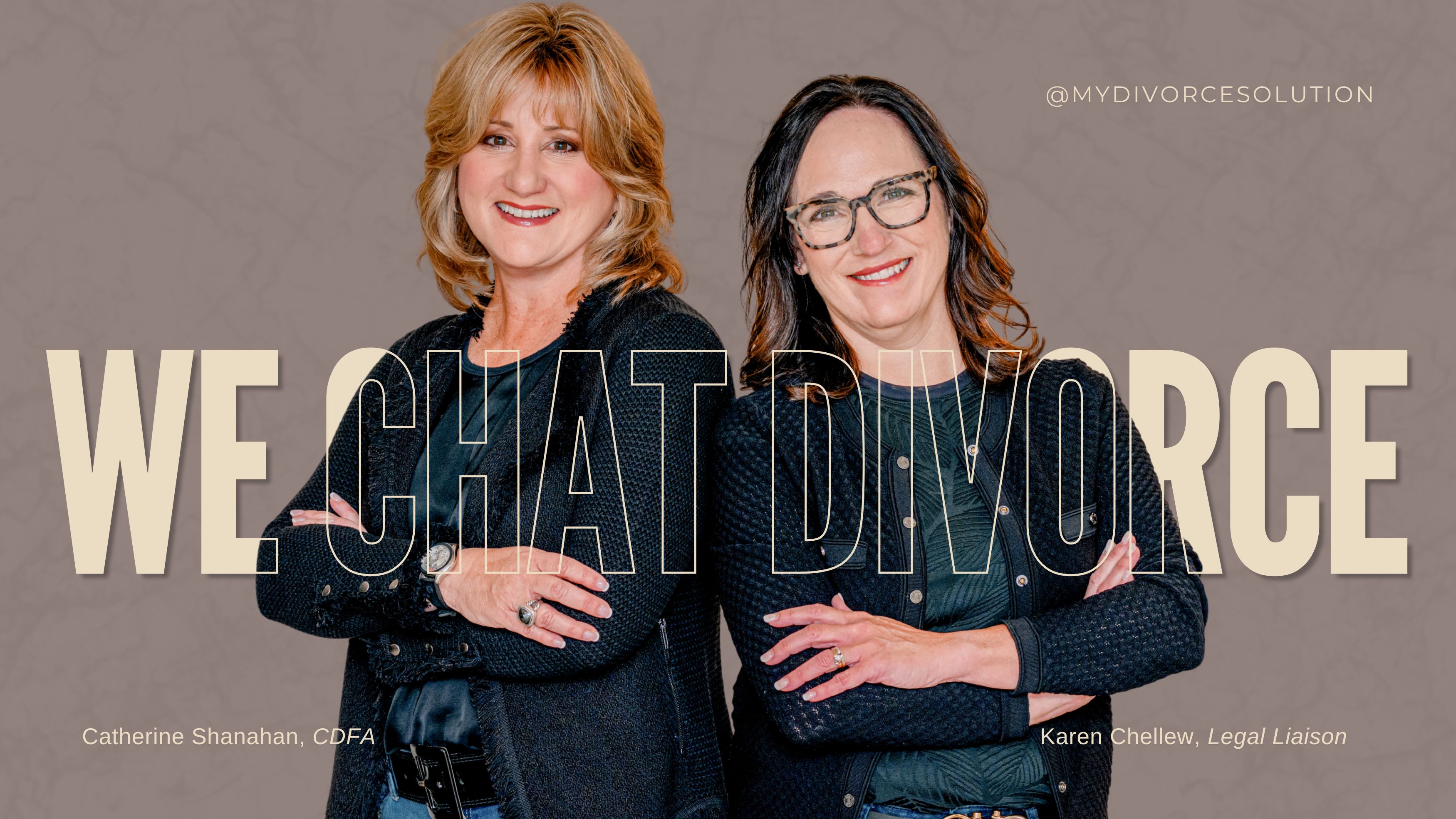
We Chat Divorce is produced by My Divorce Solution (MDS) — a financial divorce preparation company dedicated to helping individuals navigate divorce with clarity, confidence, and a strategic financial plan. Founded by Karen Chellew, Legal Liaison, and Catherine Shanahan, Certified Divorce Financial Analyst (CDFA), MDS was created to solve one of the most common and costly mistakes in divorce: entering the legal process without fully understanding your financial picture.
Divorce is not just a legal event — it is a financial transition that can shape your long-term security. Through the MDS Divorce Financial Portrait™, clients receive expert financial analysis, organized financial disclosures, and scenario planning to understand how different settlement decisions impact their future. This financial preparation often reduces legal fees, shortens the divorce process, and helps individuals negotiate from a position of knowledge rather than fear.
If you are considering divorce or already in the process, you can begin by taking the Free Divorce Financial Assessment to better understand your options. You can also join the MDS Community for expert guidance, educational resources, and live Q&A events designed to help you move from uncertainty to clarity.
At My Divorce Solution, the mission is simple: replace fear with knowledge so you can make informed, confident financial decisions during divorce.
Episode Transcript
0:01
Welcome to WeChat Divorce, hosted by Karen Chellew, Legal Liaison and Catherine Shanahan, CDFA.
Each episode we sit down with divorce professionals and industry experts to provide insights and frank discussions about real people, real situations, and real divorce to help you achieve your best life post divorce.
0:39
Welcome back to WeChat Divorce, brought to you by my divorce solution.
I’m Karen Chellew and I, yes, I can say my name today.
Your legal liaison and wallet warrior, helping you navigate divorce with more clarity and less chaos.
And I’m Catherine Shanahan and you know, Karen, I used to use my marriage the first time, last name a couple of times a few weeks ago.
1:00
So I’m gonna get that certified divorced financial analyst and your go to for transforming fear into focus when it comes to the financial side of divorce.
Today’s episode is an important one.
We’re talking about what happens when divorce intersects with major life assets like retirement, family businesses, prenups, post nup, especially later in life.
1:22
We’re looking forward to talking with our guest, Kara.
Oh my God, what is it with last name?
I know, here we are.
She’s a family law attorney who works with high net worth clients navigating exactly these kinds of complexities.
So whether you’re nearing retirement, you’re tied to a business with your spouse, Today’s conversation is sure to help you feel more informed and more prepared.
1:44
Let’s welcome Kara to the show.
Kara, welcome to WeChat Divorce.
We’re so glad to have you here today.
Thank you for having me.
Of course, first and foremost, I want to introduce you to our listeners.
Kara Chrobak is a family law attorney representing high net worth clients across Colorado.
2:04
She handles complex dissolution cases involving business valuations, trust, interest and executive compensation.
A former commercial litigator, she has significant experience challenging and defending marital agreements.
Kara has been recognized by top industry publications for her work and is active in the Denver and Colorado Bar associations and various other community leadership initiatives.
2:29
Kara enjoys collaborating with other professionals in the industry to develop creative strategies on behalf of her clients, and she approaches every case with the ultimate goal of resolution.
But before we dive into the legal talk today, we’d love for our listeners to hear a little bit about your personal journey and your recent developments.
2:48
Cara, what led you into this area of law and what fuels your passion for supporting families through divorce?
Sure.
So I started, I was a journalism student in college and I’ve always really enjoyed the story and the facts and kind of what motivates people to do what they’re doing.
3:06
I went to law school, ended up doing commercial litigation at a big law, big international law firm.
Loved the complexity, but didn’t feel like I was doing a whole lot in terms of helping my community and having kind of like a personal impact on people that are nearby me.
3:23
So I made the change to do family law because I was really looking for a little bit more of a purpose in my everyday legal life and kind of stumbled into family law still at the high net worth level.
I still kind of get to enjoy the complexity of of, you know, dealing with really difficult estates, but having a little bit more of a purpose and a personal touch.
3:45
And I also get to learn the story and understand what’s young people.
And so it’s a really good kind of combination of my skills and what interests me in a way that I think is actually really giving back to the community around me.
Also, I should say I just recently finally took the the scary leap and started my own solo family law practice.
4:06
Having worked in big law for 15 years, anyone who has done that knows how hard it is to break free of the big law machine but finally started a practice.
It’s called Bespoke Law LLC and it’s based in Colorado.
It’s awesome.
Many great change like that is so scary, so good for you.
4:24
That’s exciting.
Yeah.
Thank you.
I love that you have the litigation background.
So that must mean you’re really good in the courtroom.
But you see resolution.
That’s really what we admire and attorneys that we work with.
So good for you, Kara.
4:40
Thank you.
I think that, you know, this process can be emotional as it is.
It’s a really difficult thing for people to go through, and trying to keep people on the rails so that they can eventually kind of move forward in a really positive way is always my goal.
And from my perspective, fighting in court should be, you know, your last case, last chance efforts and you’ve tried everything else.
5:03
And, you know, because I think that that’s the best way people can move forward in a positive way.
So it could be very disruptive, but it does not have to be.
I want to push back and challenge you a little bit on that because I want people listening to understand this and, and you probably just listening to you have a good way of explaining this.
5:22
What I have a problem with a lot of times is when I see people going into mediation and they get the verbiage from their own attorney and I’ve been a financial neutral in this situation listening to this and they say you got to take this deal.
It’s the best deal.
You’re going to have you, if you go in front of a judge, it’s going to cost you $100,000 to do that.
5:40
And maybe that’s true to some level, but that doesn’t feel like a resolution to the person who’s sitting there.
Yeah, you’re trying to get me to that, but I’m feeling now like I’m being pressured into making that decision because you’re scaring me with we shouldn’t go to trial.
And I agree, less than probably 1% of people need to go to trial, but the way that the attorneys a lot of times put it out there doesn’t sound so nice like that.
6:02
You almost feel like you’re being pushed into it.
So how did, how does the person going through that or if I’m that person, you’re my attorney, how can you make me feel better about rather than just saying you’re going to pay $100,000 to go to trial and you’re going to have to pay my fees.
And the judge is going to tell you this.
There has to be a nicer way to or just not nicer, but just a more a different way that you say that to your clients.
6:24
Well, I, I would probably not be saying it to my client.
I would be saying that would be coming from the mediator, right?
Or the, or the other individual’s client.
But I would hope that, that if you are my client and we’re into this mediation and we’re hearing that it’s going to cost $100,000.
As an attorney, my job is to advise you of the risks.
6:39
And so you should be very well prepared going into mediation, what your risks are, what they look like.
And so that’s not a conversation make you feel pressured.
That’s just so you’re educated and then you can make I, I, I view this all, especially in Colorado.
It’s, it’s an equitable distribution state.
6:56
That means it’s all very, you know, mushy in terms of what a court could end up deciding.
And so there’s always a risk assessment that needs to be done for anybody who’s entering into any type of agreement or whether or not they’re choosing to go to court.
So my job is to advise you of the risks and how that’s presented.
7:13
Doesn’t need to be a done and a threatening way, but it can, you still need to be educated about what your risks look like.
So then you can make a decision of, you know what, this doesn’t feel right to me.
I, I, I’m going to push back and say no or yeah, I agree, that’s too high of a risk.
And I don’t have that kind of a risk tolerance.
7:28
But I think presenting it from that perspective rather than by it’s a threat, I think can be better received for people so that they feel like they have the power to make the choice themselves as to what feels comfortable for them.
I’m really in line with that.
7:43
I like how you lay that out, you know, and I don’t think that’s how it’s laid out.
And I’m glad your clients are hearing that from you.
You know, using that, let’s, let’s evaluate the risk tolerance here, you know, sounds so much more reasonable and makes me just feel so much better for the person who doesn’t feel financially secure or they’re sitting there.
8:01
Then listen, it’s going to, I’m telling you, attorneys say to their own clients, I’ve been witnessed to it where they say, okay, you want to pay me $100,000 to go and the judge is going to tell you something different.
And I’m, I’m sitting like what?
Like, why are you presenting it like that?
But I love, I love that layout that you just put out there.
8:17
Let’s evaluate the risk tolerance to the next step after this.
So I mean don’t.
Don’t get me wrong, I’ve definitely had that conversation where I’m saying we’re fighting over 15,000 and it’s going to cost you 30 just to even get this in front of a judge.
Like there I have that conversation.
The difference is you know you’re able to tell your client that you’re fighting over 15,000.
8:39
I think where we see happen is the case is developing discoveries out one party hasn’t fully disclosed or fully produced documents, but they either the court mandates or the attorneys decide that they’re going to go to mediation.
8:55
And so the client believes that they’re going to go settle.
However, the attorneys take the position, well, we’re going to go see how we can work out the exchange of documents.
However, when they get there, settlement negotiations go on and then the attorneys feel like they’re close enough to a settlement and then you can just see what happens there, right?
9:16
It’s, it’s all the time, Cara.
We see it and you know, from our end, we’re all about financial clarity.
Please don’t go to mediation.
Please don’t have settlement negotiation till you know what you’re dividing and you have documentation to support it.
9:32
So you know, it, that’s the Gray area where we find our clients.
I know we’re talking about Gray divorce and that’s a different thing today.
That’s where that’s where we are in the mix a lot because we feel like our clients don’t have enough documentation to make good decisions, but yet they’re being forced through the system for a variety of reasons.
9:54
As an attorney, the circumstances you just presented give me hurt, palpitations because I, I believe that I have a ethical duty to make sure that my client is educated on what exactly they’re agreeing to and what exactly they’re agreeing to give up in the event that they’re giving something up before they’re entering into an agreement.
10:13
And so I don’t believe you can do that until you either have full and fair and adequate financial disclosures or they’re advised all the different which ways via letters, etcetera, of the fact that they’re walking away from this disclosure process and agreeing to the settlement.
10:29
But I would not be pressuring a client into agreeing to something before they’re even have the knowledge of what it is they’re, you know, actually agreeing to.
So I don’t, this situation makes me nervous.
I’m sure you saw my face, but I I did and.
I appreciated your facial expressions.
10:46
Yeah, for sure.
All right, so let’s start into our topic today of Gray divorce.
What are some of the unique financial and or legal concerns when people are divorcing later in life?
What are the special nuances of those cases?
11:02
I think that when people are divorcing later in life, often times they are approaching or very near retirement.
And so that is front and center in terms of what is at issue for Gray divorces retirement accounts and how they will be divided and what that will look like for both of the parties after their divorce is finalized.
11:21
Because a lot of people in a marriage do their financial planning, make decisions, save in contemplation that they will be jointly living off of X retirement account and then all of the sudden X retirement account is divided in two, hypothetically speaking.
11:38
And then you, that’s a whole different can of worms in terms of how you will live, what your financial situation looks like, you know, and whether you can swing it.
And so that is a huge aspect of Gray divorce.
This is how those retirement accounts will be divided.
Additionally, the idea of spousal support can get a little bit complicated in Gray divorces because Colorado at least is a state where you can be a lifetime maintenance candidate.
12:06
And so if an individual’s approaching retirement and looking at not working anymore, that can become challenging.
If you end up with an award of lifetime maintenance is how do I, what do I do then?
Because I don’t want to be stuck paying maintenance forever.
And then, you know, I would say the idea of individuals who’ve stayed at home on the flip side of that and not worked in 35 years.
12:28
Suddenly recognizing that first of all, the retirement account that we’re dividing up in 2 is not going to be enough to help me.
But also I have to get back into the workforce.
And what does that look like for me?
And that can be a big burden for individuals to kind of overcome as they’re approaching the big life transition later in life.
12:46
Yeah.
You know, then you have the emotional side with great divorce.
Great divorce a lot of times just means that you don’t really say anything bad about your spouse.
You just don’t want to be married to them anymore.
So how do you make, how do you reconcile that emotional part with the financial part where you know, OK, I just don’t want this divorce, but I don’t want to stay neither.
13:07
So we do have to split these accounts.
And it’s true, you do work your life and then you hear you’re at retirement and you’re retiring on half the value.
That’s a very different passive income than than what you were anticipating.
And they’re common.
I mean, these are these are this I always kind of think about divorce kind of coming in waves in life.
13:24
Different life phases have different, you know, stressors and transition and, and approaching retirement or immediately after retirement is actually, I think a very common time for people to re evaluate life and, and kind of consider what is the next 20 years going to look like for me?
13:41
And, and do I want to keep doing what I’m doing?
I think that people, you know, suddenly have not been together for a while and are seeing each other a lot more than they have historically.
And they’re recognizing maybe the dynamic has shifted in a way that neither one of them wants anymore.
But it is a very common transition time for people in life.
13:59
And so, you know, for those that are, are considering it, you know, it’s not abnormal, obviously, because here we are talking about it.
It’s common enough that we, you know, are very, all three of us are very experienced and kind of had to navigate the the challenges with them.
A little bit before we got on, we got to speak a little bit about post nuptial agreements because at my divorce solution, when they go through our method and we talked through the finances and what’s going to look like, possibly because we go through a couple of scenarios for them to bring to you their attorney.
14:28
They decide, you know what, maybe we don’t want to get divorced.
Maybe we just want to live different financial lives.
And so we tell them to go to an attorney and talk about a post nuptial agreement, which is probably very common for great divorce thinkers as well.
Absolutely, Yeah.
I mean, I think that they see what you guys have presented, they see what the financial circumstances will look like.
14:48
And then they recognize, you know, another thing is like if they’re still using enjoying one party’s health insurance, if there’s, you know, there’s a lot of aspects to think about as you’re approaching a divorce.
And there’s also a way to do it such that you live effectively separate lives but continue to stay married so you get to enjoy the benefits of the marriage later in life.
15:07
And I’ve seen that happen a lot as well for for post naps in Colorado.
The 11 of the main factors for enforceability is ensuring that the parties are not contemplating divorce.
And so as long as the parties are not contemplating a divorce, it will be held up as enforceable.
15:25
But I just would throw that out there as you’re discussing that with your clients, and I’m sure you do that, make sure that you know they’re really committed to continuing to stay married and this will help them do that.
Oh, that’s interesting.
Yeah, because you’re elaborating, right?
Yeah, we don’t give legal advice.
So that’s, you know, that’s a great.
15:42
Iteration, right?
Yeah.
Thank you.
Yeah.
Yeah.
I mean it’s a tricky area of the law because what that looks like I think can differ depending on the situation, right.
I’ve had a clients before who were had filed a divorce and then decided they wanted to reconcile, but a divorce case was still pending.
15:59
And how you go about negotiating a post nuptial agreement after you filed for divorce, because those two facts in sequence demonstrate that they were contemplating a divorce at some point, you know, in the very near future.
And so I think it’s a matter of really just making sure that you have the facts to support the idea that you’re really trying to continue to stay married.
16:22
And so sometimes you know that’ll be dismissing the divorce case before you start negotiating postnup.
Sometimes that will mean, you know, the fact that you stay married for several years after the divorce was filed and and then dismissed can also be a helpful fact, right?
16:38
So if you file for divorce, dismiss the divorce, negotiate a postnup and file for divorce again six months later, you’re going to have some issues with the idea that this was being done in anticipation of a divorce rather than being done for the purposes of staying married.
16:55
So it’s a, it’s a very fact based analysis and there’s a lot of Gray area in it, but I certainly think lawyers will be advising their clients to be thoughtful of that standard as they’re negotiating a post op.
If you file for divorce and you reconcile and you just forget about the filing, both of you, does it dismiss itself ever or does it have to be dismissed by one of you?
17:19
A court would eventually probably dismiss it.
They would issue the court would issue like a delay reduction order and say you guys have to file X before this date.
And if you nobody files anything, then the courts just going to on its own dismiss it.
So it would eventually get itself dismissed.
But certainly if I was involved, I would be like, let’s just notify the court so we don’t make the judges mad at us, right?
17:39
But if if parties are on their own, if, the court should eventually dismiss it.
So I have a question back to the Gray divorce and you mentioned a lot of retirement accounts.
So we could all understand that as you’re later in life, you’re probably, you probably are, for lack of a better term, retirement account heavy, right?
17:59
And so sometimes we’re in a conversation where I one of the first things we do when a client hires us and they have an attorney, we get on the phone with the attorney.
And so there have been situations in just like the one I just laid out where the attorney would say what we’ve we’ve already split the retirement accounts and now we have the home and the business and some cash accounts.
18:22
And I’m always confused about that approach because it to me it takes away the the real integrity of an equitable distribution if you just split the retirement accounts or split the cash accounts or split anything without considering the whole, what is your take on that?
18:41
I guess I would push back and ask why, why, Why?
If they’re equally dividing the retirement account, for example, why would that raise alarms to you?
Because to my, to my perspective, if you’re equally dividing the retirement accounts, you’re both getting the tax consequence, you’re sharing the tax consequences associated with, you know, taking distributions and you’re also you also face the same liquidity challenges.
19:07
So I guess I would be curious if the intent is to divide everything, I would want to know a little bit more about what the plan is with the business and the cash accounts in the real estate.
But the retirement account itself, I don’t know.
I guess I would.
That would be a little bit more palatable to me than saying we’ve already divided the business, but now we need to divide everything else because of the liquidity and tax consequences associated.
19:29
Yeah.
And it’s not so much that it creates alarms.
It’s just from my perspective, you know, if there’s a lot of equity in the home or one spouse is still working and the other one isn’t and you’ve just made a decision to split down the middle retirement accounts, you can’t use those to offset any other asset or debt.
19:50
Some attorneys are pretty solid in that.
And some attorneys say, well, of course you got to divide everything as a whole.
And I, I find all different kinds of perspectives and I, you know, wondered what it was like maybe in Colorado or the way, you know, the attorneys around you practice.
20:11
Yeah.
I mean, I would say on a general level, it’s important to do it as a whole.
But I do think that it’s probably a fact intensive question because I would have more concern about the idea that we’re using the equity in the house and one party is getting the equity of the house and the other party is getting all of their retirement account.
20:29
That would be more upsetting to me.
And in terms of a liquidity issue and a tax associated issue rather than saying we’re just going to equally divide the retirement and then we’re going to work out dividing up the business and otherwise.
But I mean that is such a hard.
Yeah, it is.
20:45
Until you know the exact facts and what the balance sheet looks like and what you’re trying to divide, it’s really hard to weigh in as to like whether or not that would feel comfortable to me.
Yeah, I mean financially speaking, I think to kind of go off this, you know, it really just takes away a lot of negotiation power moving forward, right.
21:02
And and a couple of instances that we have seen that really I felt was not right was that retirement accounts get split up because that’s where a lot of the money is sitting right now.
But then what they do is they go take the non weight, they go tell the non wage earner to start living off their retirement money that they just got because they just got $1,000,000 in retirement money.
21:23
Now you can go liquidate from that and pay my legal fees and you could go liquidate from that to live on it where the wage earner still has their income and the APL, the any pending alimony isn’t really set in place.
So they just look at the non wage earners.
They go spend that $1,000,000 you just got.
21:39
So now we just lost some negotiation power.
Now she dips into typically she or he dips into this retirement account.
They got to pay taxes on it because everything else is held up for future negotiations.
So you got to, you know, consider what’s the impact of that.
And no, you’re not taking income off of that yet if there’s other resources.
21:58
Agreed.
And also if the individual, if the other if individual continues to be working, I would say that the person who’s expected to live off of the retirement is a candidate for maintenance or spousal support until the time that the other spouse stops working.
So I would argue that, but I think you have a good point that you do lose some negotiation and bargaining power when you’re agreeing to things piece meal rather than doing it as a whole.
22:20
Yeah.
Tara, I so appreciate you saying that.
So appreciate you because sometimes I just hear that’s how we do it here and there’s there’s no further thought then that’s how it’s always been done.
So I appreciate your perspective of other angles for sure.
22:40
Yeah.
It’s, it’s hard because there have definitely been times when I’ve told to clients, yeah, this is what the law says here.
Like there’s not a whole we can do to get around it.
So I’m, I’m both sides to that.
But certainly being able to think about things as a big picture, I think it’s helpful, especially when you’re trying to come up with, you know, going back to the beginning of our conversation, settlement can be creative.
23:00
You know, settlement doesn’t have to be the way we do it here or the way the judge will do it in the event that we have to take it to a judge.
Like if you’re in mediation, you don’t have to do it that way.
And you can do it very different ways that feel good for you and feel good for your soon to be ex-spouse.
And, and if you don’t have people in your corner who are willing to get creative and roll up their sleeves to figure it out for you guys, then you should find somebody who is.
23:22
Because that’s the beauty of mediation and resolution on your own, is you get to take the control rather than have somebody else decide it for you.
Yeah.
And I also want to back up what you just said.
Again, it’s how you’re framing it, which really goes a long way when you said that’s what the law is in this, you know, state in Colorado.
23:39
Here’s the law.
Now if you say that to me, I’m going to listen to you and I’m going to respect you as my attorney.
Tell me that unlike what Karen just said, where we hear that’s just how we do it here.
Like you’re, you’re dismissing, dismissing my my fears or my concerns by just saying that’s how we do it here.
23:58
But when you again, you’re, I appreciate your framework there.
You know, as the lawyer, tell them what the law is that’s that’s making you dry.
Give them that decision or helping them make that decision.
I should say I think your practice is going to do quite well.
This is how you’re treating your clients.
24:14
Well, thank you.
I mean, I, I think it’s all about it’s a lot.
Yeah.
I mean, thank you.
It it’s it’s such a scary, life altering experience to go through a divorce.
Like it is just one of the greatest, scariest, most anxiety inducing, you know, things that individuals experience in their life.
24:32
And so I think that being educated is one of the best ways to help quell a lot of the anxiety, at least for people who are like me, who I manage my anxiety by just trying to gain control as much as I can, right?
And I think I see a lot of that in my clients of what can I control?
24:49
This feels topsy turvy and it’s spinning out of control and I cannot control it.
What can I control?
And so the, I like to educate my clients because I feel that being educated and understanding the confines of the law, understanding how this process works, the more that you can be educated, the more control you feel like you have over the, the, the situation, which we, we don’t.
25:09
I mean, there’s only we can take today and then tomorrow and, you know, work our way through it.
But at least being educated I think can help a lot.
Oh, yeah.
When we go through the MD’s method, it’s about educating our clients.
Knowledge is power for us, right?
But then we say take your financial portrait to your attorney and let them apply the law with you so that you can, they’re your advocates, applying the law to what you have and what you don’t have and what’s there and what’s not there.
25:32
And we kind of tie that all up in our portrait and we just need the attorneys to now take it like you’re saying, you know, apply the law to what they have so that they understand it because we’re pretty smart.
You know, we might not know what the markets doing today and we might not know how our finances run before, but our clients, we see them sit a little differently towards the end of the process.
25:53
And you know, they have those aha moments.
Oh, I get it.
Oh, This is why we did that.
So they’re smarter than they think that they are at that time.
So if they can go to you educated and informed and you could just further that education with them, divorces wouldn’t be as painful as they currently are.
26:09
And they are painful.
They’re 2nd and grief to only the death of a spouse or a child, right?
So it is a painful process.
So the more we can educate them, the better off everyone will be.
How do you guys deal with situations kind of going back to the, you know, conversation about how this is just how we do it here.
26:26
When you have a client and you feel like you have set an expectation for a maintenance or spousal support amount and the client goes back to the attorney and the attorneys says there’s no way in this world you’re getting that.
How do you guys deal with that?
Because I have also experienced that working with financial planners before.
26:44
And I’m curious kind of, you know, I’m, I’m a big believer in working with advisors to make a really holistic team effort.
And sometimes it can get very challenging working with advisors when we’re giving contradictory information or advice because expectation setting is everything.
27:00
And that can really mess up our ability to negotiate.
Oh boy, we.
Can answer that one really.
You’re going to go first.
You go. 1st, I’m a CDFA, right?
And I’ve had this conversation before with attorneys.
So our Cdfas do not invest anybody’s money.
27:15
We don’t have any stake in the game, but we come from a we come from a space of providing the knowledge about what investments they have, what they don’t.
We do their lifestyle analysis and their budget.
We don’t tell them what they’re going to get.
As a matter of fact, Karen will tell you that I hate when they’re when they say what’s my support payment going to be?
27:33
Because if they have an attorney, we always get on the call with the attorney because I want to hear the attorney strategy, right?
He say, can you run a support calculation to me?
I hate it.
I want to talk to the attorney one-on-one at 1st and say, what do you think this client will get?
You know, because there’s really no good, there is really no alimony calculator that everyone relies on, but we rely on their budget.
27:56
And we say this is your budget.
However, you need to present this to your attorney and let them tell you what you could get if you’re even a candidate for support.
And it’s the same thing when we go through division scenarios, you know, it always stops at the starts at the top of the house.
You know, if you want the house, this is what it will look like to balance that out.
28:11
Now take these two scenarios to your attorney or to mediation and let them talk you through it.
So we don’t ever tell them what they’re going to get or give them an expectation or this is what how it’s going to happen.
We just talk through different scenarios and really rely on that budget.
28:27
Now can we do a child support calculation?
Yes, but I’ll tell you this, there’s a disclaimer on ours at the bottom because of overnight stays and this and all the factors that go in.
So if they have an attorney, we’re definitely in line with the attorney strategy before and actually invite the attorney onto the calls if possible so that we don’t have any misaligned incentives here because it could be messy.
28:48
So we totally to see that, but go ahead, Karen.
I don’t know what you’re doing there.
No, just that we, if a client has an attorney, we are just short of insistent that we get on a call and we say this is, you know, the client came to us, this is our role.
29:04
We would, we would love your perspective.
This is some areas where we need your lens so that we’re all working together with this client to get them to a solution.
Yeah, Karen, how many times we insist?
And the reason being is because if Karen, you know, they’ll say, well, Karen said because what Karen said, well, Karen said.
29:26
So when we’re on with the OR they’ll even say, well, my attorney told me XY and Z about something.
OK, well, can we talk to your attorney just because it’s always better.
We all hear it from each other and we want to be on with the attorneys so they know that it’s not Katherine’s or anyone on our teams said.
So we stick with the knowledge of we’re getting anything you prepared, we do a draft of your state affidavit if you have your state has one.
29:49
We do their income and expenses so we they can, they can stand behind the numbers they gave us.
And then we collect the data and go through what’s potential scenarios can be.
And then we make sure we always get on the call with the attorney first.
I mean, I think that’s huge to just make sure you’re aligned.
30:05
So I think again, going back to the control and scariness of all of this expectation setting can also play a big, big part in that and an ability of an attorney to get things across the finish line for people.
So I think it’s important everybody’s communicating and on the same page I do going back to kind of the Gray divorce thing.
30:23
I also am curious from your guys’s perspective, listening to your process, I would expect that you see more just based on my own experience, you guys would see more or provide more of a value to individuals going through like a later in life divorce than perhaps you would for individuals who are younger.
30:44
Because from my perspective, the clients that I have had who are older have more attachment to a home, for example, and care a lot more about maintaining their house and keeping their house.
And you know, the, the questions about retirement accounts become a lot more complicated and need to be much better plotted out when you’re dealing with an individual who’s 50 versus somebody who’s 28.
31:10
And so I’m curious from your perspective in terms of a workload, do you think that you guys provide more of a value for older people who are going through a divorce rather than those who are younger?
I believe that our method provides clarity for everyone.
31:25
So while the issues may be different from Gray divorce to younger, our younger families are more, they have more issues like executive compensation or building the business or cryptocurrency or investing that a lot of people are investing in all kinds of things now and breaking those down into bite sized discussions so that things become clear because the supporting documents are typically hard to get your hands on for valuation purposes, as you well know.
31:55
So I think it’s just a different way of helping these various couples go or families going through divorce.
I think that and I think that the I agree with Karen there, but I think with the the older clients, they find so much value in our process because they can talk to us about division series.
32:14
They won’t talk to their attorney about they don’t, it’s a different conversation, right?
They’re either afraid of their attorney or it’s not the same financial conversation.
And because we don’t have a stake in the game, we’re not telling them what asset they should keep.
We’re not telling them that we’re going to invest this for the future.
32:30
They really feel like it’s a safe space for them to ask questions that they think are done because we’re bringing it down to the numbers and we’re looking at that number and we’re showing them if you shifted, if you don’t keep the house and you downsize, you’re not giving up this pension plan because your attorney’s going to do what you ask them to do.
32:46
You know you want to keep the house.
They’re going to do what they can to help you keep the house, but do you really know the impact of that, what you are really giving up and what do you need to consider with your life?
So they talk more freely about with us because we don’t, we don’t have a any kind of, we’re not attorneys, so we’re not giving them legal advice.
33:04
So they feel really safe about that.
And we’re we’re just laying out the information in kind of Karen’s term, those bite sized Nuggets that they now start saying, oh, aha, you know, even when we do their budget, Oh, I didn’t know I was paying so much for that, you know, and now they go back and they feel so much more confident talking to their attorney, you know, saying like, this is what I was, this is what a scenario look like.
33:26
What do you think legally for me?
Like they feel stronger.
They feel instead of being embarrassed that they weren’t involved, you know, they’re not as adventurous as our younger clients who are doing like Karen said, invest.
They’re more like, Oh my God, I don’t have a retirement plan.
It’s all in his name.
Well, let’s look, you know, so I find them to be the ones that I love seeing their transition where there’s stop apologizing for being that stay at home parent, you know, you know, they start getting a realization that this is what the marital state could look like, you know, and now I can go talk to my attorney and not feel like I have to explain.
34:00
You know, I can really sit there and feel more confident talking to them because they’re an attorney’s Not as scary when you have knowledge, right?
I mean, I’m just so I’m, I’m like the biggest believer and there’s no such thing as a dumb question.
So that’s so interesting to hear from your perspective that that clients come to you afraid of asking me dumb questions because I’m all for the dumb ones.
34:22
I love the.
Dumb ones.
Oh, I love that.
Again, I love that we we give them questions to ask.
Good.
Yeah, it’s great.
Again, education is like the whole point of all of this is being.
Yeah, 100% and.
I’m glad you say that.
Oh, sorry, Karen.
I’m glad you say that.
OK.
We always say if your attorney can’t answer some of these questions, if you’re not comfortable asking these questions, you might not be with the right attorney.
34:42
Totally.
I’m going to give a little snapshot of a Gray divorce situation where I had a conversation this week.
So 2 professionals, 1 spouse is 59.
The other spouse is 6465.
They had agreed that when they turned 60 they would retire.
35:01
One spouse is already retired.
Now they’re approaching divorce 59.
That spouse is still actively working, making a very good wage.
She says.
Attorney told me that it’s the law that I have to work until I’m, I think she said 67 and I said, but you’re in mediation, right?
35:19
Yes, I’m in mediation.
And your attorney told you you have to work until you’re 67 and pay your spouse support until then.
Yes, that’s what the attorney said.
So I have nothing to say other than, OK, when you hire US, one of the first things we’re going to do is get on the phone and and I’ll better understand how we can support you through this process.
35:39
So I don’t know if the attorney will say you misheard because you’re in mediation, you can negotiate anything or she’s going to hold fast.
I have no idea, but these are the questions and this is how clients receive information and they don’t understand all the various nuances of the options and the decisions that are available to them when they choose to mediate.
36:01
It is very important that they know if they’re in front of a judge, how the judge is going to decide.
That’s critical.
But they also should be aware and in the know educated about what other options may be available to them.
Yes, and so there’s certainly law that could support the attorney, what the attorney said, at least in Colorado with respect to, you know, the expectation of continuing to work.
36:24
But I also because these are courts and equity and because everything is equitable in nature, I think that there could be arguments to be made on, you know, various different aspects of that fact pattern you just presented.
But I also would say that, you know, some of our job too as lawyers is similar to what I was asking you guys about expectation setting.
36:45
And so it’s possible that there was a, a point or a part of a conversation where the lawyer was trying to set some expectations that there is a risk here.
Again, going back to the risk analysis, right, there’s a risk here that you might have to work until you’re 67.
There is there would be a risk that is a risk, though, you know, making sure that that expectation is set.
37:04
And so that then when they go into mediation, all of a sudden they’re saying, oh, no, you don’t need to do this past 60 or something like that.
That feels like a win.
And so really at the end of the day, we also want our clients to walk out feeling like who I dodged a bullet there, you know, and and I feel like I got I don’t love the mediation agreement.
37:22
I it’s not, you know, the mediators say this all the time.
If both parties walk out saying I don’t love it, but I can live with it, that’s how you know you’ve struck a good deal.
And so part of that kind of psychology of feeling like I don’t love it, but I can live with it is recognizing that could have been a heck of a lot worse for me if I had taken that in front of a judge.
37:42
And so it’s very possible that’s what the attorney is trying to communicate.
But what’s being heard is I’m stuck paying until I’m 67, you know?
Absolutely.
And I know that just by virtue of my role, but I can’t say anything to the point that would essentially be dispensing legal advice.
But I appreciate that you say that.
37:59
And I fully expect the attorney to report that back to my point being how the clients receive information when everything is essentially a foreign language at that juncture of the divorce, right?
Well, I, I really value and appreciate how you interact with your clients and your approach and your openness to them being fully financially prepared, so.
38:24
If you’re listening and you’re under 35 or over 65 or anywhere in between, I know we call this the great divorce and we’re talking about that.
But you know, due to the great conversation, I feel like it LED in another direction.
And it’s a direction I think is really, really, really, really important.
38:41
And that is Cara.
I love the framework of which you speak to your clients.
And if you’re with an attorney who’s not speaking like she is, and that is by explaining to you, you know, what is the law based on something?
What are your expectations for whatever scenario or for if your support candidate, what are the expectations here?
39:00
And, and let’s apply the meaning behind all of that and know what your risk tolerance is like when we walk into a mediation or you, when you start your negotiations with your attorney, make sure they’re explaining to you what the risk tolerance is not.
If they have the language to you that this is what’s going to happen or this is what’s going, they’re talking down to you.
39:18
Or do you feel like they’re being dismissive?
If you’re prepared and you have everything in line, your attorney’s going to speak to you the way they should.
And I, like I said, Kara, I think you just laid out so many ways that made me as a financial feel better that if you were talking to me that way, I know I would feel better.
39:36
So if you’re listening and you need that kind of guidance, don’t, don’t be afraid to leave a message or a comment.
I’m sure we can get Kara to come back on and we could talk some more.
Or I’m sure she’s going to supply her information or where you can find her directly if you’re in Colorado.
For sure.
And so on that note, Kara, thank you for your wisdom and for your work.
39:53
I Ditto everything Catherine said.
So for our listeners who want to connect or learn more about your practice, where can they find you?
They can find me on my website, bespokelawllc.com or to the extent they want to connect, connect on LinkedIn.
40:10
I would be happy to accept their connection.
Cara Crowback.
Awesome, right?
Thanks for listening today.
Be sure to like, subscribe and share this episode with anyone who needs it.
You can find more resources on your own by taking our divorce financial assessment and of course, listening to the.
40:26
Podcast and remember, knowledge is power and you’re stronger than you think.
Until next time, thank you again, Kara.
You’re welcome.
Thanks for joining us on another episode of WeChat Divorce.
We hope this episode was informative and supportive on your divorce journey.
40:43
If you're looking for more support for navigating divorce with confidence and clarity, head over to azure-emu-499854.hostingersite.com/ for more podcast episodes, divorce events, and resources for your divorce.
We’ll see you back here for our next episode.