






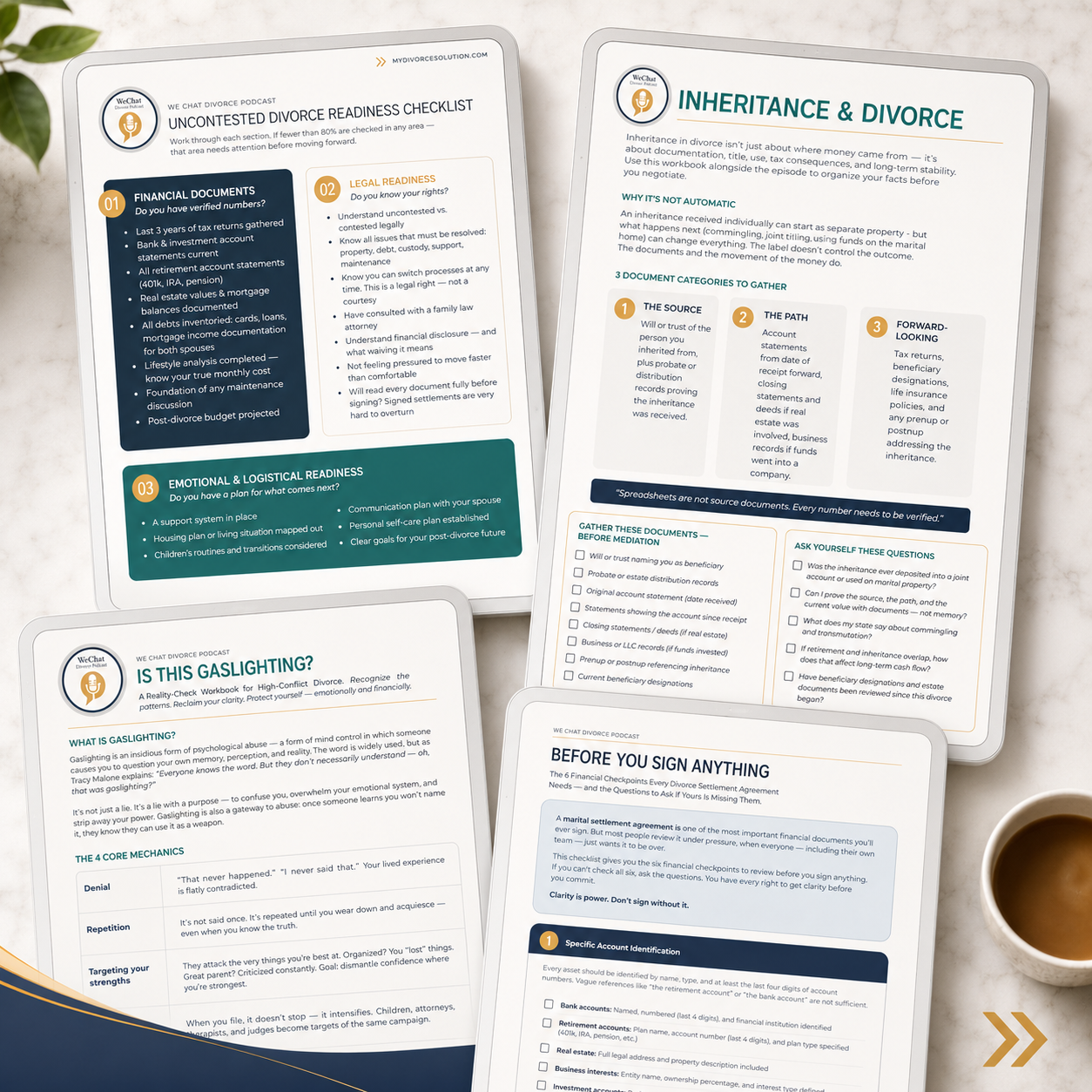
Download The "Is This Gaslighting?" Workbook
A Reality-Check Workbook for High-Conflict Divorce. Recognize the patterns. Reclaim your clarity. Protect yourself — emotionally and financially.
By submitting this form, you agree to receive communications from My Divorce Solution. Your information is confidential and protected.
Gaslighting in Divorce: How to Recognize It, Document It, and Protect Yourself
You’ve probably heard the word. But do you know when it’s actually happening to you?
Gaslighting is one of the most commonly discussed concepts in divorce conversations today — and one of the least understood in practice. Everyone recognizes the term. Far fewer people recognize the moment they’re living it.
In a recent episode of We Chat Divorce, Karen Chellew and Catherine Shanahan sat down with Tracy Malone — narcissistic abuse expert, coach, and bestselling author of Divorcing Your Narcissist — to talk about exactly that: what gaslighting actually looks like, how it shows up in divorce, and most importantly, what you can do about it.
If you’re currently in a high-conflict divorce, or if something in your marriage has always felt “off” in ways you couldn’t name, this article is for you.
What Is Gaslighting, Really?
Tracy Malone offers one of the clearest definitions available: gaslighting is an insidious form of abuse — a form of mind control in which someone causes you to question your own memory, perception, and reality.
The term comes from the 1944 film Gaslight, in which a husband slowly convinces his wife she is losing her mind by manipulating her environment and denying what she observes. The tactic is the same today: repeated manipulation designed not just to lie, but to make the target doubt their own ability to perceive the truth.
“Everyone knows the word. But they don’t necessarily understand — oh, that was gaslighting? Whether it’s in divorce or any relationship with a narcissist, when I explain it, they’re like, oh yeah, that’s been happening way longer than I thought.” — Tracy Malone, narcissistabusesupport.com
That last part matters: it’s been happening way longer than you thought. If you are divorcing a narcissist, Tracy says plainly, you have been gaslit since the beginning of the relationship — from the very first version of themselves they presented to you.
And it’s not just a lie. As Tracy puts it: “A lie is gaslighting, but it’s not just a lie. It’s a lie with a purpose — to confuse you, to overwhelm your emotional system, so that you have no power.”
Gaslighting as a Gateway
Tracy makes an important distinction: gaslighting isn’t just one abusive behavior among many. It’s the entry point. When a controlling partner first tests whether you’ll push back — and you don’t, because you don’t yet have the language to name it — they learn that manipulation works. From that point, they know they can use it as a weapon.
This is also why gaslighting is increasingly recognized within the framework of coercive control — a pattern of behavior now being codified in law in many states. As coercive control gains legal footing, gaslighting documented through journals, communications, and behavioral patterns may carry weight in family court proceedings.
The 4 Core Mechanics of Gaslighting
Understanding gaslighting as a behavior means understanding the tactics behind it. Tracy breaks it down into four key mechanics:
1. Denial
The most direct form: your lived experience is flatly contradicted. “That never happened.” “I never said that.” The goal is to make you question the reliability of your own memory.
2. Repetition
It’s not said once. It’s repeated — again and again — until the target wears down and acquiesces, even knowing it isn’t true. Tracy describes this as “almost brainwashing.” Her own example: after 10 years of being told she lost $1,200 in Home Depot gift cards she knows she never touched, she finally gave up and said “fine.” Not because she believed it — but because the fight was exhausting. That’s exactly what gaslighting is designed to do.
3. Targeting Your Strengths
This is one of the most insidious mechanics, and Karen highlighted it in her conversation with Tracy: the thing they attack is often the very thing you’re best at. Tracy is famously organized — she labels items in her bathroom. The gaslighting claim was that she lost the gift cards. A great mother becomes “a bad parent.” A thoughtful cook is told the dinner wasn’t good enough. Over time, the target of this tactic becomes a shell of the person they were, doubting the very strengths that once defined them.
4. Escalation During Divorce
When divorce is filed, gaslighting doesn’t stop — it intensifies, and it expands. Tracy describes how the behavior spreads to new targets: the children, the attorneys, the therapists, and the judge. The narcissistic spouse campaigns to be seen as the victim across every arena of the divorce simultaneously.
DARVO: The Acronym That Names the Pattern
Tracy calls it “the love language of a narcissist.” DARVO stands for:
- D — Deny: “I didn’t do that. I never said that.”
- A — Attack: “How dare you accuse me. You’re the problem here.”
- R/V/O — Reverse Victim and Offender: Suddenly the one who caused harm is now claiming to be the one harmed — and you are the abuser.
If you’ve been in a high-conflict relationship, that pattern likely sounds familiar. Catherine’s experience mirrors it precisely: when she’d use the word “always” in a conflict, the response was never to address the concern. Instead, it became: “Always? Did I say it yesterday? Did I say it this morning?” One word, weaponized to make her feel irrational.
DARVO is gaslighting in its most structured form. Knowing the name changes how you receive it.
What Gaslighting Sounds Like: Common Phrases
Tracy shared the phrases she hears most often from clients navigating these dynamics. Many will be immediately recognizable.
Emotional Gaslighting Phrases
- “You’re too sensitive.” / “You need to grow a thicker skin.”
- “That never happened.” / “You’re remembering it wrong.”
- “You’re always imagining things.” / “You’re crazy.”
- “I don’t want to hear that again. You’re just trying to confuse me.” (withholding)
- “You always do this.” / “You never appreciate what I do.” (the weaponized word)
- “Don’t worry — I’ll be fair.” (the false reassurance that keeps victims off guard)
- “I’ll destroy you if you divorce me. I’ll take the kids.” (intimidation as reality control)
Financial Gaslighting Phrases
In divorce, gaslighting frequently turns financial. As Catherine explains, a narcissistic spouse who has been the money controller has often been managing the financial narrative for years.
- “There is no money.”
- “You spent that.” / “You took that money out.”
- “I’m not hiding anything.”
- “You wouldn’t understand the finances.”
- “I’ve already paid support.” (stated with no documentation to support it)
“I have a friend who divorced her husband after 29 years. The whole time, she thought they didn’t have a lot of money. If she spent more than $50 at the grocery store, she was sent back with the items. When the financials came in for the divorce, they were multi-millionaires.” — Tracy Malone
That story isn’t unusual. Financial gaslighting — controlling a partner’s access to and understanding of marital finances — is one of the most common forms of financial abuse, and one of the hardest to see from the inside.
The Financial Antidote to Gaslighting Catherine’s approach at My Divorce Solution: You don’t need to call anyone a liar. You simply say: “Can you show me the statement that supports that? We believe you — we just need to verify it with the document.” Documents don’t gaslight. Numbers verified against paperwork become your protection.
How Gaslighting Escalates When You File for Divorce
Filing for divorce is not the end of the gaslighting. For many people, it’s when it intensifies and spreads.
The Children
This is one of the most painful escalations. Tracy describes narcissistic parents who slowly “morphing” children against the other parent through repeated false narratives. The tactics are calculated: telling children not to eat food at Mom’s house because “you don’t know what she’s doing with it.” Creating fear where there was none. Children, whose brains are still developing, are impressionable — and repetition works on them just as it works on adults.
The Legal System
The narcissistic spouse often brings the same campaign to attorneys, therapists, custody evaluators, and judges. They are, as Tracy says, “gaslighting the judge into thinking they are the victim.” When you understand this, you understand why documentation isn’t just helpful — it’s essential.
It Doesn’t Always End at Divorce
Karen shared that her ex-husband still speaks disparagingly about her to their children, decades after the divorce. As Tracy explains: “He’s never going to let it go, because that’s his story. And if it’s slipping away, he goes back in and hits it again.” For people divorcing someone with narcissistic traits, ongoing co-parenting communication is often where the pattern continues.
The Most Important Thing You Can Do: Document
Both Tracy Malone and Catherine Shanahan — speaking from both professional experience and lived experience — say the same thing:
“Start documenting now. Judges love patterns. If you start the day of the divorce, you won’t have the historical patterns you need.” — Tracy Malone
Catherine kept a detailed journal for years before her divorce. She wrote the date, the room they were in, and the exact words spoken. She describes watching her handwriting get larger and more agitated across the years — and also being profoundly grateful for it when her ex later denied saying things she had documented clearly.
The journal didn’t always make it into the courtroom. But it kept her sane. It gave her something to return to when reality felt unstable.
She eventually burned the journals five years post-divorce — a deliberate act of letting go. But during the process, they were irreplaceable.
What to Document
- Date, time, and location of incidents
- Direct quotes where possible — exact words matter
- Any witnesses present
- Texts, emails, and voicemails — screenshots and backups
- Financial discrepancies: what you were told vs. what you later found
- Changes in the children’s behavior following visits
- Any threats made, directly or through intermediaries
| Why Documentation Matters in Court Tracy explains it clearly: gaslighting them in conversation before the divorce is often a preview of what they plan to use against you in court. By the 45th time they’ve told you something you know isn’t true, your notes show a documented pattern — and judges respond to patterns. |
How Financial Clarity Protects You from Financial Gaslighting
Catherine draws a clear line between the emotional recovery from gaslighting and the financial: both require the same foundation. Documentation. Verification. Independence.
In the context of divorce financial planning, this means not accepting verbal assurances about what assets exist, what debts are owed, or what income has been earned. It means requesting — and reviewing — the actual statements. It means building a financial picture that is based on documents, not narratives.
As Catherine puts it: “Whether your spouse is a confirmed or diagnosed narcissist or not, in divorce, most of them have narcissistic traits. You really need to verify information with data.”
“Financial clarity was my superpower. If I didn’t have that, I don’t know how I would have worked on the emotional side of it. You need independence — and independence is what gives you the strength.” — Catherine Shanahan, Co-Founder, My Divorce Solution
At MDS, the MDS Financial Portrait™ is specifically designed to bring that clarity: organizing, verifying, and analyzing your financial landscape before settlement negotiations begin — so your decisions are made on documented facts rather than contested claims.
Recovery After Gaslighting: What to Expect
The effects of long-term gaslighting don’t disappear when the divorce is final. Tracy names the internal work involved:
- Guilt — that you stayed, that you believed it, that you didn’t see it sooner
- Shame — about the relationship, the decisions made, the person you became inside it
- Self-blame — internalizing the false narrative the gaslighter created
- Self-doubt — a pervasive uncertainty about your own perceptions and judgments
- Difficulty trusting — others, and yourself
Tracy’s message to her clients: “You have to get to a place where you recover, hit all these wounds, because it really does make your life unsafe to feel like you are back in control.”
Catherine echoes this with her own experience. The healing took years. She notes that a person coming out of this kind of relationship is also vulnerable to love bombing from the next partner — a different form of the same pattern. The work of recovery, she says, is not optional. It’s the foundation for every relationship that comes after.
Green Flags for Recovery
- Working with a therapist who understands coercive control and narcissistic abuse
- Building a trusted support network — attorney, financial advisor, coach, friends
- Re-establishing financial independence and knowledge
- Learning to name the pattern when it’s happening — in real time
- Setting clear limits on what you will and won’t accept, and holding them
Practical Takeaways: What to Do Right Now
Whether you’re in the middle of a high-conflict divorce or just beginning to recognize these patterns, these are the concrete steps both Tracy and Catherine recommend:
1. Start documenting today
You don’t need a formal journal. A notebook, a notes app, a dated email to yourself. Write down what was said, when, where, and who was present. Do it as close to the event as possible.
2. Request documentation — not promises
In any financial conversation with your spouse, respond to verbal claims with: “Can you show me the statement that supports that?” This is not accusatory. It is reasonable. It is what financial clarity requires.
3. Build your professional team
A divorce attorney who understands high-conflict dynamics. A therapist who specializes in narcissistic abuse recovery. A Certified Divorce Financial Analyst who can verify and model your financial reality. These are not luxuries — they are protection.
4. Name the pattern — at least for yourself
You don’t need to convince anyone else that gaslighting is happening. You need to name it for yourself. That naming — “oh, that was gaslighting” — is where reclaiming your clarity begins.
5. Know DARVO when you see it
When you find yourself suddenly on the defensive for raising a legitimate concern — when the conversation has somehow shifted so that you are the abuser and they are the victim — that is DARVO. Name it internally. Disengage from the dynamic. Document it.
| Karen’s closing message from this episode: “Take a breath. If things feel confusing right now, that doesn’t mean you’re doing something wrong. It means you need clarity. And that’s something you can build, one step at a time.” |
Download This Week’s Companion Resource
Is This Gaslighting? — A Reality-Check Guide for High-Conflict Divorce
Our free 2-page companion workbook for this episode includes:
- A 10-sign gaslighting checklist you can use today
- The DARVO explainer and emotional gaslighting phrases to recognize
- An incident log and financial discrepancy tracker
- Phrases to use when your memory is challenged or finances are withheld
- A practical next steps checklist for this week and beyond
About My Divorce Solution
My Divorce Solution was founded by Karen Chellew and Catherine Shanahan to help individuals gain financial clarity before, during, and after divorce. Through the MDS Financial Portrait™, MDS organizes, verifies, and analyzes your financial picture so that settlement decisions are made on documented facts — not assumptions, not pressure, not narratives.
Learn more at azure-emu-499854.hostingersite.com/ | Listen to We Chat Divorce on all major podcast platforms
About Tracy Malone
Tracy Malone is a narcissistic abuse recovery coach, educator, and bestselling author of Divorcing Your Narcissist: You Can’t Make This Sh*t Up and Estranged by Lies. Through five websites, a globally ranked podcast, and a YouTube channel with over four million views, Tracy reaches more than one million people annually. Find her at narcissistabusesupport.com.
Legal Disclaimer: This blog post is for educational and informational purposes only and does not constitute legal, financial, or psychological advice. Please consult qualified legal, financial, and mental health professionals regarding your specific situation.