

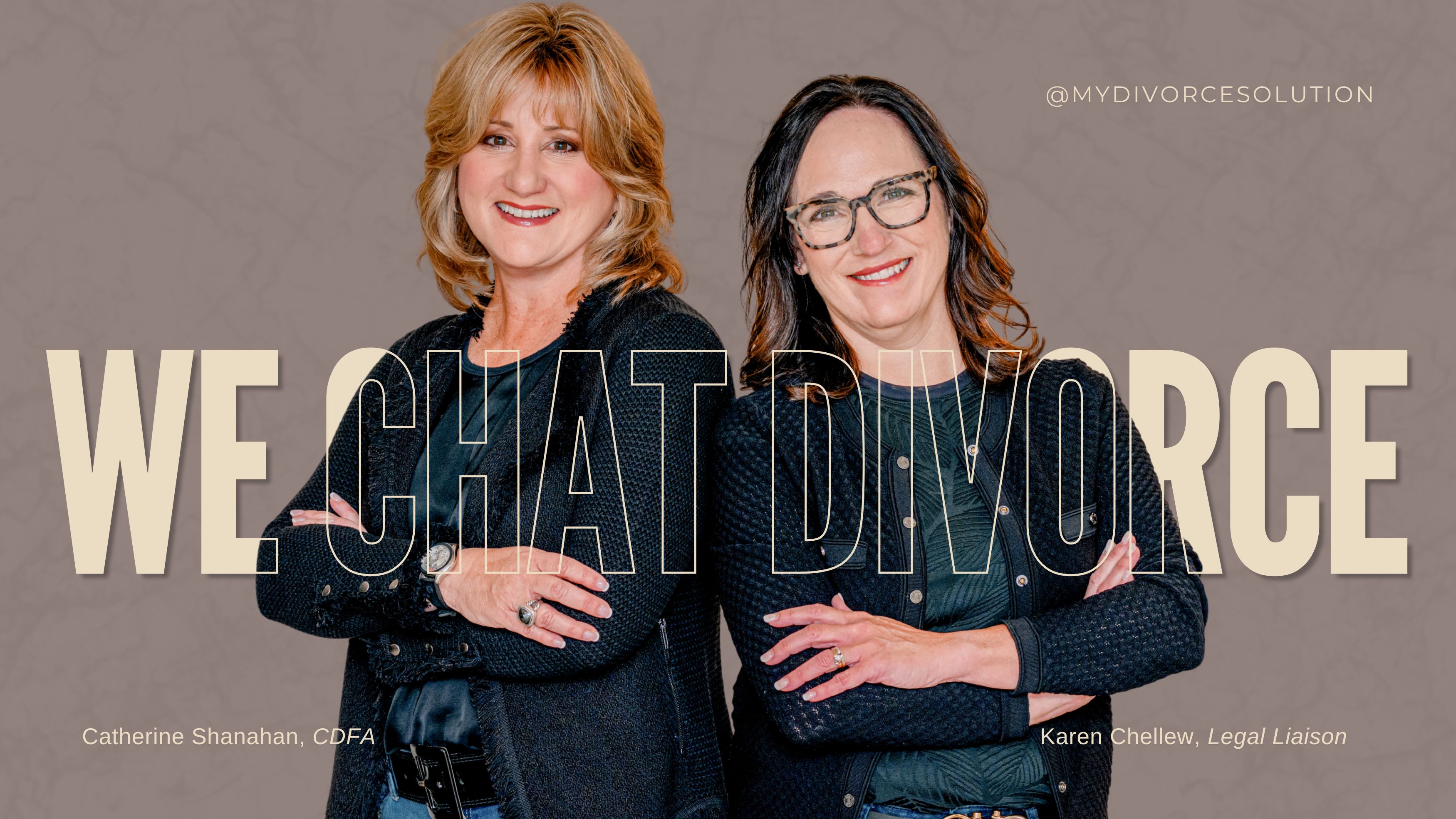

In this empowering episode of We Chat Divorce, Karen Chellew and Catherine Shanahan welcome financial powerhouse Laura Webb, founder of Webb Investment Services and an advocate for women’s financial empowerment. Together, they dive deep into the emotional and practical barriers that keep women from owning their financial lives — and how to overcome them. From personal money stories to professional lessons learned, this candid conversation is full of aha moments and actionable insights to help you shift from financial uncertainty to unstoppable confidence.
Whether you’re married, divorced, or starting over, this episode will inspire you to take the next step toward financial autonomy.
Laura is a trailblazer in wealth management with over 30 years of experience and a passionate advocate for increasing the presence of women in financial services. Now in her “third act,” she’s helping lead the charge to recruit and support more women in the financial advisory profession through her work with the Women’s Leadership Alliance.
- My Divorce Solution – Learn more about the Divorce Financial Portrait™
- Women’s Leadership Alliance – Explore Laura’s advocacy work
- Divorce Financial Portrait™ – Gain clarity, confidence, and control in your financial future
Have a question or topic you’d like us to cover? Email us at WeChat@ck11.net
💬 Like what you hear? Subscribe, leave a review, and share this episode with someone navigating divorce.
Resources Mentioned
About My Divorce Solution
We Chat Divorce is produced by My Divorce Solution (MDS) — a financial divorce preparation company dedicated to helping individuals navigate divorce with clarity, confidence, and a strategic financial plan. Founded by Karen Chellew, Legal Liaison, and Catherine Shanahan, Certified Divorce Financial Analyst (CDFA), MDS was created to solve one of the most common and costly mistakes in divorce: entering the legal process without fully understanding your financial picture.
Divorce is not just a legal event — it is a financial transition that can shape your long-term security. Through the MDS Divorce Financial Portrait™, clients receive expert financial analysis, organized financial disclosures, and scenario planning to understand how different settlement decisions impact their future. This financial preparation often reduces legal fees, shortens the divorce process, and helps individuals negotiate from a position of knowledge rather than fear.
If you are considering divorce or already in the process, you can begin by taking the Free Divorce Financial Assessment to better understand your options. You can also join the MDS Community for expert guidance, educational resources, and live Q&A events designed to help you move from uncertainty to clarity.
At My Divorce Solution, the mission is simple: replace fear with knowledge so you can make informed, confident financial decisions during divorce.
Episode Transcript
0:01
Welcome to WeChat Divorce, hosted by Karen Chellew, Legal Liaison and Catherine Shanahan, CDFA.
Each episode we sit down with divorce professionals and industry experts to provide insights and frank discussions about real people, real situations, and real divorce to help you achieve your best life post divorce.
0:39
Hello everyone, welcome back to WeChat Divorce.
I’m Catherine Shanahan, divorce financial specialist and Co founder of My divorce solution.
I’m also your partner in turning chaos into clarity.
And I’m Karen Shalu, legal liaison and Co founder, here to keep you grounded in the process while Catherine wrangles the numbers.
0:58
Together, we’ll break down the real life roadblocks you tell us about every week.
Josh, Karen, today is a big one.
As a matter of fact, I feel like I had this conversation you probably did too with some of our clients over the last couple of weeks.
So today’s roadblock is a big one.
1:14
It’s your mediation date is set and the clock is ticking and your spouse still hasn’t handing over the bank statements.
The four O 1K summary maybe anything beyond just a couple of screenshots?
And that happens 90% of the time.
1:31
I think we can confidently say that and we know that stick to your stomach feeling because without complete information, mediation can feel like negotiating in the dark.
And all while you’re being advised that maybe other things will be resolved at mediation, it’s a very common conversation.
1:50
So in the next 30 minutes we’re going to give you a step by step playbook for what to do right now, from the friendly nudge e-mail to the do we pause or push forward decision.
Yeah, and if you ever worried that asking for documents Will Rock the boat, as they say, stick around because we’re going to give you enough confidence that will show you how getting the facts is not aggression, it’s protection, actually.
2:13
To grab your coffee, your notebook, and let’s dive into mediation with missing numbers.
Oh, gosh.
So let’s give a scenario.
Actually, you know, we have a client, let’s just call her Lisa, and her mediation is next week or even tomorrow.
And she’s produced everything, five years of bank records, whatever has been asked for, done her expenses, or I should say, completed her expenses several times and she’s ready to go.
2:37
But her husband, let’s call him Rob, sent three screenshots of a checking account.
Period, end of story.
So now what do you do?
How do you actually reconcile numbers to actually try to mediate?
Right.
And the conversation that you may be getting from your spouse if you’re doing private mediation or court mediation is let’s just get started.
2:57
You know, sometimes your attorney may think that they already have it figured out or that you’re going to show up for mediation to get more documents.
And the fact that your spouse hasn’t provided sufficient documentation seems to be way down at the bottom of the list.
3:13
So why do complete documents matter?
Well, mediators rely on shared facts to create options.
So often they’re seeing half paid, half baked data, skewed proposal and let’s one side of the room control the narrative.
3:32
Catherine, how many times have you seen that?
Because you’re a trained mediator.
All of our divorce financial specialists here are trained mediators.
Talk about that a little bit.
How that dynamic happens not only in private mediation, but in court mediation.
Yeah.
Well, I love that I have the aspect of, or I should say the viewpoint of a CDFA who’s a trained mediator, right?
3:54
So I’m a financial mediator.
And of course, we have to verify things with documentations.
And I can believe a spouse’s spreadsheet and it spreadsheets look so beautiful.
And especially to people who aren’t comfortable around numbers, you hand them a nice spreadsheet and they’re going to believe it just because how do you argue it?
4:11
But for me, when I, I need the document to support that data, right?
And so then once it’s verified, OK, we could take that to mediation and we can have a really good discussion.
But what happens is you go into mediation and you have a spouse who’s been the controller of information and finances and they present this spreadsheet or Word document, and they actually even sometimes sit there and work it on it on their computer.
4:34
So it looks very legit.
And so I feel bad for the other spouse who’s sitting there saying, how do I argue against this?
Because on the third party neutral, that mediator is saying, well, what do you want?
You know, does these numbers look good to you?
You know, can you live off of that?
4:50
That’s a lot of money.
You’ll be OK, right?
So how do you know what you want if you don’t actually know what’s there other than numbers that are being shown on a screen?
That’s not really fair.
You know, you can’t really do that.
That’s not fair to the other party.
And that’s why people live with a great regret.
5:06
And that’s why we always here.
Gosh, I wish I would have met you five years ago.
Yeah.
And, you know, there’s a couple of different scenarios there.
We’re involved in a case right now where we were speaking with the attorney, we’re working with the client financially and they’re pushing the case forward.
5:22
And the attorney looked straight at us and said, you know, spouse has provided so much information and documentation, it’s really hard for us to push back and say we need more.
Oh, my gosh.
Does that aggravate us?
Well, yeah.
5:38
I could throw you up the last seven years of every piece of paper that I have and throw it on your desk.
You’re never going to look at it for one.
And #2 is what is that?
What does that have to do with the missing information that you need to make really good decisions?
5:54
100% and I think we said that to them.
Yes, he has provided the same documentation about three Times Now, but clearly there’s the critical information that remains missing and everybody wants to push forward because you’re tired of reading through documents.
6:13
So how do you address the situation?
So that’s the solution we had to talk about.
And people do need to understand that courts in every state require full financial disclosure before a settlement is final.
And so many attorneys and or mediators and even or your spouse may say well before settlement is final that all will be delivered, but how are you supposed to mediate short of that?
6:37
And what if your attorney wants you to go to mediation without that disclosure?
Frankly, most of the time they do because it’s not easy for them to push the agenda that we need everything before we can stop, start mediation.
And frankly, you as a client may feel like, well, if we can settle in mediation, I don’t want to use the court system.
6:59
I want to do it as amicably as possible.
And so you’re kind of arguing with yourself all the time.
Do I hold my space or do I see what we can do in mediation?
It is a tough decision.
And sometimes people are just not ready to take a strong confidence stance because they get confused with aggression versus protection.
7:26
It’s a really good point, you know, but you also said something there that really aggravates the shit out of me.
I know this for sure.
And that is you said, and and correct me if I’m wrong how you said it, you said the courts require full financial disclosure and it’s written in agreements.
7:42
But if you’re listening to this right now, I would love you to send us a message on how many of you did not get full financial disclosure even though it says the courts get have the courts require it.
Karen, there’s so many cases, if not all of them, that full financial disclosure is never really attained by one of the parties.
8:01
And so they just come to settlement agreements then, you know, because everybody gets worn out.
Absolutely.
And you know, a fallacy that happens is the attorney say all the time, I’m on calls all the time where this happens or even a mediator.
We even say it, well, if your spouse doesn’t disclose an asset, then you can go after it later after the divorce if it becomes known.
8:25
However, the situation is the spouse may have said, well, I have Coinbase accounts or I have a business or I have these assets.
That is disclosure that doesn’t give you typically from how I understand attorneys to reply back to us, that doesn’t mean you have anything to go after afterwards because that essentially becomes the disclosure for it.
8:51
We even have a case where the spouse gave the sworn affidavit and said see attached.
The attachment didn’t say anything about being a part of the disclosure.
And so it has become this huge thing where the spouse will not sign that the attachment is a part of the disclosure.
9:11
And six months later, we’re still waiting for Full disclosure.
So there’s so much nuance in those discussions, but it’s important.
It really is important.
Really important.
And unfortunately, that six months of period that you just mentioned probably cost the client, what, $50,000 of communication to go nowhere.
9:32
Minimum.
Yeah, which I know is going to be on another podcast that we’re going to speak about, but it’s really frustrating, you know, because you never know, you know, do you move forward with mediation?
Do you pause the mediation?
Or do you do you pivot and say, I’m not going to waste my time or money with a spouse that’s not cooperating and just ask for a trial date and really kind of light a fire under them.
9:54
Hopefully that would scare them.
But again, all of it is can be really costly.
But you know, I say this as I, I might be digressing here a little bit, but when we talked about this documents, that’s what I love about our process and the MD’s method.
And I swear every judge should require it because there’s no reason why we need 2 attorneys collecting the same data if parties want to save money getting divorced and anyone we meet out there, because divorce effects everyone to some capacity, whether you know someone, you’ve gone through it one or two or maybe 3 times yourself, or you just have a friend that’s going through it.
10:28
There’s nobody can explain to me why 2 attorneys are collecting the same data.
And so our process is set up to collect that data.
And sure, 10% of the cases will go to litigation.
And so let them litigate over data, but be forthcoming with the information if you really want to save money on the court, on the attorney process and then have a symmetry of information, you know, because you need that.
10:51
And, and with us, even with the missing information, at least you know what some of your options are moving forward, You know, get organized financially.
You know that that’s the best thing to do for yourself when you’re preparing for mediation or anything else in the divorce process.
Yeah, absolutely.
And it gives you a good perspective of where you want to spend money chasing assets that are not fully disclosed.
11:14
You know, that’s super important.
So let’s let’s do some pre mediation triage here, number one.
And exactly what you’re saying is understand what your spouse has and has not provided.
You need to at least know that.
And sometimes people will say, well, I don’t know.
11:30
Well, that’s why you need to develop an MD’s portrait so you know where the holes are.
That’s so important.
And then if mediation is scheduled, either you know, a lot of time, the courts mandate mediation within a certain amount of time, or if you have mediation and you’re scheduled and you don’t feel that you’re ready in a private mediation, you can put a list of this.
11:56
These are the documents I know are missing in order for us to have effective communication.
Please provide the documents listed on my attached list.
That’s very appropriate.
And enough time that’s to stay a week or so ahead of mediation so that everybody has time not only to receive the information, to review the information.
12:17
If you get information in less than 24 hours or even 48 hours, how can you even know what it is in order to effectively communicate at mediation?
So mediation sounds wonderful, but if you’re not using it the most effective way, that’s mediation’s going to fail, and so many people will be able to speak to that point.
12:39
Yeah, Yesterday there was a case that I had to prepare a division scenario and then I reached out to the attorney, OK, last week you were requesting the updated statements from the other council for the spouse’s information and she said yeah, we had.
I did request it, but there was but has been no response.
12:55
So I said, well, it’s really hard to reconcile accounts without the statements and you’re going to mediation tomorrow like makes no sense to me.
But anyway, we’ll see how that turned out.
Go ahead.
I didn’t mean to triage here, but.
Well, that, that’s what I’m trying to convey here, is that if you’re headed towards mediation, you need a window of time for people to to reach out either via your attorney or if you’re reaching out directly to your spouse in private mediation and copy your private mediator.
13:25
And we need these items before we can have an effective discussion.
So then what do we do?
And that’s our next section in the Playbook.
You know where we say why you going to mediation?
Of course, it’s not our decision.
We can only point out from your portrait what’s missing and how.
We can’t reconcile accounts to go to to go to mediation.
13:44
But I often hear clients tell us that their attorneys have said to them, we can’t cancel this late.
We can’t postpone this late in the game.
The mediator will get mad or the other side will get mad.
Or, you know, they give you this pressure that you can’t reschedule because it’s too late and everybody will get mad at you.
14:06
That’s true.
So that’s really important.
It’s going to go back one step here that when mediation is scheduled, there’s a plan.
If missing documentation is out there as to when it would be, the discussion is appropriate.
14:22
Do we pause, reschedule, or do we go?
Because I’m telling you, it is not uncommon for people to get information within 24 hours of mediation and they move forward.
And just because you have the documentation or even some of the documentation that’s requested doesn’t necessarily mean it’s a green light.
14:42
So that’s that is definitely in the planning stage.
And if you feel bad that people are going to get mad because you’re not ready because information has not been provided to you, then go talk to your coach.
You know, go talk to your therapist.
Go talk to your coach about getting over being mad, because you have to be really smart and you have to make decisions based on the information that you have, not based on the information that’s missing.
15:05
And in that context, then you will have you at least need to know if the information that is missing, how critical it is to have before you can make a confident settlement decision, right?
So if you exceeded ABB value of your car, that’s easy, right?
15:23
But if you need a business valuation or if you need documents to support business activity, I don’t know.
Usually that’s not negotiable.
Yeah.
And by the way, AK 1 is not a business valuation and I was just thinking of another client going to meeting, but the value of the business was the K1.
15:39
That’s not the value of the business.
No, and the bank account balance is not the value of a business.
True.
Yes, we’re laughing, but we don’t mean it to be a joke.
You know, we just, this is what we see all the time.
15:56
That’s not enough information.
We do have a divorce checklist of information that you should have.
You know, again, you can reach out to us and we’re happy to get that to you.
Yeah.
So let’s go on to the decision point.
Catherine, go pause or pivot.
Yeah.
Gosh, that’s a hard one, right?
16:11
And it’s the only one that you can make for yourself.
So rarely, rarely ideal is proceeding anyway, meaning proceeding without all the information needed.
But some of you, I know because we hear it all the time, feel like you’re just so anxious.
You want to get to that mediation.
You just want to have that next step occur.
16:27
You feel like you’re being pressured by your attorney to have that mediation because it’s been scheduled for so long and this is the best mediator that you’re going to get.
We hear often time.
So we don’t want to mess that up.
We don’t want to make them mad.
So for whatever reason that you feel like you need to proceed anyway.
16:43
Listen to your gut.
You know when you’re in that meeting, if it does not feel right, do not agree.
You know you’re not for mediation is not a forcement and enforcement to agree to something.
If your gut is telling you this is not right, do not sign no matter what they say because the pressure will come down on you to sign.
17:04
You know they all want to move on.
That’s a big the con to that is that it’s a really big power imbalance if you don’t have the information.
You know, in divorce, knowledge is absolutely everything and to remove the emotions from this, you have to have the data to support any decision you make because that’s making a really smart decision for yourself.
17:26
The next one is asking for a short continuance in take taking a pause.
You know, maybe it’s one to three weeks.
So if you’re really anxious to move forward, you don’t have to ask for six months of continuance.
You can just say, let’s come back in three weeks and get the other side to get the mediator to get the other side to give you the missing information, get new dates.
17:43
You know, be prepared with what’s missing when you go there so that you can leave it on the table and say this is what I need to move forward.
And it doesn’t take three weeks for a lot of people to get information.
So it doesn’t have to be a really long continuance.
And then the next one is pivoting.
17:58
If you need to talk to your term attorney about formal discovery, what does that look like?
You know, file or threaten the other side that you’re going to do a motion to compel or you’re going to issue subpoenas.
You know, often that statement in itself, the other side does not want to go through that either.
18:14
You know, some people like to keep things quiet.
You know, a lot of times if you’re dealing with a narcissistic spouse and this is your route, their ego is more important than some discovery.
So they don’t want to be embarrassed.
And I’m going to let everyone know that it’s my experience that both mediators and attorneys take their cue from you, take their cue CUB from you.
18:39
If you’re tentative, if you’re reticent to want to put be proactive in these litigation measures or in, you know, saying I need these documents, they’re not going to force that on you.
They’re following your tenor in moving your case forward, you know, Because short of that, if they go file a motion to compel without your consent and your approval and your buy in, then you could be yelling at your attorney the next day for making your spouse met at you via a series of texts that you just got overnight.
19:15
So they definitely are following your lead relative to how you want the case to move forward.
So a lot of people get angry with their attorney, but you know, you are the client and a healthy relationship with them.
It’s really important to the extent that you can establish that.
19:32
And that’s really important to listen to what Karen just said because your tenor will be the track of your divorce.
And so the best way to equip yourself is to turn your fear into focus and turn that focus into knowledge.
And that’s why we have the portrait because that then you’re driven on the documents and what they mean to you, what’s the impact and what are the scenarios available to you and if you know you’re AB or C scenario.
20:00
Financially speaking, what’s there to confirm that these are your scenarios?
What documents are missing?
With that, then your tenor to your attorney is going to be really powerful.
You’re going to have to.
You’ll be able to stand behind documents and not stand behind emotions, and that really actually will make you sit a little straighter and walk into any meeting feeling really good about yourself.
20:25
And both here, we’re going to move on to the tools that can be used to get the information requested and necessary for your knowledge base.
Attorneys can issue subpoenas, Mediators can ask for documentation to support your discussion.
So many people take the position that, well, the judge is going to be really mad at my spouse.
20:45
They’re going to see that he or she didn’t provide what was asked for.
And I often say, and I asked attorneys to help their clients understand this, but no, that they’re just actually aren’t going to be mad.
They’re going, they’re going to be mad at council attorneys for not doing the work necessary to get the information and documentation in in a way that both clients can make informed decisions.
21:08
It’s not the judge’s role to determine who did what the the your attorney and her mediator, when your mediator is not in litigation, but your attorney has the tools necessary to get the information in, whether it’s subpoenas, motions, whatever it is, threatening letters.
21:25
They have the tools necessary.
And then they also have the ability to put protective clauses in the settlement if you feel that Full disclosure hasn’t been made, and they can go over that with you as well.
Yeah.
So, you know, just, I just want to point out again in conclusion that sometimes refusing to mediate is not a refusing to mediate.
21:47
It’s really asking for a pause, you know, because sometimes it’s the wisest move.
A bad agreement is harder and costlier to fix than the delayed one.
So again, get yourself prepared.
Know what you have, know what’s missing, know what your scenarios are.
And then of course, try mediation if it’s available to you.
22:05
If not, work with your attorney to do all the other things that Karen just mentioned.
And again, remember, knowledge is everything and divorce and the only knowledge you can get can be bet based on data.
That’s what we do here at My Divorce Solution.
We want to make sure you’re financially informed to make really good decisions for yourself.
22:23
All right, friends, take a breath.
Remember, complete, transparent numbers are not a luxury.
They’re a prerequisite for a settlement that actually sticks.
If your spouse hasn’t delivered, you now have the nudge.
E-mail the triage checklist, and the confidence to press pause if the playing field isn’t level.
22:42
And one favor for us.
If this episode gave you a little courage, share it with someone who’s feeling stuck in the dark.
There’s many out there.
We see you, we’ve got you, and we’ll be back with another divorce explored.
Until then, keep your numbers clear and your future even clearer.
23:00
Thank you for tuning in.
We invite your questions or feedback.
Always we want you to be.
We want to be discussing what is financially most important to you.
E-mail us at hello at ck11.net with your questions or comments.
Stay tuned for future episodes as we continue to unravel the fascinating world of finance and divorce.
23:20
Remember, knowledge is power, and in Catherine’s words, knowledge is everything in divorce.
Disclaimer The information provided in this podcast is for educational and informational purposes only and should not be considered as financial or legal advice.
23:36
Please consult with professionals in the relevant fields for personalized guidance.
Thanks for joining us on another episode of WeChat Divorce.
We hope this episode was informative and supportive on your divorce journey.
If you're looking for more support for navigating divorce with confidence and clarity, head over to azure-emu-499854.hostingersite.com/ for more podcast episodes, divorce events, and resources for your divorce.
24:04
We’ll see you back here for our next episode.
Disclaimer:
The information provided in this podcast is for educational and informational purposes only and should not be considered financial or legal advice. Please consult with professionals in the relevant fields for personalized guidance.
The WeChat Divorce podcast (hereinafter referred to as the “WCD”) represents the opinions of Catherine Shanahan, Karen Chellew, and their guests to the show. WCD should not be considered professional or legal advice. The content here is for informational purposes only. Views and opinions expressed on WCD are our own and do not represent that of our places of work.
WCD should not be used in any legal capacity whatsoever. Listeners should contact their attorney to obtain advice with respect to any particular legal matter. No listener should act or refrain from acting on the basis of information on WCD without first seeking legal advice from counsel in the relevant jurisdiction. No guarantee is given regarding the accuracy of any statements or opinions made on WCD.
Unless specifically stated otherwise, Catherine Shanahan and Karen Chellew do not endorse, approve, recommend, or certify any information, product, process, service, or organization presented or mentioned on WCD, and information from this podcast should not be referenced in any way to imply such approval or endorsement. The third-party materials or content of any third-party site referenced on WCD do not necessarily reflect the opinions, standards or policies of Catherine Shanahan or Karen Chellew.
WCD, CATHERINE SHANAHAN, AND KAREN CHELLEW EXPRESSLY DISCLAIM ANY AND ALL LIABILITY OR RESPONSIBILITY FOR ANY DIRECT, INDIRECT, INCIDENTAL, SPECIAL, CONSEQUENTIAL, OR OTHER DAMAGES ARISING OUT OF ANY INDIVIDUAL’S USE OF, REFERENCE TO, RELIANCE ON, OR INABILITY TO USE, THIS PODCAST OR THE INFORMATION PRESENTED IN THIS PODCAST.
If you would like to obtain a typed transcript of this podcast episode, please email us at hello@mydivorcesolution.com. Please be sure to include the episode name in the transcript email request. Thank you!: