

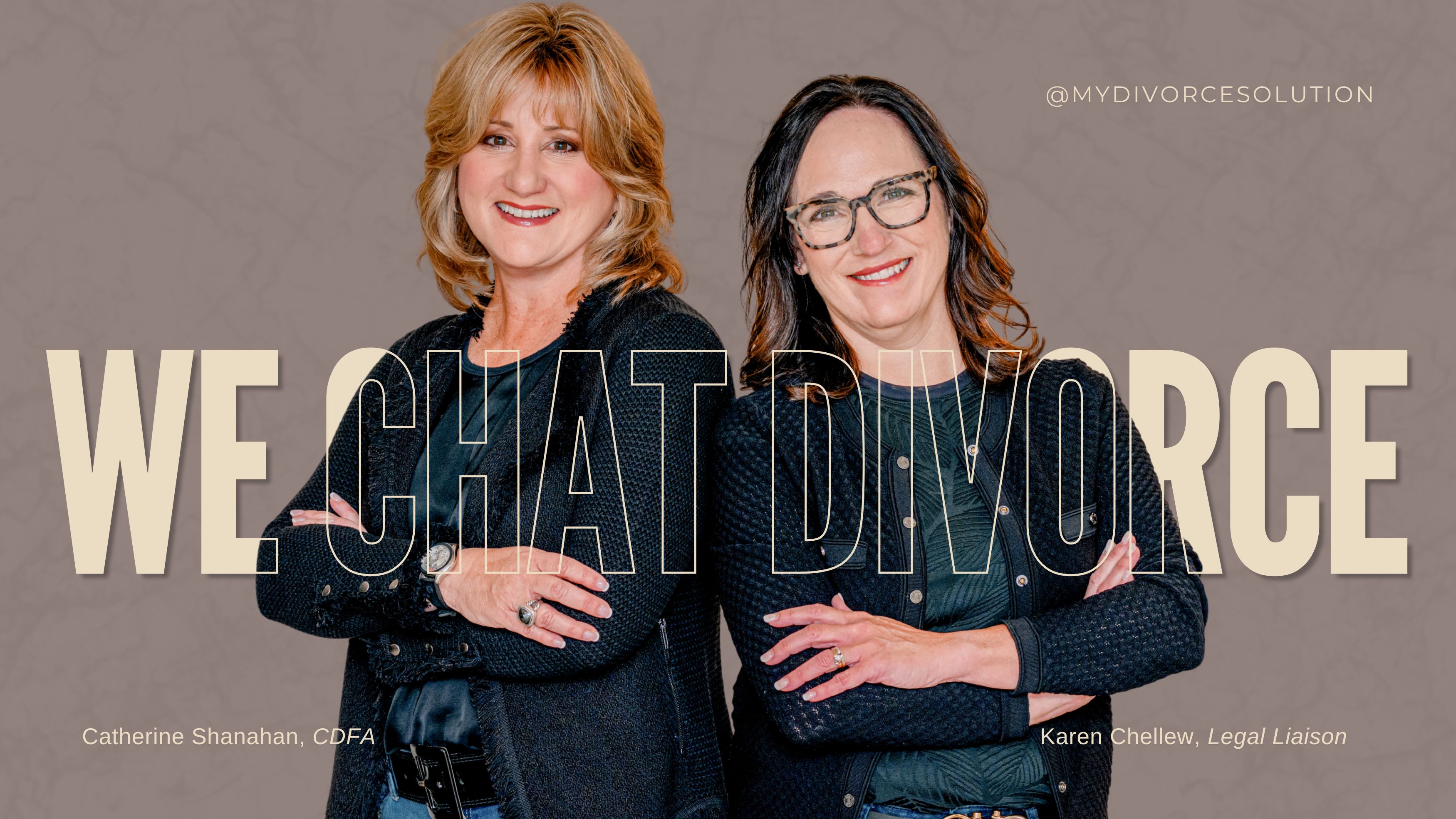
144. From Courtroom to Kitchen Table: Financial Lessons For High-Conflict and High Net Worth Splits

In this episode, Karen and Catherine discuss the financial impact of starting divorce from the courtroom versus the kitchen table — and why preparation is everything, especially in high-conflict and high net worth cases. They break down costly mistakes, emotional traps, and the importance of data-driven decisions over emotional reactions.
Mentioned in the Episode:
- My Divorce Solution
- MDS Financial Portrait™
- MDS Community (free support + live Q&A)
- AMG National Trust article on financial planning in divorce – https://www.amgnational.com/navigating-the-complex-terrain-of-a-high-net-worth-divorce/
- Have questions? Email us at WeChat@CK11.NET – we’d love to hear from you!
About My Divorce Solution
We Chat Divorce is produced by My Divorce Solution (MDS) — a financial divorce preparation company dedicated to helping individuals navigate divorce with clarity, confidence, and a strategic financial plan. Founded by Karen Chellew, Legal Liaison, and Catherine Shanahan, Certified Divorce Financial Analyst (CDFA), MDS was created to solve one of the most common and costly mistakes in divorce: entering the legal process without fully understanding your financial picture.
Divorce is not just a legal event — it is a financial transition that can shape your long-term security. Through the MDS Divorce Financial Portrait™, clients receive expert financial analysis, organized financial disclosures, and scenario planning to understand how different settlement decisions impact their future. This financial preparation often reduces legal fees, shortens the divorce process, and helps individuals negotiate from a position of knowledge rather than fear.
If you are considering divorce or already in the process, you can begin by taking the Free Divorce Financial Assessment to better understand your options. You can also join the MDS Community for expert guidance, educational resources, and live Q&A events designed to help you move from uncertainty to clarity.
At My Divorce Solution, the mission is simple: replace fear with knowledge so you can make informed, confident financial decisions during divorce.
Episode Transcript
0:01
Welcome to WeChat Divorce, hosted by Karen Chellew Legal Liaison and Catherine Shanahan, CDFA.
Each episode we sit down with divorce professionals and industry experts to provide insights and frank discussions about real people, real situations, and real divorce to help you achieve your best life post divorce.
0:39
Welcome to WeChat Divorce, brought to you by My Divorce Solution and hosted by myself, Karen Chellew, Legal Liaison, and Catherine Shanahan, Divorce Financial Specialist and CDFA.
On these special explainer episodes, we answer the top questions about divorce, giving you confidence and clarity today.
0:58
The topic of our conversation is from courtroom to kitchen table, financial lessons for high conflict and high net worth splits.
This seems to be a prevalent discussion and most of our incoming clients and I thought it would be really timely to have this discussion today.
1:18
Catherine.
I totally agree.
But it’s interesting, our title from courtroom to kitchen table, is it really from kitchen table to courtroom or courtroom to kitchen table?
Because I know it happens in both directions because everyone gets frustrated.
But I’m going to focus a little bit about not making decisions at the kitchen table until you’re clear because high conflict splits is such an emotional toll.
1:45
Really if you’re listening to this, you’re saying yes, it is, right?
Just because the high conflict is just, it’s high conflict because of the misaligned incentives or lack of information by one party and just we want to just chip away at somebody emotionally, right to get them to agree to something and someone gives up so it’ll.
2:07
Be true about.
That.
But I also want to talk about the other way because a lot of people, they’ve had a fight, something’s happened, an event has happened.
So the first place they go is to the courtroom, whether it’s a domestic incident or someone’s cheating or like it doesn’t even matter, right?
2:26
So they start with the courtroom and so they get their own separate representations and everything blows up.
Thirty $40,000 in, they finally have a conversation, realizing that, you know, they’ve just, it’s been scorched earth for what purpose?
2:48
So that that pathway, I think it’s really important too, especially for high conflict forces.
Totally divorce is that life altering?
It’s you know, it’s going to change the rest of your life basically.
But you have to careful financial planning and execution, particularly when you’re a high net worth individual and particularly when you’re dealing with a high conflict split.
3:11
So with the right guidance and a well thought out financial strategy, you can position yourself to turn the page with a better financial security and some Peace of Mind.
So let’s talk about some of the tips.
Yeah, and we got some.
And by the way, some of these tips are coming from ANG National Trust.
3:28
It was a pretty good article.
That’ll be part of the discussion notes at the end of the podcast as well.
So a little bit more reading, just if you know, you need some type of resource for financial planning.
But in the space of the strong advisor team, you know, you and I both were talking about whether you start at the kitchen table or whether you start in the court system.
3:51
Most people completely overlook a strong advisor team and financial planning for divorce.
I think we need to start there.
Yeah, but I want to just caution people too, you know, talking to your financial advisor, be specific.
4:08
Thank you.
Couldn’t get the word out about what you’re actually talking to them about because they’re not going to be able to relate it to your overall divorce agreement.
So what are you actually trying to get from them?
Is it just that you want to get the data?
You know, because you don’t have the data, which is really great.
4:26
I do think that you should get as much data as you can, but I, I, I just want to back up a little bit because I’m just having a fog When you, you keep saying they start with the courtroom, right?
But it takes them so long to get to the courtroom.
So what do you mean by that?
Actually, And I know I’m digressing here.
4:42
Yeah, that’s OK.
That’s good.
So you, you, you go hire an attorney, you fill out a financial disclosure or a financial statement or a financial affidavit.
That is like yesterday.
I was just speaking with two people back-to-back where they said, you know, my attorney just they were both high conflict divorces, male individuals, but they said their attorney just handed them a pack of papers and said, fill it out.
5:08
And they realized that it was.
So now six months in, they both realized that the data on that paperwork was inaccurate relative to how the courts looked at it.
So they go, so they go hire an attorney.
They fill their in their financial affidavit, they start talking about negotiations when all of the data hasn’t been collected.
5:30
So that’s what I’m talking about, starting a courtroom.
OK, so to me that’s not OK.
Well, OK, so for me that’s not the courtroom because it takes people forever to get to a courtroom.
So you mean starting the litigation process basically?
Yeah.
Well, I don’t know.
Temporary orders are in the courtroom, right.
5:48
They they’re usually very early part of the process in many of the states.
Sometimes it’s not but but most are.
Unless you’re starting a mediative process, which is terribly elongates the process.
If you don’t start with some formality, you can’t.
6:04
It’s kind of hard to start with past litigation, but anyways, that’s where I was coming from.
Yeah.
And it is important to know what actually you’re doing.
So if you’re going for temporary orders, as you mentioned, what are they for, you know, somebody filling out these forms and, and just agreeing to things and they don’t even really know what the outcome is supposed to be.
6:26
And again, to your point of not being prepared for it, for those meetings, you end up spending so much money to go nowhere.
I mean, I hear that all the time.
You know, we’ve paid X $20,000 and we’re really just filing paperwork at all over the place.
6:42
But there’s no financial clarity to any of that.
Yeah.
And the financial impact can be detrimental temporarily and for the long term because a lot of times those temporary orders set the precedents for the eventual divorce decree.
So people don’t realize how important, we cannot stress it enough, how important preparation is.
7:06
And so a lot of times in these high conflict divorces, Catherine, there’s one spouse that’s very reticent to hop in the ring with the other spouse because the other spouse has been the dominant financial manager, controller of the household, hence the conflict, right?
7:23
And so they think that somehow they’re going to mediate.
They’re not one of our my clients.
I’m who I’m helping with in the legal liaison work.
You know, she said you since she met with us, we’ve stressed preparation, get prepared, make sure you’re getting the statements.
7:42
And she said I was so reticent because I just thought somehow we were going to mediate.
Somehow, you know, things were going to change.
Somehow this was going to work out.
And now I have to hold my ground and get the statements.
But I lost a whole year and she’s $200,000 in.
8:00
And she said I just wasn’t ready to hear that.
And people here holding your ground as being creating adversity, but it’s not.
And so that I think there’s where a lot of high conflict divorces kind of start out just, you know, untangling that relationship.
8:19
Yeah.
And listen, you’re not asking for anything that you shouldn’t be asking for.
You know, if it’s in your marital state, you should be asking for it.
But people are afraid to ask for that, just like married couples, you know, one party is afraid to ask the other party to look at statements or to go over a tax return with them because they just feel inferior.
8:38
And so of course, you know, you’re, you’re held hostage to a system that’s basically broken.
And then what do you do until that $200,000 goes by and you have some confidence?
But I know we stress it all the time, not only being prepared is important, but it matters how you start.
8:55
So if you have the luxury of not starting the process yet, don’t start it until you’re prepared, unless of course there is a situation where you have you have no choice or you have to start.
So I just want to put that disclaimer in there.
But most people can take the time to get organized and get their financial information.
9:14
I mean, that is why we created the MD’s method.
You know, our process allows for that so that you make good decisions based on the data and you’re more confident going through the process.
And not only that, but when you talked about building a strong advisory team, and I know I digressed off of that.
9:33
Knowing the complexities of your case or where you have to spend the most energy and time before going down any rabbit holes first will allow you to hire the appropriate attorney for your case.
You don’t just always hire your best friend’s attorney who did great by them because you don’t even know your best friend’s financial situation truly.
9:54
So going through and getting you know yourself together financially speaking, will allow you to ask an attorney when you’re interviewing them the right questions to make sure that they can handle the complexities of your case.
Absolutely.
So I’m going to go back to three, 3 telephone calls I had this week that I mean, they’re, they’re repeated.
10:13
You have the same calls, people calling in wanting help, right?
They, they want to know about our services, but they can’t really place it because we are unique in our approach.
But almost every time they’ll say to me, you’ve asked me more.
10:29
I’ve, I’ve learned more from you in 15 minutes and I’ve learned from my attorney in the process in the last year.
So we ask questions about, well, what is the date of division of assets?
I don’t know when your temporary orders, how are these certain expenses separated?
10:46
Oh, I don’t know.
Well, if you’re paying spousal support on what you know, what were, what was the basis of that calculation?
I don’t know.
Oh yeah, I get that one.
There’s so many when we talk about how household expenses are being paid, you know, is it, are you using separate money, joint money, The list goes on and on and on.
11:08
And they have no clarity about that.
They know something’s wrong, but they don’t know why, why they feel that way.
But yet they’re still reticent because somehow the court system almost seems like a security blanket or mediation.
11:25
I had one lady say I need your help, but I’m going to wait till after mediation.
So she’s going to spend $5000 in one week.
I already know where she’s going to end up.
I think she knows where she’s going to end up.
She’s just tentative and fearful.
Well, and you should get wound up and I know that’s what every day, which is why I heart we have a hard time sleeping at night, right, because it’s in every state.
11:47
Every state is the same thing.
So people are expecting that mediation is such a nice word and everybody wants you to try mediation, but they don’t understand that a mediator is a neutral third party and they are expecting you to know what you want.
12:03
So when you go in there and they ask you what you want and you’re like, wait a minute, I thought you were going to tell me what I should be getting, right.
And it’s the same thing with the attorney.
You know, you’re expecting your attorney to tell you what you want.
Well, the attorney only knows what the law is, right?
But they don’t know what you want.
12:19
And you need to be clear on what you want because.
But you can’t do that unless you know what you have so.
Or else you’re talking about what you want from emotions, not from understanding financial impact.
And that means I just want to screw my spouse over.
12:34
I want to get as much as I can from my spouse.
Well, guess what?
It doesn’t work that way.
And that’s why they think, oh, I’ll get my court date because I’ll get that justice that they think they’re going to get.
But you’re not going to get justice.
Trust me, in a courtroom, it doesn’t happen that way.
So let’s all back up and gather and assess your financial information.
12:52
It’s probably the most important thing you could do.
And while your spouse is participating with you at any level, get as much as you can because it’s the less expensive route and it’ll give you the most encouragement moving forward when you can get the clarity on that.
Right, because people that come in and need emergency help, you know, that’s another host sector of our clients that they they’ve hit a wall and they need emergency help.
13:18
It’s much more expensive to unpack all that and redo it and undo everything that you’ve created is essentially what has happened then just starting out in the clarity space.
I’ll never forget the one, the one attorney who said, you know, I’ll have a hard time arguing this because your prior attorney already submitted it to the court.
13:42
So they were kind of giving it up even though it was wrong information.
And, you know, you sit back and you think, well, wait a minute, it’s the wrong information.
Why would it be a hard time to get the court to accept the amended version?
You know, it’s just a lot of work to do it.
And I feel like some attorneys don’t want to do the work.
But again, that’s another podcast for another time.
13:58
And I know you don’t want me going off on that.
So, you know, frankly, the attorneys and the mediators, their constant questions are, what do you want?
A&B?
Just give me a number.
Just give me a number.
14:13
Well, how do you do that if you don’t know what those numbers mean?
You know, everyone thinks they’re just going to hand their file over and things are going to be OK to their attorney or that the mediator is going to help them.
The mediator is only going to facilitate conversation.
14:30
That is the role of a mediator.
That’s their job.
You know, your attorney is, you’re the client.
They’re they’re at your direction, making sure the law is followed, of course.
But if you’re changing your mind every day and you’re surprised at the bills coming through, they’re they’re just doing their job.
14:48
And I know you hate to hear that, but that’s, that’s how the system works.
And I think people don’t realize it until they’ve spent a ton of money.
Well, another podcast is when they say, what do you want?
Give me a number and you give them a number and they say we’re not doing that.
15:04
That is another a year ago time.
But another tip that the AMG National Trust article talked about was protecting your financial future.
And when you’re in a high conflict divorce.
This topic to me goes to don’t make premature agreements, which means premature negotiations.
15:24
How you protect yourself is not agreeing to something that sounds good in the moment.
You know, I see so many narcissistic spouses tell their other, their spouse that, you know, I want to protect you.
You know, I’m going to do what’s best for you.
I’m always going to take care of you.
15:40
We’ve been married 30 years.
I would never want to take the house or, or what they say, Well, that sounds great, but don’t agree to that until you have documentation to prove it and you have it in writing.
Just say, you know, you want to, you want to look at it, you need to think about it, and then you go and get the help that you need.
15:57
If it’s not our process, get the help that you need, but I think it should be our process and let’s go through that and make sure it is a good agreement for you and make sure you’re not negotiating away something that you didn’t, you’re not aware.
Of or you didn’t.
Expect so protect yourself by getting the information you need and base your decisions on data, not the emotions in the moment.
16:17
Absolutely.
You know, one of the one of the biggest assets and going through the divorce process in protecting your financial future and then all sectors is asking the right question, knowing the questions to ask and you don’t know the questions to ask if you’re not prepared.
Yeah, that’s so true.
16:33
And don’t be afraid to ask those questions.
You remember they’re questions.
You’re not questioning someone.
You are asking questions so that you have the financial knowledge that you need to make really good decisions for yourself.
Absolutely.
So understanding the tax consequences is always a really important thing that that can get overlooked and updating your estate plan that really is overlooked.
16:58
Some people don’t know if they should do it pending the divorce.
They don’t know what would happen if one spouse would pass during the pendency.
It’s different in every state, but you need to understand those ramifications in case you need to make some temporary provisions during the divorce process.
17:15
Yeah, but I want to talk about a couple people I talked to this week.
You know, one party was going to go and have a trust set up.
And I said, why are you having a trust set up now?
Well, you know, in case something happens to us with, you know, where the house will go.
17:31
OK, well, do you know which party would be keeping the house if you got divorced?
No, we didn’t go through that yet.
So why would you set up a trust if you’re not even going to keep the home?
And she’s like, oh, I didn’t even think of that.
I said, so although it could be a good plan, it’s not a plan for now, you know, gather the information and wait to see how your negotiations go.
17:52
And then set up a trust when you know what you’re, what asset you’re walking away with.
But the house could even be sold.
You don’t even know.
Yeah.
So I should wait.
I said you should.
If you’re considering divorce, you know, just get all the information together and then you bring that up when you’re negotiating.
18:09
If the two of you are going to jointly hold the property, then maybe it’s a conversation that needs to be brought up.
You know, it’s the same thing with someone who wanted to buy another house because, you know, you have to live separate and part in some of the states.
Well, should I get my spouse to just buy it with me because he has the income?
18:24
Wait a minute, you’re going to have to refinance it again in a couple of months and who’s going to pay the expenses to do that?
And do you really want to have to?
Be part of your divorce agreement.
Right?
Right you.
Need to know, well, you need to know the impact of that before you decide to run ahead and do that.
Yeah, I would just continue renting until you came to an agreement because you don’t want to get yourself into another sticky, sticky situation.
18:44
You’re trying to get away from your spouse, so why would you and, you know, engross yourself in another asset with them?
So just know before you make these decisions.
And because it’s high conflict, it’s easier sometimes just to agree and move forward, right?
It’s just easier to say, OK, yes, I agree.
19:00
Let’s just do that.
Then you don’t have to have the conversation with them again.
But what you don’t realize is that you do have to have the conversation again, and the more time goes on, the less that person wants to talk to you, nor do you want to talk to them.
So just get the information first.
19:15
Write these things down, address them before you agree to anything.
Let the high conflict, let the stress of that just kind of work with your therapist for yoga or whatever you have to do.
Step away from it.
Get your financial clarity and don’t make these agreements just because it’s high.
19:31
Conflict, absolutely, because it’s not going to remedy anything unless you fully understand the financial impact.
Yeah.
So let’s just talk about some takeaways today.
Listen, I know that this is difficult process for you and you’re trying to work and you’re trying to raise your kids or you’re trying to go back to work or you’re trying to figure out where you’re going to live.
19:51
That’s a lot.
It’s emotional.
It takes a toll on you.
But you have to just remember to take the time to get financially organized, get in the know of what’s going on.
We do have that resource for you, but just do it for yourself and it doesn’t matter if it takes longer and.
20:09
It doesn’t matter if somebody tells you that you don’t need that information or trust me, or we’ll take care of that later, that’s another one.
We’ll take care of that later.
No, you don’t take care of that later.
You take care of that first and take the first step towards it and you’ll feel stronger.
20:25
I know it’s scary.
It’s never too late to change your relationship with money.
I say that 1000 times.
Send us messages, listen to our other podcast, you know, send us questions if you have them.
For us, we’re just on a mission to make sure that you’re financially in the know before you make decisions that’s going to impact the rest of your life.
20:43
Absolutely.
This concludes our discussion from courtroom to kitchen table.
Financial lessons for high conflict splits.
Thanks to all of our listeners for tuning in.
We always invite your questions and feedback.
We want to be discussing what is most financially important to you. e-mail us at hello at ck11.net with your questions and comments.
21:05
Stay tuned for future episodes as we continue to unravel the fascinating world of finance and divorce.
Remember, knowledge is power.
Disclaimer The information provided in this podcast is for educational and informational purposes only and should not be considered as financial or legal advice.
21:24
Please consult with professionals in the relevant fields for personalized guidance.
Thanks for joining us on another episode of WeChat Divorce.
We hope this episode was informative and supportive on your divorce journey.
If you're looking for more support for navigating divorce with confidence and clarity, head over to azure-emu-499854.hostingersite.com/ for more podcast episodes, divorce events, and resources for your divorce.
21:51
We’ll see you back here for our next episode.
Disclaimer:
The information provided in this podcast is for educational and informational purposes only and should not be considered financial or legal advice. Please consult with professionals in the relevant fields for personalized guidance.
The WeChat Divorce podcast (hereinafter referred to as the “WCD”) represents the opinions of Catherine Shanahan, Karen Chellew, and their guests to the show. WCD should not be considered professional or legal advice. The content here is for informational purposes only. Views and opinions expressed on WCD are our own and do not represent that of our places of work.
WCD should not be used in any legal capacity whatsoever. Listeners should contact their attorney to obtain advice with respect to any particular legal matter. No listener should act or refrain from acting on the basis of information on WCD without first seeking legal advice from counsel in the relevant jurisdiction. No guarantee is given regarding the accuracy of any statements or opinions made on WCD.
Unless specifically stated otherwise, Catherine Shanahan and Karen Chellew do not endorse, approve, recommend, or certify any information, product, process, service, or organization presented or mentioned on WCD, and information from this podcast should not be referenced in any way to imply such approval or endorsement. The third-party materials or content of any third-party site referenced on WCD do not necessarily reflect the opinions, standards or policies of Catherine Shanahan or Karen Chellew.
WCD, CATHERINE SHANAHAN, AND KAREN CHELLEW EXPRESSLY DISCLAIM ANY AND ALL LIABILITY OR RESPONSIBILITY FOR ANY DIRECT, INDIRECT, INCIDENTAL, SPECIAL, CONSEQUENTIAL, OR OTHER DAMAGES ARISING OUT OF ANY INDIVIDUAL’S USE OF, REFERENCE TO, RELIANCE ON, OR INABILITY TO USE, THIS PODCAST OR THE INFORMATION PRESENTED IN THIS PODCAST.
If you would like to obtain a typed transcript of this podcast episode, please email us at hello@mydivorcesolution.com. Please be sure to include the episode name in the transcript email request. Thank you!