

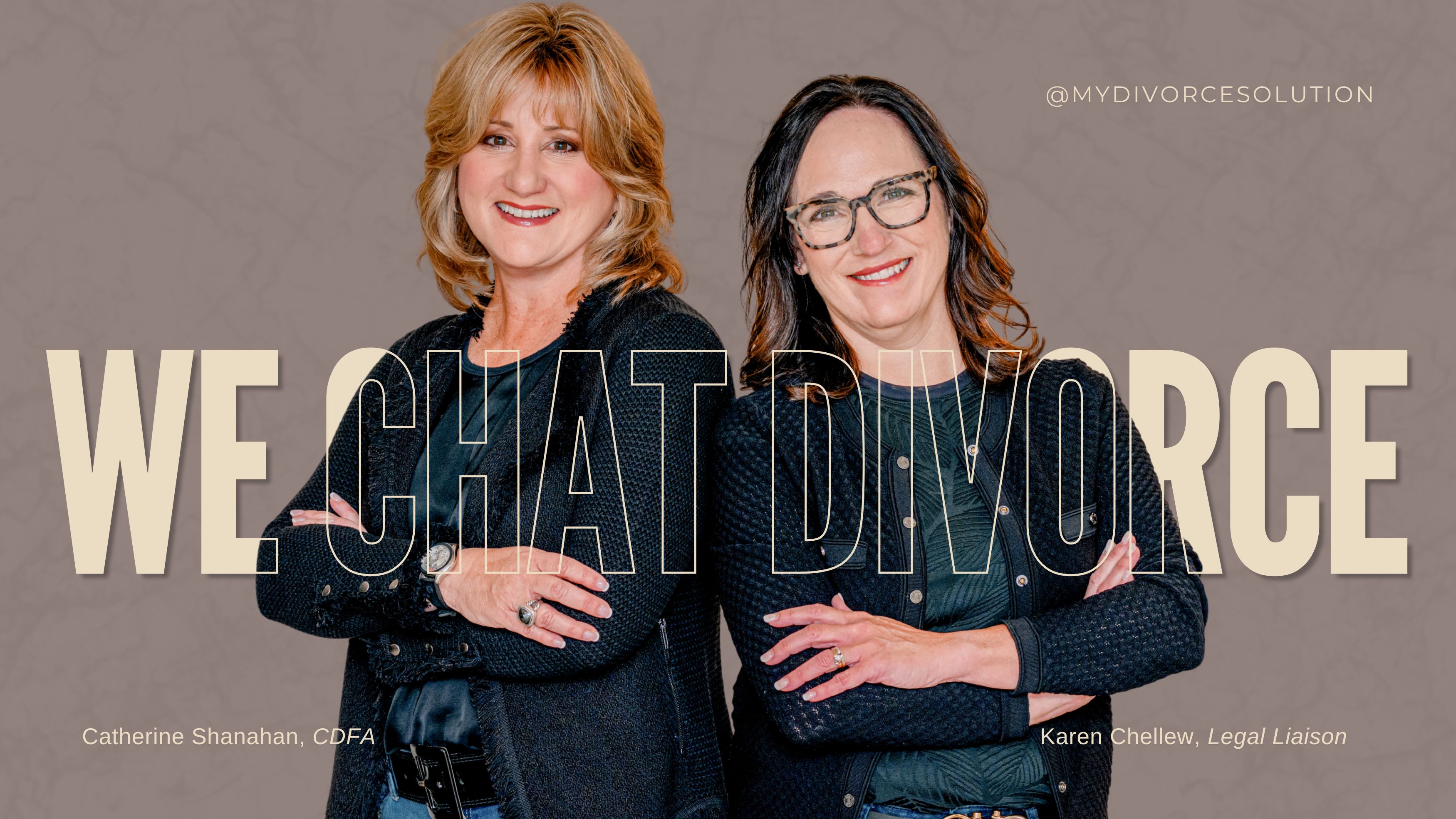

Divorce is already an emotionally charged and financially challenging process—but what happens when the industry itself makes things even harder? In this episode, Karen and Catherine pull back the curtain on the divorce process, putting Divorce on Trial, shedding light on inefficiencies, costly mistakes, and systemic issues that can leave individuals feeling powerless.
They discuss why so many divorcing individuals struggle to obtain basic financial information, how the legal system treats divorce like any other civil litigation (even when it shouldn’t), and the hidden financial toll of unnecessary subpoenas, repetitive document reviews, and mismanaged mediation. More importantly, they share how to protect yourself, gain financial clarity, and avoid the common pitfalls of the divorce system.
Key Takeaways:
- The Divorce Process is Broken: Many divorcing individuals enter mediation, hearings, or negotiations at a disadvantage due to missing or inaccessible financial data.
- Subpoena Shock: Subpoenas often fail to yield the necessary information, leading to wasted time and money.
- Mediation Misconceptions: Mediation is often framed as amicable, but in reality, many individuals feel pressured to settle—even when crucial financial details remain unresolved.
- Attorneys vs. Financial Experts: Attorneys play a critical role, but they are not financial experts. Many clients mistakenly expect financial guidance from their lawyers, only to realize too late that attorneys don’t provide that level of financial insight.
- Taking Back Control: The MDS Financial Portrait™ is designed to equip individuals with financial clarity before they enter the legal system, reducing costly inefficiencies and empowering them to make informed decisions.
Resources Mentioned
About My Divorce Solution
We Chat Divorce is produced by My Divorce Solution (MDS) — a financial divorce preparation company dedicated to helping individuals navigate divorce with clarity, confidence, and a strategic financial plan. Founded by Karen Chellew, Legal Liaison, and Catherine Shanahan, Certified Divorce Financial Analyst (CDFA), MDS was created to solve one of the most common and costly mistakes in divorce: entering the legal process without fully understanding your financial picture.
Divorce is not just a legal event — it is a financial transition that can shape your long-term security. Through the MDS Divorce Financial Portrait™, clients receive expert financial analysis, organized financial disclosures, and scenario planning to understand how different settlement decisions impact their future. This financial preparation often reduces legal fees, shortens the divorce process, and helps individuals negotiate from a position of knowledge rather than fear.
If you are considering divorce or already in the process, you can begin by taking the Free Divorce Financial Assessment to better understand your options. You can also join the MDS Community for expert guidance, educational resources, and live Q&A events designed to help you move from uncertainty to clarity.
At My Divorce Solution, the mission is simple: replace fear with knowledge so you can make informed, confident financial decisions during divorce.
Episode Transcript
0:01
Welcome to WeChat Divorce, hosted by Karen Chellew, Legal Liaison and Catherine Shanahan, CDFA.
Each episode we sit down with divorce professionals and industry experts to provide insights and frank discussions about real people, real situations, and real divorce to help you achieve your best life post divorce.
0:39
Welcome to WeChat Divorce, brought to you by My Divorce Solution and hosted by myself, Karen Chellew, Legal Liaison, and Catherine Shanahan, Divorce Financial Specialist and CDFA.
On these special explainer episodes, we answer the top questions about divorce, giving you confidence and clarity.
0:58
Today, the topic of our conversation is divorce on trial, the industry under scrutiny.
Unfortunately, many of you might not be surprised about this topic with many of you in the divorce process.
We’re talking about the divorce industry and how the process treats you and how to prepare yourself and take back some control.
1:19
So instead of challenging all of our energy into searching for justice, we’re going to explore a perspective that you should be aware of.
I love that, Catherine.
I wish you didn’t love that, because I wish it wasn’t actually a problem, right?
Yeah, but it is.
1:36
And I’m glad that we’re talking about that, about divorce, the divorce industry that so many people don’t understand.
They know they need financial clarity.
They don’t understand the difference between that work and the work an attorney does versus the work of a mediator versus the work of an accountant, a divorce coach, etcetera, etcetera.
1:58
So having this conversation today, I believe is really important.
Well, let’s just start with the basics, Karen.
You know, I myself don’t even understand how you can go to a hearing or go to mediation and you bring all the information that you have access to, but your spouse has control of most of the information and they can just show up with nothing.
2:21
How did they get away with that?
Yeah, or even if you have most of the information, but some critical pieces are are missing.
It’s the divorce industry through and through.
So the way the litigation process proceeds in, in all states is by rules and regulations.
2:43
And so the attorneys have a specific method of how they can obtain information.
And unfortunately it’s managed the the family law sector is regulated exactly like any other civil litigation.
3:00
So even though you’re asking someone for your own information, it’s it’s handled as if it’s someone else’s information that has to be turned over to you, which is incredulous.
I wonder if they took a survey or they actually audited every attorney’s file in every state because we see it in every state and actually figured out how much money is spent on searching for documents.
3:32
Right.
Or reading the same document five times every time the topic comes up right?
Or three people in the firm reading the same e-mail and everybody billing for it.
We could go on and on in that space.
3:50
But I believe when people start the divorce process, if they understood that at the end of the day, you need to know what you have and what it means to you so that you can make really good decisions for yourself.
If you start that, then when you enter into the divorce process, you’ve narrowed down the unknowns into a space that can actually be better managed by the industry.
4:18
So if you need to subpoena, if you need to send discovery, things like that, or if, frankly, if you can have a conversation with your spouse in a way that is more in the context of information and not emotion, how farther along would most families be in the divorce process?
4:36
OK, but let’s talk about subpoenas.
You know, you think that, oh, that’s the answer.
The attorney will say we’ll just subpoena that.
We’ll subpoena that.
I cannot tell you how many subpoenas that have come through our offices that it doesn’t provide you with any more information than you already had.
Goodness.
4:53
Well, we have a client, plural many right now where we will look at the subpoenas and A, the incorrect type of account is being requested, A or B, the subpoena isn’t comprehensive enough to capture the information and data that you need or C, the wrong entity is being subpoenaed.
5:19
So we see that routinely.
And so then the attorneys will go back and correct it.
And then sometimes in that entity will say, well, we’ve already answered the subpoena, not even looking at the second subpoena.
And then the attorney saying, well, they don’t have any more information and then the client has spent thousands of dollars on that process that wasn’t effective.
5:43
Yes, sometimes you need to know what not to spend money on, don’t you know?
But you go to your attorney and you’re expecting them to tell you what’s going to happen because one, you’re looking for justice and you don’t trust your spouse.
But that doesn’t really, I see more and more clients just getting frustrated, you know, for exactly what you just said.
6:02
The wrong subpoena comes back.
And so now when it comes back wrong, how do you move on from that?
You don’t you just keep talking to your attorney about the same thing.
And then here’s the heels of your court date or something else.
And you have to make a decision and they they’re going to make you cave.
They’re going to say you, we’re not going to get that information.
6:19
So now you’ve just spent thousands and thousands of dollars on information you’re never going to have, and that’s a hard pill to swallow.
It is, it is.
And so that’s why it’s so important to, for the information you do know, what does that mean to you?
6:35
And for the information you don’t know, where is the best place to get it?
Because you know, you, you can say by default, you know, we’ll send discovery or we’ll get a subpoena, but what are the chances of receiving that information in that context?
That’s very, very important for sure, because most of the time that that first round of discovery is leading up to mediation.
7:00
And so the attorneys will say, no worries, we’ll handle that at mediation.
And, and therein lies I want to call a sand trap where, you know, there’s no coming back off of that, especially if you’ve made agreements or if information is being delivered that everyone seemingly agrees to, you know, that can’t be undone.
7:24
Or if you do try to undo it, you’re facing other motions in court and things like that.
Yeah, you know the MD’s method and why I love it.
Well, there’s a lot of reasons why I love it.
But you know, getting your documents together because, you know, I always say, I don’t know why any family would go through divorce without coming to our process because I don’t know why we’d pay 2 attorneys to collect the same data or to collect data at all.
7:50
You know, if you, most of you have more access than you think.
But even if we invite a spouse to participate, it’s less expensive for them to just put documents in one place that we organize anyway right before we’re assessing it.
But you know, I’m talk, I want to talk about a real scenario.
And this client came through our process and he’s a business owner and evaluation came in, but we noticed that part of that evaluation didn’t include a marital property.
8:16
It was confusing to all the parties.
Is this part of the business?
Is it not?
But it was not on the attorney’s spreadsheet, if you will, but it is in our conversation with division scenarios.
So we point that out.
And he goes to the attorney and the attorney has all the information.
8:32
They go to mediation and wife’s side brings up that marital asset, but his attorney didn’t have it on their spreadsheet.
So it looked like he was trying to hide that information.
So the mediator didn’t treat him very kindly, but he was not.
8:47
This guy is so forthcoming with information.
It’s just that his attorney didn’t feel it needed to be on their spreadsheet.
Big mistake.
It’s a couple $100,000 mistake.
But more than that, he was so angry because it made him look bad.
He provided the data.
9:04
That’s why his spouse had the data, you know.
So he luckily he went through our process and I prepped him saying this is what might happen.
Be be prepared.
And he came back and said, how do you guys know the industry so well?
Exactly what you said was going to happen, happened.
9:19
But because he felt so empowered with the knowledge that he had and he was a he was not blindsided by that because we pointed out some things that could occur.
He was able to end that mediation saying I’m not ready to move forward, you know, and and he said I was treated so poorly in there.
9:35
It made me feel bad because it because of his own attorney.
He looked like he was in the in the wrong.
Yeah, I agree.
I mean that people have no idea the the word in and of itself.
Mediation sounds amicable, it sounds productive, it sounds constructive.
9:58
But what our experiences with our clients is you get to mediation and all of a sudden there’s a lockdown and a pressure to settle.
Well, I’m glad you said that because that’s how.
Thank you for reminding me that that’s exactly how the mediator started.
10:15
He said I’m here to get you guys to settle today.
We’re going to make decisions today.
And because we told him that he was prepared for that, and because we told him about the missing information that might occur, he knew to stop this mediation.
I’m glad you brought that up.
That’s exactly how it started out.
10:31
Right.
And you know, a lot of times attorneys and mediators are not happy if if you’re not agreeing or acquiescing at the beginning that, yes, I’m here to settle.
And we often tell our clients, we have another client who just went to mediation about 3 months ago.
10:50
And, you know, we knew that there were too many unknowns on the table that would not allow for a good constructive settlement.
However, the court mandates mediation.
You can find out some information, you can understand where all the parties are.
11:08
But we encouraged her to tell her attorney and to know herself that she wasn’t going into the mediation to settle.
She was going into the mediation to get more information.
At the end of the day, her attorney actually made a settlement offer to opposing counsel on the notes to her client.
11:26
And then the client said I’m not signing.
So after mediation, then out came the mediation agreement and her attorney was really upset that she didn’t settle.
But we reviewed it and you remember this and there was 3 to $400,000 left on the table and it was requiring her to pay several $100,000 to the spouse because of this erroneous mistake.
11:54
Within 90 days was it or two years?
It was ridiculous.
Yeah, very upsetting.
So the attorney fired herself and she got a new attorney and they have it resolved.
Now all of the issues that we said were unknown that need to be addressed, that are so important to you client not to settle without these being resolved.
12:17
So now she’s at a place now where she is getting a fair settlement.
Is she still going to compromise?
Absolutely.
She’s going to compromise, but not the patient.
Level, yeah, that’s what mediation means.
I really should say a compromise session.
It’s really the.
12:33
I know the nouns right?
Yeah, you’re and you’re.
Pointing on what you know, yeah.
You’re, you’re pointing compromising on what you don’t know also because you’re compromising, right?
So, but this is an older woman who never handled the finances, who didn’t take control for herself when we first met her.
12:51
And the fact that she was able to stand up because her gut was telling her this is wrong.
Stand up to her first attorney.
Her gut was saying this is wrong, going over the information.
It was pointed out based on the data that it was wrong, not the emotions, the data.
And then she stood up for herself.
13:06
And isn’t it funny that her attorney fired her because she wasn’t listening to her, which would have been over a $200,000 mistake.
Good for her.
I, I, I, I champion all of our clients who have that power to do that for themselves.
That was a scary process for her right now because she had a switch attorneys at the end, but.
13:27
Yeah, it wasn’t fun at all.
And I admire and commend people who have to stand in their truth and in the, you know, their space of holding tight so they don’t get ruined by the divorce industry.
13:43
Financially ruined, is what I’m saying.
But there’s also that same subset of people or different subset of people that the knowns are on the table.
And however emotionally distraught you are, if you take this settlement, this is a good proposal for you.
14:00
Even with all the unknowns, you will be OK.
And, and you know, in lieu of paying hundreds of $1000 on valuation and chain, you know, chasing international accounts or whatever the IT may be, helping them get to a place where they know they’re going to be OK and making an informed decision to move forward is equally a great decision sometime.
14:24
Let’s talk a little bit about what we hear all the time.
We either hear it on our assessment calls or we hear it from our clients who have attorneys already.
You know, they thought their attorney would tell them this or they thought their attorney would do this for them.
And you know, even when I ask on an assessment call if I take 1, you know, if you have an attorney, why are you calling us?
14:43
Because I thought the attorney was going to give me this financial clarity and they’re not.
They said they would in the beginning in the console, but then they’re not.
Why is that?
What should they expect from their attorney?
Yeah, well, attorneys aren’t financially trained.
They’re typically experienced in the division of marital states, but not always on the nuances or the details of various assets and debts.
15:06
And what a lot of people don’t understand is that in the settlement agreement, there’s a clause in most every agreement I read that says, I understand that my attorney did not give me financial advice or tax advice.
However, most people are relying on their attorneys for that very advice.
15:25
So, you know, having the financial clarity is so important because the attorney’s role is to provide enforcement, protection and getting you divorced by getting that divorce decree for you.
And so if you’re able to understand financially what you need and you’re able to make those decisions from financial knowledge, then you can take that information and that documentation and that knowing.
15:53
And then your attorney’s work is to craft your proposal or advocate your proposal to a conclusion so that whatever you decide and whatever you agree on, you can rely on that happening.
And if it doesn’t happen, you know, where is your protection and your enforcement provisions?
16:14
Well, let’s further that a little bit, something that you even taught me.
You know, we all think that the judge is going to see it.
The judge is going to tell us what to do, but you don’t actually get to talk to the judge if you in fact get in front of a judge, which is less than probably 1% of the people out there.
Can you talk a little bit about why it’s so important that your attorney has all the information and you know your scenarios because they’re the ones that actually have to persuade the judge to go in your favor?
16:41
Yeah.
The judge’s role is to make a final decision based on the attorney’s presentation of case law, how that you know all of the rules and regulations relative to your state and your county.
It’s the judge’s role then to make the determination based on both attorneys presentation.
17:03
So it’s really not the judge’s role to make and sometimes I guess it may play a small factor, but it’s not the judge’s role to hear your story right and then make a decision.
That’s just not how it works.
17:18
And I think a lot of people get caught up in that.
Well, you know, I didn’t plan for this.
Somebody cheated on somebody else, OK, But we’re talking about divisions of assets now.
We’re talking about a transaction.
And so doesn’t sound good, doesn’t sound fair, but it is a transaction and that’s how the courts look at it.
17:42
And at NDS, that’s what we help you understand and know so that you’re making really good decisions for yourself, irrespective of the emotional trauma you’re also dealing with.
Let’s talk a little bit about this part of the process.
This is another huge one.
17:59
I haven’t heard from my attorney in weeks or going to mediation in two weeks.
I don’t think they know my case.
When am I going to hear from them?
They won’t get on a call with you ’cause some of them don’t like to get on with financial people.
We, I think it’s because we hold them accountable.
But that’s my personal opinion.
18:16
You know what can their expectations from involvement with their attorney is much higher than what actually occurs.
Yeah, Attorneys typically carry very large caseloads.
And my experience in civil litigation and family law litigation is that file is getting picked up maybe two days to four days ahead of that, right, Because they have other cases in the meantime.
18:41
And when we’re working with clients, we say hold those questions.
You want to get on the attorney’s calendar three to five days, maybe 6 days for that final prep before your mediation and have all of your questions in.
Because if you send questions and questions and emails and emails, I’m telling you it’s getting lost in someone’s e-mail inbox and it’s not getting addressed.
19:04
So the more organized you are, the more you know what the real financial issues of your case are, the better client you can be, and the your attorney can then better represent you at mediation, hearings and so forth and so on.
19:20
Yeah.
You know, we used to think that we would go to the attorneys and get them to adopt our process, right.
We thought that would be the best thing would be so cost efficient.
But we quickly realized that that’s dipping into their billable hour.
The amount of work we do dips into their billable hour.
So now we’re really focused on educating the individuals going through the process because I think that’s where change will take place.
19:40
When you realize that you are hiring the attorney or the mediator, they work for you, you do not work for them.
And if that could be your take away would be fantastic.
The more organized you go, the more prepared you go.
You’ll be able to compromise.
You’ll be able to live with your C scenario because you’ll be in the know to that.
20:00
So if you want to help change your process and help go through it in a streamlined way, in an informed way that you’re making decisions based on the data that’s either there or that’s missing, then you’ll change the process for yourself and probably save thousands and thousands of dollars.
20:17
Yes, yes and yes, Catherine, we were on a discussion yesterday with a client and his attorney.
Catherine had worked through a division scenario with him.
He felt comfortable with it.
We were providing it to the attorney for context so that they could start settlement negotiations.
20:34
And he just sat there and said, I just want to send this proposal over to opposing counsel.
They have no idea what the assets are in this case.
I need them to see this.
That is the divorce industry all day long.
20:52
And it’s only, I’m going to credit our client for that because this attorney has, we’ve done multiple cases with him now at this point, but it’s the client who insists that they’re involved with our process that wins.
Because if he didn’t, this attorney, although I like him, he’s still an attorney that does what they all do in family law.
21:13
He would have just sent all these emails back and forth with missing data because we had to clarify a few things with him if it’s worth thinking about why we’re on the call.
So it’s the client who insist on it.
And it’s because he went through our process that he had the strength and the courage and the knowledge to insist that upon his attorney.
21:32
And that’s what we want for all of you that are listening.
That is why we created this process, so that if you are forced to go through the divorce process, that you can do it a better way.
And our process is definitely a better way.
Excellent.
This concludes our discussion.
Divorce on trial.
21:48
The industry under scrutiny.
Stay tuned for future episodes as we continue.
As we continue to unravel the fascinating world of finance and divorce, Remember, knowledge is power.
Disclaimer The information provided in this podcast is for educational and informational purposes only and should not be considered as financial or legal advice.
22:12
Please consult with professionals in the relevant fields for personalized guidance.
And just an added note here, if you have a story that you would like to share, we are trying to change the way people go through the process, please send a comment and let us know.
We’ll be happy to chat about it.
22:28
Thanks for joining us on another episode of WeChat Divorce.
We hope this episode was informative and supportive on your divorce journey.
If you're looking for more support for navigating divorce with confidence and clarity, head over to azure-emu-499854.hostingersite.com/ for more podcast episodes, divorce events, and resources for your divorce.
22:50
We’ll see you back here for our next episode.
Disclaimer:
The information provided in this podcast is for educational and informational purposes only and should not be considered financial or legal advice. Please consult with professionals in the relevant fields for personalized guidance.
The WeChat Divorce podcast (hereinafter referred to as the “WCD”) represents the opinions of Catherine Shanahan, Karen Chellew, and their guests to the show. WCD should not be considered professional or legal advice. The content here is for informational purposes only. Views and opinions expressed on WCD are our own and do not represent that of our places of work.
WCD should not be used in any legal capacity whatsoever. Listeners should contact their attorney to obtain advice with respect to any particular legal matter. No listener should act or refrain from acting on the basis of information on WCD without first seeking legal advice from counsel in the relevant jurisdiction. No guarantee is given regarding the accuracy of any statements or opinions made on WCD.
Unless specifically stated otherwise, Catherine Shanahan and Karen Chellew do not endorse, approve, recommend, or certify any information, product, process, service, or organization presented or mentioned on WCD, and information from this podcast should not be referenced in any way to imply such approval or endorsement. The third-party materials or content of any third-party site referenced on WCD do not necessarily reflect the opinions, standards or policies of Catherine Shanahan or Karen Chellew.
WCD, CATHERINE SHANAHAN, AND KAREN CHELLEW EXPRESSLY DISCLAIM ANY AND ALL LIABILITY OR RESPONSIBILITY FOR ANY DIRECT, INDIRECT, INCIDENTAL, SPECIAL, CONSEQUENTIAL, OR OTHER DAMAGES ARISING OUT OF ANY INDIVIDUAL’S USE OF, REFERENCE TO, RELIANCE ON, OR INABILITY TO USE, THIS PODCAST OR THE INFORMATION PRESENTED IN THIS PODCAST.
If you would like to obtain a typed transcript of this podcast episode, please email us at hello@mydivorcesolution.com. Please be sure to include the episode name in the transcript email request. Thank you!