

129. Divorce Explored: Real Life, Real Numbers: Unpacking Financial Case Studies in Divorce

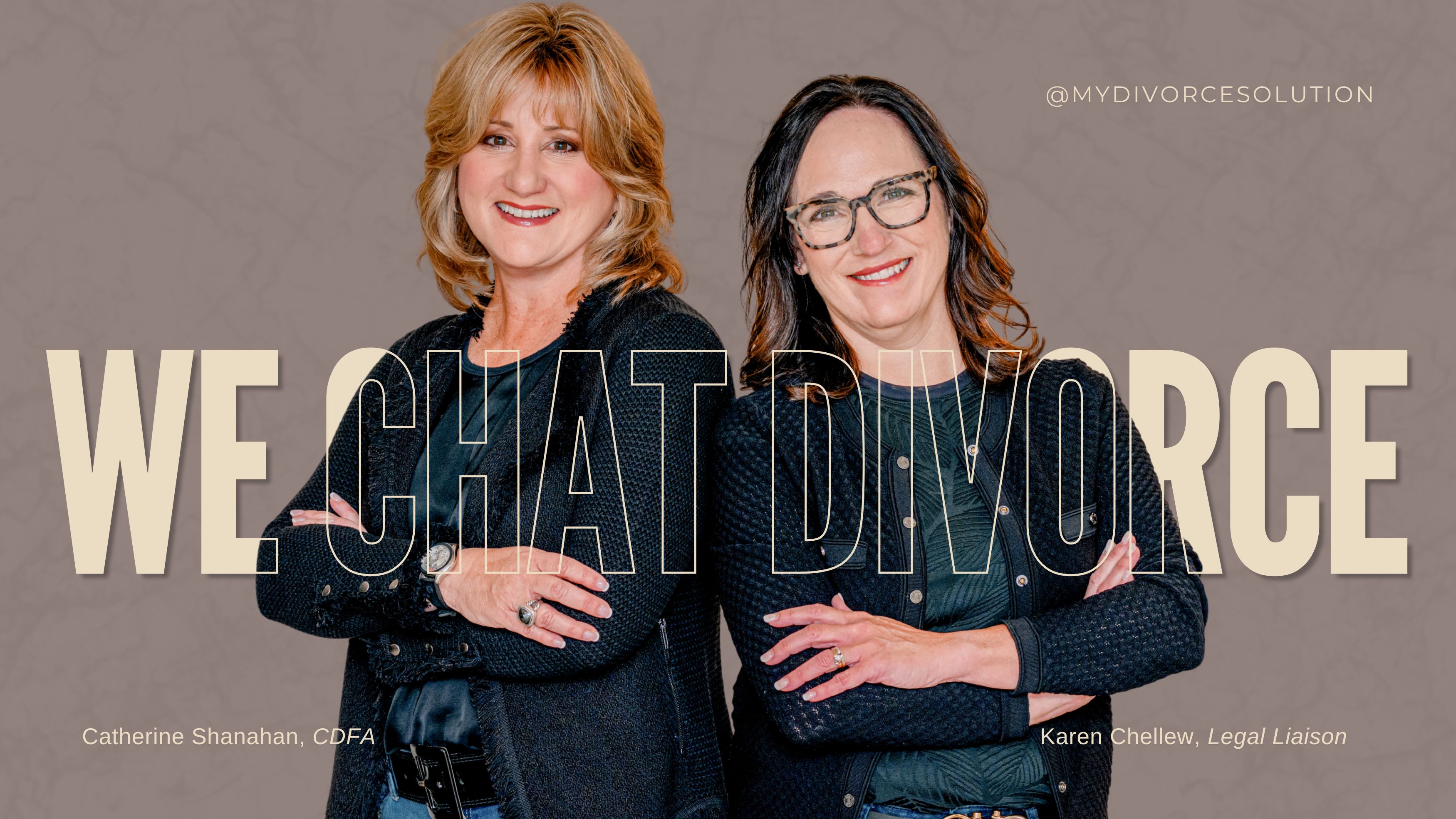
Welcome to We Chat Divorce, brought to you by My Divorce Solution! In this episode, co-hosts Karen Chellew, Legal Liaison, and Catherine Shanahan, CDFA®, dive into real-life divorce scenarios, unpacking the financial complexities that often arise during the process.
What We Cover in This Episode:
The Power of Financial Clarity:
Why understanding your financial picture is critical to reducing stress and making informed decisions.
Real-Life Case Studies:
From a 37-year marriage transformed by transparency, leading to a postnup instead of a divorce to the challenges of valuing a family business and navigating marital estate divisions and more real stories.
Overcoming Assumptions and Building Collaboration:
Karen and Catherine discuss how encouraging spouses to participate can lead to unexpected cooperation, even in seemingly contentious situations.
Balancing Emotions and Data:
Learn how separating trauma from transaction empowers clients to make sound financial decisions while navigating the emotional challenges of divorce.
Key Takeaways for Listeners:
- Understand the importance of financial data—numbers don’t lie.
- Encourage participation from your spouse for a smoother process.
- Be prepared for mediation or litigation by knowing your best, worst, and middle-ground scenarios.
Why You Should Listen:
This episode is a must-listen for anyone navigating divorce and its financial challenges. Packed with actionable insights and relatable stories, it offers practical advice to help you move forward with confidence.
🎧 Subscribe & Listen wherever you listen to podcasts and on YouTube!
Follow Us: @mydivorcesolution
About My Divorce Solution
We Chat Divorce is produced by My Divorce Solution (MDS) — a financial divorce preparation company dedicated to helping individuals navigate divorce with clarity, confidence, and a strategic financial plan. Founded by Karen Chellew, Legal Liaison, and Catherine Shanahan, Certified Divorce Financial Analyst (CDFA), MDS was created to solve one of the most common and costly mistakes in divorce: entering the legal process without fully understanding your financial picture.
Divorce is not just a legal event — it is a financial transition that can shape your long-term security. Through the MDS Divorce Financial Portrait™, clients receive expert financial analysis, organized financial disclosures, and scenario planning to understand how different settlement decisions impact their future. This financial preparation often reduces legal fees, shortens the divorce process, and helps individuals negotiate from a position of knowledge rather than fear.
If you are considering divorce or already in the process, you can begin by taking the Free Divorce Financial Assessment to better understand your options. You can also join the MDS Community for expert guidance, educational resources, and live Q&A events designed to help you move from uncertainty to clarity.
At My Divorce Solution, the mission is simple: replace fear with knowledge so you can make informed, confident financial decisions during divorce.
Episode Transcript
0:01
Welcome to WeChat Divorce, hosted by Karen Chalou, Legal Liaison and Catherine Shanahan, CDFA.
Each episode we sit down with divorce professionals and industry experts to provide insights and frank discussions about real people, real situations, and real divorce to help you achieve your best life post divorce.
0:39
Welcome to WeChat Divorce, brought to you by My Divorce Solution and hosted by myself, Karen Shalu, Legal Liaison, and Catherine Shanahan, Divorce Financial Specialist and CDFA.
On these special explainer episodes, we answer the top questions about divorce, giving you confidence and clarity.
0:57
I’m really excited about today, Karen, because we’re talking about real life case studies and we’re going to talk about why financial knowing and being prepared is so important.
This is where you and I usually just banter back and forth every morning, but we never record it.
So I’d love to share some stories today with our listeners.
1:15
Yeah, and I feel like every week by Friday we have 5 stories.
It’s incredible the amount of information and documentation and families helped everyday come through our company and you know, we’re really blessed to be in the space, I believe.
1:34
Yeah.
And it adds a little stress because my anxiety gets so high for our clients.
It’s almost like I’m thinking I’m them.
And I can’t believe what’s happening in the industry that I sit here.
And because we know the financial side of the divorce process, it does get a little stressful for us knowing that we can only do so much, right?
1:55
So imagine how they’re feeling on the other side, thinking that they can do half as much as actually what we can do by just knowing what the industry entails.
Absolutely, because divorce is, I think you say this a lot.
It’s one of the most stressful times of life.
2:10
And our goal at my divorce solution is to really kind of separate the trauma from the transaction.
Because if we can do that, then allows them a space to just be in to make really good financial decisions for themselves.
2:28
And then deal with all of the emotions.
Maybe not completely separate, but at least be able to coexist with it and not make decisions based on trauma, fear, revenge, whatever.
All of those emotions that kind of cycle through the divorce experience.
2:47
Totally.
And that all those emotions that are all unknown, right?
They change and by moment, by moment, day by day.
But what we like to focus on is the actual data.
You know, numbers don’t lie and also data doesn’t lie.
You either have it or you don’t, which is what the problem is.
But you know, you also couples have to give your spouse the benefit of doubt before going down any rabbit holes.
3:10
And I know that’s a hard concept for people to actually listen to because how many of our clients say my spouse will never participate, my spouse is a narcissist, my spouse will not give any information.
And I’m always like, well, let’s, let’s try, let’s ask them, you know, we’re going down the court system and, and we have a pretty high percentage rate, I think over 80% of spouses that actually participate.
3:33
Right.
And I think we have AI think our most recent numbers of percentage rate was pretty high to get all the way to a settlement, a financial division scenario, an agreed division scenario, that’s what we call it.
But even if a couple doesn’t get all the way to a final agreed division scenario, more than that, they agree on what they’re dividing or they agree on the marital component of their estate.
4:04
And that is where I.
Don’t know that they always agree on the components.
You know, if they don’t come, you know, some might say no, I don’t believe that’s separate property or I believe it is, or I believe that this is all the information.
And some might say no, there’s more information, but they they at least agree to participate up to a certain point.
4:22
Well, when I say the components, they agree that there is an inheritance or there isn’t or that there is an ESOP plan or there isn’t.
Whether it’s separate or not, they may not agree on, but at least they agree and they have shared the information to to document the assets.
4:42
And yeah, maybe they don’t agree for sure.
Well, I mean, I love that the fact that they, you know, they’re not hiring us to come to a different agreed division scenario.
But I love the fact that our platform, for example, let’s talk about the case where, you know, she didn’t know if she wanted a divorce or not.
5:01
She didn’t know if he wanted a divorce or not.
They were married 37 years, but there was some definite financial control in the relationship.
And you know, when we said, would you like him to participate, at first she was like, no, he’ll never participate.
He doesn’t even want to share this information with me.
5:16
Why would he share it with you?
And lo and behold, she finally got to the point where, you know what, maybe I will ask him if he’ll participate.
And so she did.
We sent our letter of introduction and he said OK.
And he provided the missing information that we did not have, that she did not have access to and actually got on the 1st review with me.
5:36
And I remember him saying, I don’t know why I’m on this call.
You know, I don’t, I don’t know what I’m supposed to be doing here.
Why I don’t even know you.
She’s your client.
Why would you even talk to me?
And I appreciated him just telling how he felt, right, because a lot of times our feelings get in the way of our decision making.
5:55
So the call would not have been successful if we didn’t unload that.
And so by him saying that, I said, yes, she did hire, but you’re participating.
And I’m really just looking to verify the data and help the two of you talk about what you’re thinking.
And so I could see him ease down a little bit.
6:11
And he went through all of their financials, you know, explaining, you know, what this account was used for, what they’re doing.
And it was really nice to give him that benefit to do that, you know, because if they went to two attorneys, the attorneys start talking for them and everything gets lost in translation.
So, you know, through that our whole process, they end up getting a post not they’re not even getting divorced.
6:35
And he couldn’t be more thankful for that.
So that goes to a space of where I see a lot of mistrust happen, especially when our client is not the financial manager.
So they don’t know what to trust or not trust.
6:53
A lot of times they’re tagged as a spender of the relationship and so they’re always in defense mode, having to defend why they you know what they spent last week or whatever the IT may be.
So when their spouse then is trying to explain what they have that exists, that would be divisible, they’re not in a space to accept that information as truth, right?
7:19
Because they don’t know.
And in that situation that you’re talking about, I think it’s a lot of situations where we’re able to tell if it’s truth or not truth or, or maybe needing to explore assets or debt a little bit more to clarify, you know, we often run into situations where there’s a family business and the spouse typically that’s the owner of the business has their own, I guess, conclusion or the way they describe the value of the family business.
7:54
But it’s most of the time not the way the courts look at how that business would be valued or what the benefit is to the couple.
So, you know, just being in that space helps clarify a lot of issues as well.
Yeah, that’s always a tricky 1 when you have businesses because, you know, when you’re married, it is great to take all these deductions from your Schedule C Let’s if we’re talking about a Schedule C here on a business and it makes sense because he wants to pay the IRS any more than they have to in it.
8:25
So being married and doing that, you’re all on board.
But now Fast forward and you get divorced, well, all those expense write offs now lower somebody’s gross income, you know, so or yeah, lowers their net income, which is the income you need for support purposes.
8:43
So now you’re challenging that.
But you know, I got to say, some of the business owners that we have talked to, you’re right, they get on, they want to explain.
But when we ask for the receipts or the documentation to prove those amounts, you know, if you can’t come up with it, you know what?
You can’t take that as a deduction.
8:59
Yeah, or sometimes even the position that they take.
I know just recently the business owner spouse said to, you know, us or at least tried to stay in the beginning.
Oh, I don’t file a separate tax return now.
I I don’t, I don’t really know what you’re talking about.
9:15
But you know, the more we had discussion, he actually did have tax returns.
I remember the client saying he said he doesn’t have them, he said he doesn’t have them.
He said he gave them to you and then you got on with them and he said OK, I’ll send it over to you.
Yeah.
And so, you know, that is just just imagine that conversation.
9:34
It took us probably, let’s just say an hour, right?
We read the message.
He doesn’t have them.
He gets on the call, he then provides them.
Imagine what that would be like in a litigation setting or even a mediation setting.
That could be two mediation settings and a mediator is not going to know if tax returns exist or not, right.
9:54
And litigation, then you’re going to have to file, you know, a motion to compel.
You’re talking $10,000 later to see if there’s tax returns.
So, you know, it is, to your point, a space where they can clarify and come to some terms of understanding before they move forward.
10:14
Yeah.
Yeah, totally.
Again, it’s giving the spouse the benefit of the doubt.
Whether they’re a narcissist or just a jerk or whatever you want to call them doesn’t matter.
At the end of the day, they have to give the information to some level, right.
So, you know, why not go through the process where we ask them to participate?
10:31
It doesn’t mean you have to agree with everything that they’re doing or giving or not giving, but at least you’ll know.
Our whole standpoint is just know what’s missing, know what’s there and try to work together as much as you can.
And don’t just say because my house is aggressive or narcissistic or what have you that they won’t participate because maybe they will, you know, how about that?
10:52
There’s another case and I remember her saying, and she’s an executive at a good company and very nervous, right?
And again, another long term marriage.
I think those long term marriages are the one where there’s a lot of guilt and fear because they want to move forward with a divorce.
11:09
And she said her husband would not participate.
And in going through the process, we gave her so much time and our reviews that she started to feel comfortable around the numbers and really never really had anything bad to say about her spouse.
She just said he would never participate because he knows it all.
11:26
And so Fast forward, I don’t know if she was with us for maybe six weeks, and she said, yeah, I’d like to see if he will participate.
And so she reached out to me.
I remember getting the message.
Oh, my gosh.
She said, yes, good news, good news.
I’m going to tell you he couldn’t be more delightful, you know, doing the reviews with him.
11:45
And he couldn’t be more gracious of her by just saying, of course, yes, this is that, this is that.
Of course, yes, you know, we should do this, We should do that.
But everything was, gosh, it was really just, they were both really succinct with it that she started to tear up at the end.
12:01
And she actually thanked him for being, you know, she thanked him with gratitude for coming to the table so that she didn’t have to use an attorney to talk to him.
Because after all these years, it was so much better to hear from each other in this platform that it got to stay here.
12:18
So hopefully they have some kind of friendship moving forward.
Yeah, I love that.
And you know, there’s enough families that we have where there’s still tension and adversity, but they’re still able to go through the process because at the end of the day, that’s what you have to do, right?
12:38
So, you know, just having the awareness that no matter what tension or adversity exists, this is still something that has to be done if you’re moving towards divorce.
So, Catherine, can we also talk about the, our male clients that come to us and if, you know, really, sometimes it’s in the space of trying to renegotiate their whole life, especially if they’ve been the financial manager and the parent who worked and wasn’t at home, but now they’re faced with divorce and trying to figure that out.
13:13
I I feel like we’ve had quite a few of those situations too.
Yeah, yesterday was a tough conversation with a client, although I’ve had it before we had the attorney was on the call as well.
And you know, the real, the reality of that case is that they don’t have enough money for the parties to buy each other out of the marital home.
13:35
And wife is using the children as the pawn to he should just let her keep the home.
And he’s trying to think of all the reasons, all the ways that he can just let her stay in the home for the kids sake because he feel he equates the kids having to move us as him being a bad father.
13:54
And the attorney couldn’t really get through to him.
And she’s really just going to go by his direction.
You want to let her keep the home and put in a payment plan over years or you want to keep the mortgage in your name for years.
Like whatever you want to do is what she has to do, right?
14:10
And so the attorney was actually thankful that I was on the call because I just had this talk with him about let’s look at these numbers.
Let’s talk about the scenario where she keeps the house and if you want her to be your tenant and what’s going to happen for the next 11 years.
14:26
Their youngest is 7.
You know she is manipulates him.
She has control of over the financial part.
And so he just felt like he had to think of how to do that.
But financially would it would be a room for him.
He wouldn’t even get to be a good dad because he wouldn’t get to provide for the kids what’s not covered in support or what have you.
14:47
He would be so stressed out having to try to maintain this house, a House of his own, and then do everything that his spouse wants him to do all along.
And he couldn’t really grasp that this was a financial decision, not a decision of whether I’m a good dad or not.
And I think we hear that a lot with dads who want to just do what’s right for the kids, thinking that financially it is.
15:09
But if you strap even, I don’t even think she can afford it.
So she would maybe be in a position to sell the house 2 years from now anyway.
And then he would have gave up a lot with her turning around and selling it anyway.
So sometimes it’s hard to kind of regulate that being a good parent with keeping a marital home because they in they are in fact not, they’re not equivalent to each other.
15:33
Right.
And the best thing about that discussion is they’re able to think about it in a place of financial impact versus opposing counsel with a motion and a proposal and a counterproposal that seems very sterile.
15:54
And a lot of people feel like they’re being set up for a trap that they don’t know about.
And, you know, that’s all very disconcerting and it, it makes it more traumatic for the the family moving forward, right?
16:10
Yeah, he didn’t see that.
Well, it was interesting because they have mediation at the end of the month.
And he says to the attorney now on the call, OK, what?
What am I?
Can you show me what my options are?
And we already went through the options, but he’s still going back to, he can’t reconcile in his head that the house has to be sold, right?
16:31
So he again asks an attorney replies and says, you need to know, you know, you know, do you want to keep her in that house or do you want that house sold?
You want to give up the value to the house.
And she’s going back and forth.
So I said to him, you’re going to mediation at the end of the month and the only thing you need to do now between now and then, because we have all the data attorney has all the data, you need to be able to shift your mindset because she said, I want you to go to mediation prepared to make a decision.
17:01
So I said if you’re, if you’re going to be prepared to make a decision, your mind shift has to change.
You have to be OK with your family can’t afford to keep this marital home going.
She can’t, your spouse cannot afford to keep the house going unless she comes to the table at mediation with a loan that she got from someone, a new job that she got, that she can afford it.
17:20
It’s out of your hands.
You’re not setting up your family post divorce for success, anyone in your family to keep that marital home.
So you can’t show up in mediation with a closed mind because mediation won’t go anywhere or you’ll just get bullied into a decision that you’re going to be very uncomfortable with.
17:36
So from now until then, go through the motions that you’re still a good dad if this house has to be sold.
Wow.
And the attorney said, thank you so much for that.
I’m not as eloquent with talking to people like that.
You know, she’s an attorney, so she has to go by, you know, what the law is and what’s going to happen.
17:52
And, you know, it was a frank discussion, but for me, and I felt bad for him because, you know, he looks so uncomfortable.
But frank discussions before mediation to me are the best discussions. 100% because I feel like a lot of dads do have to renegotiate their status.
18:11
I guess in the family, you know, we have a other case where dad is a physician and it’s always worked long hours and not really been at home.
It was definitely the, you know, provided the financial means for the family.
18:26
And now they’re facing divorce and he’s having to renegotiate his job so that he can have parenting time.
And, you know, then that definitely has a financial impact.
And then how does that get negotiated?
It’s really challenging.
Well, you know, what’s so challenging about it is that some do that legit legitimately.
18:46
Others just skew their income because they’re going through a divorce. 100%.
So and others pretend to be Disney dad and so they want all this time because they know overnight stays effects a support calculation, which is sad.
So you’re always going to have those cases and you know, we could talk about those as well.
19:04
But those out though.
Yeah, totally.
It’s clear.
It really is clear and the legit ones, you know, good for them.
And actually it’s not even about them as you know, it’s about their kids.
You know, good for their kids.
They’re going to have their dad because a parent, a good mom and a good dad is the best gift to give a child, right?
19:21
So let them adjust that lifestyle.
But it’s really hard on the flip side for the one who was the stay at home mom or just the caretaker overall.
They want that to continue, but they want the divorce or they don’t want the divorce, but the divorce is happening.
19:37
So how do you settle into you are one income home Now you know, that’s a it’s a different way of living and it’s a hard thing.
So again, do these tough exercises.
You know, I always say no, you’re best, worst and middle the road scenario so that you are prepared for the worst.
19:56
And if you get anything above that, it’s a bonus.
Yeah, yeah.
And yeah, I I agree with you 100%.
Good conversations, good case studies.
Yeah, I love talking about what’s actually happening because everybody wants to know somebody else that’s going through what they’re going through.
20:14
So if you’re in the middle of a case and you want to know if there’s anyone else like you and you want us to chat about it, don’t hesitate to reach out to us and give us the topic or give us your story and we’ll get on and chat about it.
Love it.
So thank you for joining us, joining us on this episode, real life, real numbers, unpacking financial case studies and divorce.
20:33
Stay tuned for future episodes as we continue to unravel the fascinating world of finance and divorce.
Remember, knowledge is power.
Catherine says that all the time.
Disclaimer The information provided in this podcast is for educational and informational purposes only and should not be construed as financial or legal advice.
20:54
Please consult with professionals in the relevant fields for personalized guidance.
Thanks for joining us on another episode of WeChat Divorce.
We hope this episode was informative and supportive on your divorce journey.
If you're looking for more support for navigating divorce with confidence and clarity, head over to azure-emu-499854.hostingersite.com/ for more podcast episodes, divorce events, and resources for your divorce.
21:22
We’ll see you back here for our next episode.
Disclaimer:
The information provided in this podcast is for educational and informational purposes only and should not be considered financial or legal advice. Please consult with professionals in the relevant fields for personalized guidance.
The WeChat Divorce podcast (hereinafter referred to as the “WCD”) represents the opinions of Catherine Shanahan, Karen Chellew, and their guests to the show. WCD should not be considered professional or legal advice. The content here is for informational purposes only. Views and opinions expressed on WCD are our own and do not represent that of our places of work.
WCD should not be used in any legal capacity whatsoever. Listeners should contact their attorney to obtain advice with respect to any particular legal matter. No listener should act or refrain from acting on the basis of information on WCD without first seeking legal advice from counsel in the relevant jurisdiction. No guarantee is given regarding the accuracy of any statements or opinions made on WCD.
Unless specifically stated otherwise, Catherine Shanahan and Karen Chellew do not endorse, approve, recommend, or certify any information, product, process, service, or organization presented or mentioned on WCD, and information from this podcast should not be referenced in any way to imply such approval or endorsement. The third-party materials or content of any third-party site referenced on WCD do not necessarily reflect the opinions, standards or policies of Catherine Shanahan or Karen Chellew.
WCD, CATHERINE SHANAHAN, AND KAREN CHELLEW EXPRESSLY DISCLAIM ANY AND ALL LIABILITY OR RESPONSIBILITY FOR ANY DIRECT, INDIRECT, INCIDENTAL, SPECIAL, CONSEQUENTIAL, OR OTHER DAMAGES ARISING OUT OF ANY INDIVIDUAL’S USE OF, REFERENCE TO, RELIANCE ON, OR INABILITY TO USE, THIS PODCAST OR THE INFORMATION PRESENTED IN THIS PODCAST.